

Examsrevision
On this page, you find all documents, package deals, and flashcards offered by seller ExamsRevision.
- 1359
- 0
- 172
Community
- Followers
- Following
42 Reviews received
1531 items
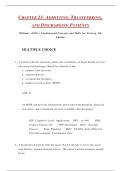
CHAPTER 23: ADMITTING, TRANSFERRING, AND DISCHARGING PATIENTS {Williams: deWit's Fundamental Concepts and Skills for Nursing, 5th Edition}
MULTIPLE CHOICE 1. A patient who has questions about the availability of home health services after hospital discharge should be referred to the: a. primary care provider. b. registered nurse. c. occupational therapist. d. medical social worker (MSW). ANS: D An MSW can provide information about long-term planning, financial assistance, and community services available after discharge. DIF: Cognitive Level: Application REF: p. 404 OBJ: Clinical Practice #5 TOP: Discharge KEY...
- Package deal
- Exam (elaborations)
- • 22 pages •
MULTIPLE CHOICE 1. A patient who has questions about the availability of home health services after hospital discharge should be referred to the: a. primary care provider. b. registered nurse. c. occupational therapist. d. medical social worker (MSW). ANS: D An MSW can provide information about long-term planning, financial assistance, and community services available after discharge. DIF: Cognitive Level: Application REF: p. 404 OBJ: Clinical Practice #5 TOP: Discharge KEY...
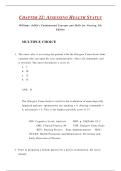
CHAPTER 22: ASSESSING HEALTH STATUS {Williams: deWit's Fundamental Concepts and Skills for Nursing, 5th Edition}
MULTIPLE CHOICE 1. The nurse who is assessing the patient with the Glasgow Coma Scale finds a patient who can open his eyes spontaneously, obeys all commands, and is oriented. The nurse documents a score of: a. 7. b. 10. c. 12. d. 15. ANS: D The Glasgow Coma Scale is used for the evaluation of neurologically impaired patients: spontaneous eye opening = 4, obeying commands = 6, orientation = 5. This is the highest possible score of 15. DIF: Cognitive Level: Analysis REF: p. 396|...
- Package deal
- Exam (elaborations)
- • 23 pages •
MULTIPLE CHOICE 1. The nurse who is assessing the patient with the Glasgow Coma Scale finds a patient who can open his eyes spontaneously, obeys all commands, and is oriented. The nurse documents a score of: a. 7. b. 10. c. 12. d. 15. ANS: D The Glasgow Coma Scale is used for the evaluation of neurologically impaired patients: spontaneous eye opening = 4, obeying commands = 6, orientation = 5. This is the highest possible score of 15. DIF: Cognitive Level: Analysis REF: p. 396|...
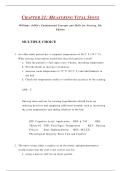
CHAPTER 21: MEASURING VITAL SIGNS {Williams: deWit's Fundamental Concepts and Skills for Nursing, 5th Edition}
MULTIPLE CHOICE 1. An older adult patient has a tympanic temperature of 96.2° F (35.7° C). What nursing intervention would best meet this patient’s need? a. Take the patient’s vital signs every 4 hours, including temperature. b. Provide fluids to increase circulation. c. Increase room temperature to 72° F (22.2° C) and add blankets to the bed. d. Check the temperature orally to confirm the accuracy of the reading. ANS: C Nursing interventions for treating hypothermia should...
- Package deal
- Exam (elaborations)
- • 21 pages •
MULTIPLE CHOICE 1. An older adult patient has a tympanic temperature of 96.2° F (35.7° C). What nursing intervention would best meet this patient’s need? a. Take the patient’s vital signs every 4 hours, including temperature. b. Provide fluids to increase circulation. c. Increase room temperature to 72° F (22.2° C) and add blankets to the bed. d. Check the temperature orally to confirm the accuracy of the reading. ANS: C Nursing interventions for treating hypothermia should...
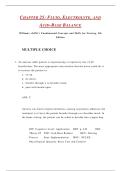
CHAPTER 25: FLUID, ELECTROLYTE, AND ACID-BASE BALANCE {Williams: deWit's Fundamental Concepts and Skills for Nursing, 5th Edition}
MULTIPLE CHOICE 1. An anxious adult patient is experiencing a respiratory rate of 40 breaths/min. The most appropriate intervention that the nurse could do is to instruct the patient to: a. sit up. b. lie down. c. breathe through a re-breather mask. d. pant with mouth open. ANS: C Anxiety can lead to hyperventilation, causing respiratory alkalosis; the treatment is to have the patient breathe through a re-breather mask. In the home setting, the patient can be asked to breathe into a...
- Package deal
- Exam (elaborations)
- • 21 pages •
MULTIPLE CHOICE 1. An anxious adult patient is experiencing a respiratory rate of 40 breaths/min. The most appropriate intervention that the nurse could do is to instruct the patient to: a. sit up. b. lie down. c. breathe through a re-breather mask. d. pant with mouth open. ANS: C Anxiety can lead to hyperventilation, causing respiratory alkalosis; the treatment is to have the patient breathe through a re-breather mask. In the home setting, the patient can be asked to breathe into a...
CHAPTER 24: DIAGNOSTIC TESTS AND SPECIMEN COLLECTION {Williams: deWit's Fundamental Concepts and Skills for Nursing, 5th Edition}
MULTIPLE CHOICE 1. Following a colonoscopy with polyp removal, the wife of the patient is distressed that there is slight bleeding from her husband’s rectum. The nurse’s most helpful response would be: a. “This small amount of bleeding is expected after the removal of polyps.” b. “I will notify the primary care provider about this hemorrhage.” c. “I will watch your husband very carefully to assess any further hemorrhage.” d. “Don’t worry. This small amount of blood hap...
- Package deal
- Exam (elaborations)
- • 23 pages •
MULTIPLE CHOICE 1. Following a colonoscopy with polyp removal, the wife of the patient is distressed that there is slight bleeding from her husband’s rectum. The nurse’s most helpful response would be: a. “This small amount of bleeding is expected after the removal of polyps.” b. “I will notify the primary care provider about this hemorrhage.” c. “I will watch your husband very carefully to assess any further hemorrhage.” d. “Don’t worry. This small amount of blood hap...
Test Bank for Fundamental Concepts and Skills for Nursing 6th Edition by Patricia A. Williams {Chapter 16-20}
Chapter 16: Infection Prevention and Control: Protective Mechanisms and Asepsis Chapter 17: Infection Prevention and Control in the Hospital and Home Chapter 18: Lifting, Moving, and Positioning Patients Chapter 19: Assisting with Hygiene, Personal Care, Skin Care, and the Prevention of Pressure Ulcers Chapter 20: Patient Environment and Safety
- Package deal
- • 5 items •
- CHAPTER 19: ASSISTING WITH HYGIENE, PERSONAL CARE, SKIN CARE, AND THE PREVENTION OF PRESSURE ULCERS {Williams: deWit's Fundamental Concepts and Skills for Nursing, 5th Edition} • Exam (elaborations)
- CHAPTER 20: PATIENT ENVIRONMENT AND SAFETY {Williams: deWit's Fundamental Concepts and Skills for Nursing, 5th Edition} • Exam (elaborations)
- CHAPTER 16: INFECTION PREVENTION AND CONTROL: PROTECTIVE MECHANISMS AND ASEPSIS {Williams: deWit's Fundamental Concepts and Skills for Nursing, 5th Edition} • Exam (elaborations)
- CHAPTER 17: INFECTION PREVENTION AND CONTROL IN THE HOSPITAL AND HOME {Williams: deWit's Fundamental Concepts and Skills for Nursing, 5th Edition} • Exam (elaborations)
- CHAPTER 18: LIFTING, MOVING, AND POSITIONING PATIENTS {Williams: deWit's Fundamental Concepts and Skills for Nursing, 5th Edition} • Exam (elaborations)
Chapter 16: Infection Prevention and Control: Protective Mechanisms and Asepsis Chapter 17: Infection Prevention and Control in the Hospital and Home Chapter 18: Lifting, Moving, and Positioning Patients Chapter 19: Assisting with Hygiene, Personal Care, Skin Care, and the Prevention of Pressure Ulcers Chapter 20: Patient Environment and Safety
CHAPTER 18: LIFTING, MOVING, AND POSITIONING PATIENTS {Williams: deWit's Fundamental Concepts and Skills for Nursing, 5th Edition}
MULTIPLE CHOICE 1. A patient in the skilled nursing facility has left-sided paralysis from a stroke several years before, as well as generalized weakness. The nurse should ensure that which of the following devices is in place to prevent flexion contractures? a. A trochanter roll to keep her legs from turning outward b. A rolled washcloth in the palm of her left hand or a hand splint c. A protective vest to keep her sitting upright in the chair d. A trapeze to permit her to change her pos...
- Package deal
- Exam (elaborations)
- • 19 pages •
MULTIPLE CHOICE 1. A patient in the skilled nursing facility has left-sided paralysis from a stroke several years before, as well as generalized weakness. The nurse should ensure that which of the following devices is in place to prevent flexion contractures? a. A trochanter roll to keep her legs from turning outward b. A rolled washcloth in the palm of her left hand or a hand splint c. A protective vest to keep her sitting upright in the chair d. A trapeze to permit her to change her pos...
CHAPTER 17: INFECTION PREVENTION AND CONTROL IN THE HOSPITAL AND HOME {Williams: deWit's Fundamental Concepts and Skills for Nursing, 5th Edition}
MULTIPLE CHOICE 1. An 84-year-old patient is hospitalized for an infected stasis ulcer on his ankle. The nurse is aware that this patient is at risk for a hospital-acquired infection (HAI) because the: a. patient already has a blood-borne infection. b. patient’s defenses are already engaged with the initial infection. c. ulcer will make this patient bedfast. d. stasis ulcers predispose the older adult to pneumonia and urinary infections. ANS: B Older adults have an impaired immun...
- Package deal
- Exam (elaborations)
- • 26 pages •
MULTIPLE CHOICE 1. An 84-year-old patient is hospitalized for an infected stasis ulcer on his ankle. The nurse is aware that this patient is at risk for a hospital-acquired infection (HAI) because the: a. patient already has a blood-borne infection. b. patient’s defenses are already engaged with the initial infection. c. ulcer will make this patient bedfast. d. stasis ulcers predispose the older adult to pneumonia and urinary infections. ANS: B Older adults have an impaired immun...
CHAPTER 16: INFECTION PREVENTION AND CONTROL: PROTECTIVE MECHANISMS AND ASEPSIS {Williams: deWit's Fundamental Concepts and Skills for Nursing, 5th Edition}
MULTIPLE CHOICE 1. The nurse instructing a patient in the home use of disinfectant would include the information that the disinfectant can be used to: a. decrease organisms on the patient’s body but take care not to use it around the patient’s eyes or in the mouth. b. sterilize instruments with a bacteriostatic disinfectant. c. thoroughly clean and rinse all soap off the equipment before disinfecting it. d. first remove all organic matter prior to disinfecting. ANS: C Disinfecta...
- Package deal
- Exam (elaborations)
- • 28 pages •
MULTIPLE CHOICE 1. The nurse instructing a patient in the home use of disinfectant would include the information that the disinfectant can be used to: a. decrease organisms on the patient’s body but take care not to use it around the patient’s eyes or in the mouth. b. sterilize instruments with a bacteriostatic disinfectant. c. thoroughly clean and rinse all soap off the equipment before disinfecting it. d. first remove all organic matter prior to disinfecting. ANS: C Disinfecta...
CHAPTER 20: PATIENT ENVIRONMENT AND SAFETY {Williams: deWit's Fundamental Concepts and Skills for Nursing, 5th Edition}
MULTIPLE CHOICE 1. When caring for a patient with acute radiation sickness (ARS) after an accident at an atomic power plant, the nurse should: a. wear a paper gown and boots, gloves, and a mask. b. stay in the room and talk to the patient to alleviate anxiety. c. decrease the amount of time spent in the room. d. wear a chemical mask with a filtered respirator. ANS: A For prolonged periods in caring for a patient with ARS, the nurse should use the barrier protection of gown, boots, ...
- Package deal
- Exam (elaborations)
- • 20 pages •
MULTIPLE CHOICE 1. When caring for a patient with acute radiation sickness (ARS) after an accident at an atomic power plant, the nurse should: a. wear a paper gown and boots, gloves, and a mask. b. stay in the room and talk to the patient to alleviate anxiety. c. decrease the amount of time spent in the room. d. wear a chemical mask with a filtered respirator. ANS: A For prolonged periods in caring for a patient with ARS, the nurse should use the barrier protection of gown, boots, ...
CHAPTER 21: NUTRIENT CYCLES
Test bank for medical terminology Chapter 09 (Male Reproductive System) by Chabner: The Language of Medicine, 11th Edition
Chapter 37: Cardiotonic and Antiarrhythmic Drugs Introductory Clinical Pharmacology 12th Edition by Susan M Ford
Chapter 06: Lower Limb Lampignano: Bontrager’s Textbook of Radiographic Positioning and Related Anatomy, 9th Edition
Chapter 16: Care of Patients with Hematologic Disorders deWit: Medical-Surgical Nursing: Concepts & Practice, 3rd Edition