

Trigonometric equations
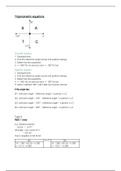
90°
S A
180° 0°
T C
270°
General solution
1. Standard form
2. Find the reference angle (acute and positive always)
3. Determine the quadrants
4. +/- 360° for sin and cos and +/- 180° for tan
Specific solution
1. Standard form
2. Find the reference angle (acute and positive always)
3. Determine the quadrants
4. +/- 360° for sin and cos and +/- 180° for tan
5. Add or subtract 360° until it falls out of given interval
If the angle lies:
Q1: unknown angle = reference angle + k.period, k з Z
Q2: unknown angle = 180° - reference angle + k.period, k з Z
Q3: unknown angle = 180° + reference angle + k.period, k з Z
Q4: unknown angle = 360° - reference angle + k.period, k з Z
Type A
Ratio = value
e.g. General solution
. cos2x = - 0.417
ref angle = arc cos(0.417)
. = 65.35°
Cos is negative in Q2 & Q4
Q2 kзZ Q4
2x = 180 – 65.35 + k.360 2x = 360 – 65.35 + k.360
x = 57.3 + k.360 x = 122.7 + k.360
, Type B
Ratio of an angle = ratio of an angle
sign (angle) = sign (different angle)
Always include brackets when substituting.
e.g. General solution
. cos2x = cos(x + 15)
ref angle = x + 15
Cos is positive in Q1 & Q4
Q1 kзZ Q4
2x = (x + 15) + k.360 2x = 360 - (x + 15) + k.360
x = 15 + k.360 x = 115 + k.120
Type C
Ratio of an angle = ratio of an angle
sign (angle) = different sign (different angle)
e.g. General solution
cos (4x + 20) = sin (x + 60)
cos (4x + 20) = cos (90-(x + 60))
cos (4x + 20) = cos (30 – x)
. ref angle = 30 – x
Cos is positive in Q1 & Q4
Q1 kзZ Q4
4x + 20 = (30 - x) + k.360 4x + 20 = 360 - (30 - x) + k.360
x = 2 + k.72 x = 103.3 + k.120
Type D
Ratio of an angle = ratio of an angle
sign (same angle) = different sign (same angle)
e.g. General solution
. cos (x) = sin (x)
. tan (x) = 1
ref angle = 45
Cos is positive in Q1 (only have to solve for Q1 for tan)
Q1 kзZ
x = 45 + k.360
90°
S A
180° 0°
T C
270°
General solution
1. Standard form
2. Find the reference angle (acute and positive always)
3. Determine the quadrants
4. +/- 360° for sin and cos and +/- 180° for tan
Specific solution
1. Standard form
2. Find the reference angle (acute and positive always)
3. Determine the quadrants
4. +/- 360° for sin and cos and +/- 180° for tan
5. Add or subtract 360° until it falls out of given interval
If the angle lies:
Q1: unknown angle = reference angle + k.period, k з Z
Q2: unknown angle = 180° - reference angle + k.period, k з Z
Q3: unknown angle = 180° + reference angle + k.period, k з Z
Q4: unknown angle = 360° - reference angle + k.period, k з Z
Type A
Ratio = value
e.g. General solution
. cos2x = - 0.417
ref angle = arc cos(0.417)
. = 65.35°
Cos is negative in Q2 & Q4
Q2 kзZ Q4
2x = 180 – 65.35 + k.360 2x = 360 – 65.35 + k.360
x = 57.3 + k.360 x = 122.7 + k.360
, Type B
Ratio of an angle = ratio of an angle
sign (angle) = sign (different angle)
Always include brackets when substituting.
e.g. General solution
. cos2x = cos(x + 15)
ref angle = x + 15
Cos is positive in Q1 & Q4
Q1 kзZ Q4
2x = (x + 15) + k.360 2x = 360 - (x + 15) + k.360
x = 15 + k.360 x = 115 + k.120
Type C
Ratio of an angle = ratio of an angle
sign (angle) = different sign (different angle)
e.g. General solution
cos (4x + 20) = sin (x + 60)
cos (4x + 20) = cos (90-(x + 60))
cos (4x + 20) = cos (30 – x)
. ref angle = 30 – x
Cos is positive in Q1 & Q4
Q1 kзZ Q4
4x + 20 = (30 - x) + k.360 4x + 20 = 360 - (30 - x) + k.360
x = 2 + k.72 x = 103.3 + k.120
Type D
Ratio of an angle = ratio of an angle
sign (same angle) = different sign (same angle)
e.g. General solution
. cos (x) = sin (x)
. tan (x) = 1
ref angle = 45
Cos is positive in Q1 (only have to solve for Q1 for tan)
Q1 kзZ
x = 45 + k.360


