

Probability
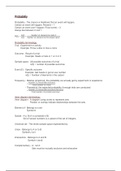
Probability - The chance or likelihood that an event will happen.
Certain an event will happen: P(event) = 1
Certain an event won’t happen: P(not event) = 0
Always lies between 0 and 1
𝑛(𝐸) 𝑁𝑢𝑚𝑏𝑒𝑟 𝑜𝑓 𝑒𝑙𝑒𝑚𝑒𝑛𝑡𝑠 𝑖𝑛 𝑒𝑣𝑒𝑛𝑡 𝐸
P(E) = 𝑛(𝑆) = 𝑁𝑢𝑚𝑏𝑒𝑟 𝑜𝑓 𝑒𝑙𝑒𝑚𝑒𝑛𝑡𝑠 𝑖𝑛 𝑡ℎ𝑒 𝑠𝑎𝑚𝑝𝑙𝑒 𝑠𝑝𝑎𝑐𝑒
Probability terminology:
Trial - Experiment or activity
Trial - Example: Throw a dice or toss a coins
Outcome - Result of a trial
Outcome - Example: Heads or tails or 1 or 2 or 3
Sample space - All possible outcomes of a trial
Sample space - n(S) = number of possible outcomes
Event (E) - Specific outcome
Event (E) - Example: Get heads or get an eve number
Event (E) - n(E) = Number of elements in the subset
Frequency - Relative (empirical), the probability we actually get by experiment or experience
𝑁𝑢𝑚𝑏𝑒𝑟 𝑜𝑓 𝑓𝑎𝑣𝑜𝑢𝑟𝑎𝑏𝑙𝑒 𝑜𝑢𝑡𝑐𝑜𝑚𝑒𝑠
Frequency - = 𝑇𝑜𝑡𝑎𝑙 𝑛𝑢𝑚𝑏𝑒𝑟 𝑜𝑓 𝑡𝑟𝑖𝑎𝑙𝑠
Frequency - Theoretical, the expected probability if enough trials are conducted
𝑁𝑢𝑚𝑏𝑒𝑟 𝑜𝑓 𝑓𝑎𝑣𝑜𝑢𝑟𝑎𝑏𝑙𝑒 𝑜𝑢𝑡𝑐𝑜𝑚𝑒𝑠 𝑡ℎ𝑎𝑡 𝑒𝑥𝑖𝑠𝑡
Frequency - = 𝑇𝑜𝑡𝑎𝑙 𝑛𝑢𝑚𝑏𝑒𝑟 𝑜𝑓 𝑝𝑜𝑠𝑠𝑖𝑏𝑙𝑒 𝑜𝑢𝑡𝑐𝑜𝑚𝑒𝑠
Venn diagram terminology:
Venn diagram - A diagram using circles to represent sets
Venn diagram - Position or overlap indicate relationships between the sets
Element of - Belongs to a set
Element of - Symbol ∈
Subset - A ⊏ B (A is contained in B)
Subset - Set of natural numbers is a subset of the set of integers.
Universal set - The whole sample space represented by
Union - Belongs to A or to B
Union - Symbol ∪ (or)
Intersection - Belongs to A and B
Intersection - Symbol ∩ (and)
Complementary - A’, not A
Complementary - Sets must be mutually exclusive and exhaustive
, Empty set - No elements
Empty set - Symbol ∅
Disjoint - Sets with no elements in common, i.e. no intersection (mutually exclusive)
Probability rules:
p(s) = 1
p(s’) = 0
p(a’) = 1 - p(a)
Events with intersections
p(a ∪ b) = p(a) + p(b) - p(a ∩ b)
Independent events
p(a ∩ b) = p(a) x p(b)
p(a ∪ b) = p(a) + p(b) - p(a) x p(b)
Non independent events
p(a ∩b) = p(a) x p(b l a)
Conditional probability
p(a ∩ b)
p(a | b) = p(b)
Mutually exclusive events
p(a ∪ b) = p(a) + p(b)
Note:
Mutually exclusive Independent
p(a and b) 0 p(a) x p(b)
p(a or b) p(a) + p(b) p(a) + p(b) - p(a) x p(b)
Probability - The chance or likelihood that an event will happen.
Certain an event will happen: P(event) = 1
Certain an event won’t happen: P(not event) = 0
Always lies between 0 and 1
𝑛(𝐸) 𝑁𝑢𝑚𝑏𝑒𝑟 𝑜𝑓 𝑒𝑙𝑒𝑚𝑒𝑛𝑡𝑠 𝑖𝑛 𝑒𝑣𝑒𝑛𝑡 𝐸
P(E) = 𝑛(𝑆) = 𝑁𝑢𝑚𝑏𝑒𝑟 𝑜𝑓 𝑒𝑙𝑒𝑚𝑒𝑛𝑡𝑠 𝑖𝑛 𝑡ℎ𝑒 𝑠𝑎𝑚𝑝𝑙𝑒 𝑠𝑝𝑎𝑐𝑒
Probability terminology:
Trial - Experiment or activity
Trial - Example: Throw a dice or toss a coins
Outcome - Result of a trial
Outcome - Example: Heads or tails or 1 or 2 or 3
Sample space - All possible outcomes of a trial
Sample space - n(S) = number of possible outcomes
Event (E) - Specific outcome
Event (E) - Example: Get heads or get an eve number
Event (E) - n(E) = Number of elements in the subset
Frequency - Relative (empirical), the probability we actually get by experiment or experience
𝑁𝑢𝑚𝑏𝑒𝑟 𝑜𝑓 𝑓𝑎𝑣𝑜𝑢𝑟𝑎𝑏𝑙𝑒 𝑜𝑢𝑡𝑐𝑜𝑚𝑒𝑠
Frequency - = 𝑇𝑜𝑡𝑎𝑙 𝑛𝑢𝑚𝑏𝑒𝑟 𝑜𝑓 𝑡𝑟𝑖𝑎𝑙𝑠
Frequency - Theoretical, the expected probability if enough trials are conducted
𝑁𝑢𝑚𝑏𝑒𝑟 𝑜𝑓 𝑓𝑎𝑣𝑜𝑢𝑟𝑎𝑏𝑙𝑒 𝑜𝑢𝑡𝑐𝑜𝑚𝑒𝑠 𝑡ℎ𝑎𝑡 𝑒𝑥𝑖𝑠𝑡
Frequency - = 𝑇𝑜𝑡𝑎𝑙 𝑛𝑢𝑚𝑏𝑒𝑟 𝑜𝑓 𝑝𝑜𝑠𝑠𝑖𝑏𝑙𝑒 𝑜𝑢𝑡𝑐𝑜𝑚𝑒𝑠
Venn diagram terminology:
Venn diagram - A diagram using circles to represent sets
Venn diagram - Position or overlap indicate relationships between the sets
Element of - Belongs to a set
Element of - Symbol ∈
Subset - A ⊏ B (A is contained in B)
Subset - Set of natural numbers is a subset of the set of integers.
Universal set - The whole sample space represented by
Union - Belongs to A or to B
Union - Symbol ∪ (or)
Intersection - Belongs to A and B
Intersection - Symbol ∩ (and)
Complementary - A’, not A
Complementary - Sets must be mutually exclusive and exhaustive
, Empty set - No elements
Empty set - Symbol ∅
Disjoint - Sets with no elements in common, i.e. no intersection (mutually exclusive)
Probability rules:
p(s) = 1
p(s’) = 0
p(a’) = 1 - p(a)
Events with intersections
p(a ∪ b) = p(a) + p(b) - p(a ∩ b)
Independent events
p(a ∩ b) = p(a) x p(b)
p(a ∪ b) = p(a) + p(b) - p(a) x p(b)
Non independent events
p(a ∩b) = p(a) x p(b l a)
Conditional probability
p(a ∩ b)
p(a | b) = p(b)
Mutually exclusive events
p(a ∪ b) = p(a) + p(b)
Note:
Mutually exclusive Independent
p(a and b) 0 p(a) x p(b)
p(a or b) p(a) + p(b) p(a) + p(b) - p(a) x p(b)


