
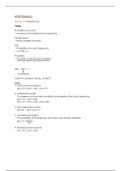
APM Statistics
Section 1: Probability laws
Terms:
Probability of an event
= A measure of the likelihood of it happening.
Sample space
= All the possible outcomes.
P(E)
= Probability of an event happening
= 0 ≤ P(E) ≤ 1
Probability
𝑇ℎ𝑒 𝑛𝑢𝑚𝑏𝑒𝑟 𝑜𝑓 𝑤𝑎𝑦𝑠 𝑡ℎ𝑒 𝑒𝑣𝑒𝑛𝑡 𝑐𝑎𝑛 ℎ𝑎𝑝𝑝𝑒𝑛
= 𝑇ℎ𝑒 𝑡𝑜𝑡𝑎𝑙 𝑛𝑢𝑚𝑏𝑒𝑟 𝑜𝑓 𝑝𝑜𝑠𝑠𝑖𝑏𝑙𝑒 𝑜𝑢𝑡𝑐𝑜𝑚𝑒𝑠
P(E) + P(E’) = 1
, Compliment
Useful for questions stating, ‘at least 2’.
Rules:
1. Events with intersections
1. p(a ∪ b) = p(a) + p(b) - p(a ∩ b)
2. Independent events
2. The happening of one does not affect the probability of the other happening.
2. p(a ∩ b) = p(a) x p(b)
2. p(a ∪ b) = p(a) + p(b) - p(a) x p(b)
3. Non independent events
3. p(a ∩b) = p(a) x p(b l a)
4. Conditional probability
4. The probability of B happening, given that A has already happened.
p(a ∩ b)
4. p(a | b) =
p(b)
5. Mutually exclusive events
5. p(a ∪ b) = p(a) + p(b)
, Section 2: Counting principles
The fundamental counting principle:
If one event can occur in m ways, another event in n ways, a further event in p ways, the total
number of ways that all the events can occur is m × n × p ways.
Identical objects
When n objects are arranged, where there are m1 identical objects of type 1, m2 identical
objects of type 1, etc, then the number of different arrangements is given by:
𝑛!
𝑚1 ! × 𝑚2 ! × …
The number of different ways, order matters, we can take r objects from n objects if we replace
them is nr.
Permutation
The number of ways we can take r objects from n objects, do not replace, if order matters
𝑛!
= nPr = (𝑛−𝑟)!
Example: The number of different 3-letter words we can make from 7 different letters is
7! 7!
P3 =
7
(7−3)!
= = 210
4!
Combination
The number of ways we can take r objects from n objects, do not replace, if order does not
matter
𝑛 𝑛!
= nCr = ( ) = (𝑛−𝑟)!
𝑟 × 𝑟!
Example: The number of teams with 3 members chosen from 7 learners is
7 7! 7!
C3 = ( 3 ) = (7−3)! × 3! = 4! ×3! = 35
7
Note: Higher number of ways, Lower probability.
Note: Lower number of ways, Higher probability.
Section 1: Probability laws
Terms:
Probability of an event
= A measure of the likelihood of it happening.
Sample space
= All the possible outcomes.
P(E)
= Probability of an event happening
= 0 ≤ P(E) ≤ 1
Probability
𝑇ℎ𝑒 𝑛𝑢𝑚𝑏𝑒𝑟 𝑜𝑓 𝑤𝑎𝑦𝑠 𝑡ℎ𝑒 𝑒𝑣𝑒𝑛𝑡 𝑐𝑎𝑛 ℎ𝑎𝑝𝑝𝑒𝑛
= 𝑇ℎ𝑒 𝑡𝑜𝑡𝑎𝑙 𝑛𝑢𝑚𝑏𝑒𝑟 𝑜𝑓 𝑝𝑜𝑠𝑠𝑖𝑏𝑙𝑒 𝑜𝑢𝑡𝑐𝑜𝑚𝑒𝑠
P(E) + P(E’) = 1
, Compliment
Useful for questions stating, ‘at least 2’.
Rules:
1. Events with intersections
1. p(a ∪ b) = p(a) + p(b) - p(a ∩ b)
2. Independent events
2. The happening of one does not affect the probability of the other happening.
2. p(a ∩ b) = p(a) x p(b)
2. p(a ∪ b) = p(a) + p(b) - p(a) x p(b)
3. Non independent events
3. p(a ∩b) = p(a) x p(b l a)
4. Conditional probability
4. The probability of B happening, given that A has already happened.
p(a ∩ b)
4. p(a | b) =
p(b)
5. Mutually exclusive events
5. p(a ∪ b) = p(a) + p(b)
, Section 2: Counting principles
The fundamental counting principle:
If one event can occur in m ways, another event in n ways, a further event in p ways, the total
number of ways that all the events can occur is m × n × p ways.
Identical objects
When n objects are arranged, where there are m1 identical objects of type 1, m2 identical
objects of type 1, etc, then the number of different arrangements is given by:
𝑛!
𝑚1 ! × 𝑚2 ! × …
The number of different ways, order matters, we can take r objects from n objects if we replace
them is nr.
Permutation
The number of ways we can take r objects from n objects, do not replace, if order matters
𝑛!
= nPr = (𝑛−𝑟)!
Example: The number of different 3-letter words we can make from 7 different letters is
7! 7!
P3 =
7
(7−3)!
= = 210
4!
Combination
The number of ways we can take r objects from n objects, do not replace, if order does not
matter
𝑛 𝑛!
= nCr = ( ) = (𝑛−𝑟)!
𝑟 × 𝑟!
Example: The number of teams with 3 members chosen from 7 learners is
7 7! 7!
C3 = ( 3 ) = (7−3)! × 3! = 4! ×3! = 35
7
Note: Higher number of ways, Lower probability.
Note: Lower number of ways, Higher probability.



