
Integration
Integral calculus:
- Reverse of differentiation
- Area under a curve
∫: Is the integral sign - an elongated s, to denote sum
a, b : The limits of integration - b is the upper limit and a the lower limit
f(x): The integrand - the function that is being integrated
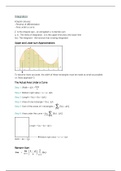
Upper and Lower sum Approximations
To become more accurate, the width of these rectangles must be made as small as possible.
i.e. Must approach 0.
The Actual Area Under a Curve
𝑏−𝑎
Step 1: Width = ∆Xi = 𝑛
Step 2: Bottom right value = xi = a + i∆Xi
Step 3: Length = f(xi) = f(a + i∆Xi )
Step 4: Area of one rectangle = f(xi) . ∆Xi
n
Step 5: Sum of the areas of n rectangles = [f(xi) . ∆Xi]
i=1
n
Step 6: Area under the curve = lim [f(xi) . ∆Xi]
n→∞
i=1
Length = f(xi) = f(a + i∆Xi )
𝑏−𝑎
Bottom right value = xi = a + i∆Xi
Width = ∆Xi =
𝑛
Riemann Sum
,Example:
Find the area under the curve y = 2x + x2, above the x axis and between x = 1 and x = 3 by
subdividing the area intro the area using n stripes of equal width.
𝑏−𝑎 3−1 2
Step 1: ∆Xi = 𝑛
= 𝑛
=𝑛
2
Step 2: xi = a + i∆Xi = 1 + i(𝑛)
2
Step 3: f(xi) = f(a + i∆Xi ) = f(1 + i( ))
𝑛
2 2
. = 2(1 + i( )) + (1 + i( ))2
𝑛 𝑛
4𝑖 4𝑖 4𝑖 2
. =2+ +1+ + 2
𝑛 𝑛 𝑛
8𝑖 4𝑖 2
. =3+ 𝑛
+ 𝑛2
8𝑖 4𝑖 2 2
Step 4: f(xi) . ∆Xi = (3 + 𝑛
+ 𝑛2 )(𝑛)
6 16𝑖 8𝑖 2
. =𝑛 + 𝑛2
+ 𝑛3
n
Step 5: [f(xi) . ∆Xi] =
i=1
n
6 16𝑖 8𝑖 2
= (𝑛 + 𝑛2
+ 𝑛3
)
i=1
n n n
6 16𝑖 8𝑖 2
= + +
𝑛 𝑛2 𝑛3
i=1 i=1 i=1
n
6 16 8
= 1+ i+ i2
𝑛 𝑛2 𝑛3
i=1
6 16 𝑛2 𝑛 8 𝑛3 𝑛2 𝑛
= 𝑛 (n) + (
𝑛2 2
+ 2 ) + 𝑛3 ( 3 + 2
+ 6)
8 8 4 4
= 6 + 8 + 𝑛 + 3 + 𝑛 + 3𝑛2
50 12 4
= 3
+ 𝑛
+ 3𝑛2
n
Step 6: lim [f(xi) . ∆Xi]
n→∞
i=1
50 12 4
= lim ( + + ) - as n→∞, the fraction becomes so small that it is said to = 0
n→∞ 3 𝑛 3𝑛2
50
= 3
+0+0
50
= 3
3
or ∫1 (2x + x ) dx = 503 2
, Note: n
1. lim [f(xi) . ∆Xi] = l answer l
n→∞ i =1
. Negative answer may be given if the area is below the x axis, but area but always be
. positive.
2. If you are required to find the area bounded by two curves, f and g, use the formula:
h(x) = f(x) - g(x) where f(x) is above g(x)
f(x)
a b
g(x)
n
The area between the two curved from a to b will be: lim h(xi) . ∆Xi
n→∞ i=1
The Fundamental Theorem of Calculus
If f(x) is continuous on interval [a ; b] and F(x) is any indefinite integral (anti-derivative) of f(x),
then:
. b
∫ a
f(x) dx = [F(x)]ba = F (b) - F (a)
Integrand (“derivative”)
Example: 6
∫ (8x - 3) dx
2
Derivative of: 4x2 - 3x
Anti-differentiation is seen as the reverse of differentiation and we can find the antiderivative
by inspection (by recognising the standard integral).
dy
𝑑𝑥
= f(x)
dy = f(x) . dx
Hence, y = ∫ f(x) . dx
The integral of the derivative = the function
i.e. Integration and differentiation are inverse operations
Integral calculus:
- Reverse of differentiation
- Area under a curve
∫: Is the integral sign - an elongated s, to denote sum
a, b : The limits of integration - b is the upper limit and a the lower limit
f(x): The integrand - the function that is being integrated
Upper and Lower sum Approximations
To become more accurate, the width of these rectangles must be made as small as possible.
i.e. Must approach 0.
The Actual Area Under a Curve
𝑏−𝑎
Step 1: Width = ∆Xi = 𝑛
Step 2: Bottom right value = xi = a + i∆Xi
Step 3: Length = f(xi) = f(a + i∆Xi )
Step 4: Area of one rectangle = f(xi) . ∆Xi
n
Step 5: Sum of the areas of n rectangles = [f(xi) . ∆Xi]
i=1
n
Step 6: Area under the curve = lim [f(xi) . ∆Xi]
n→∞
i=1
Length = f(xi) = f(a + i∆Xi )
𝑏−𝑎
Bottom right value = xi = a + i∆Xi
Width = ∆Xi =
𝑛
Riemann Sum
,Example:
Find the area under the curve y = 2x + x2, above the x axis and between x = 1 and x = 3 by
subdividing the area intro the area using n stripes of equal width.
𝑏−𝑎 3−1 2
Step 1: ∆Xi = 𝑛
= 𝑛
=𝑛
2
Step 2: xi = a + i∆Xi = 1 + i(𝑛)
2
Step 3: f(xi) = f(a + i∆Xi ) = f(1 + i( ))
𝑛
2 2
. = 2(1 + i( )) + (1 + i( ))2
𝑛 𝑛
4𝑖 4𝑖 4𝑖 2
. =2+ +1+ + 2
𝑛 𝑛 𝑛
8𝑖 4𝑖 2
. =3+ 𝑛
+ 𝑛2
8𝑖 4𝑖 2 2
Step 4: f(xi) . ∆Xi = (3 + 𝑛
+ 𝑛2 )(𝑛)
6 16𝑖 8𝑖 2
. =𝑛 + 𝑛2
+ 𝑛3
n
Step 5: [f(xi) . ∆Xi] =
i=1
n
6 16𝑖 8𝑖 2
= (𝑛 + 𝑛2
+ 𝑛3
)
i=1
n n n
6 16𝑖 8𝑖 2
= + +
𝑛 𝑛2 𝑛3
i=1 i=1 i=1
n
6 16 8
= 1+ i+ i2
𝑛 𝑛2 𝑛3
i=1
6 16 𝑛2 𝑛 8 𝑛3 𝑛2 𝑛
= 𝑛 (n) + (
𝑛2 2
+ 2 ) + 𝑛3 ( 3 + 2
+ 6)
8 8 4 4
= 6 + 8 + 𝑛 + 3 + 𝑛 + 3𝑛2
50 12 4
= 3
+ 𝑛
+ 3𝑛2
n
Step 6: lim [f(xi) . ∆Xi]
n→∞
i=1
50 12 4
= lim ( + + ) - as n→∞, the fraction becomes so small that it is said to = 0
n→∞ 3 𝑛 3𝑛2
50
= 3
+0+0
50
= 3
3
or ∫1 (2x + x ) dx = 503 2
, Note: n
1. lim [f(xi) . ∆Xi] = l answer l
n→∞ i =1
. Negative answer may be given if the area is below the x axis, but area but always be
. positive.
2. If you are required to find the area bounded by two curves, f and g, use the formula:
h(x) = f(x) - g(x) where f(x) is above g(x)
f(x)
a b
g(x)
n
The area between the two curved from a to b will be: lim h(xi) . ∆Xi
n→∞ i=1
The Fundamental Theorem of Calculus
If f(x) is continuous on interval [a ; b] and F(x) is any indefinite integral (anti-derivative) of f(x),
then:
. b
∫ a
f(x) dx = [F(x)]ba = F (b) - F (a)
Integrand (“derivative”)
Example: 6
∫ (8x - 3) dx
2
Derivative of: 4x2 - 3x
Anti-differentiation is seen as the reverse of differentiation and we can find the antiderivative
by inspection (by recognising the standard integral).
dy
𝑑𝑥
= f(x)
dy = f(x) . dx
Hence, y = ∫ f(x) . dx
The integral of the derivative = the function
i.e. Integration and differentiation are inverse operations


