

GAMETOGENESIS:
Formation of mature gametes(sperm and eggs) by reproductive glands(gonads).
- Involves meiosis: A unique kind of nuclear division.
- Results in halving of the number of chromosomes: From 46(body cells) to
23(gamete cells)
- Ensures that after fertilization, the number of chromosomes return to 46 in the
fertilised egg(zygote).
SPERMATOGENESIS:
The sequence of events during which mature, haploid sperm are produced from the
germinal epithelium in the seminiferous tubules of the testis.
- The hormone, testosterone, is essential for the production of sperm:
- Begins at puberty, between the age of 14 and 15, and continues throughout life.
- Every day a healthy adult male makes bout 400 million sperm.
- Large number of sperm produced increases the chance of fertilization.
SPERM STRUCTURE:
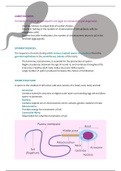
A sperm is the smallest of all human cells and consists of a head, neck, body and tail.
- Acrosome:
Contains hydrolytic enzymes to digest outer layers surrounding egg cell and allow
sperm to penetrate.
- Nucleus:
Contains haploid set of chromosomes which contains genetic material of male.
- Mitochondria:
Provides energy for movements of tail.
- Contractile fibres:
Responsible for whip-like movements of tail.
,OOGENESIS:
The production of haploid, mature eggs in the follicles of the ovaries.
- The number of eggs is determined before birth.
- Oogonia were produced by mitosis and growth from the germ cells of the
germinal epithelium before birth.
- Mature eggs are not formed continuously throughout life.
- The process starts at puberty and stops at meopause.
- Occurs in a monthly cycle(menstrual cycle), where an egg reaches maturity every
28 days.
SPERMATOGENESIS VS OOGENESIS:
Spermatogenesis Oogenesis
Gametes Sperm Egg
Number of gametes Not determined at birth Determined at birth
Formation Daily Menstrual cycle, every 28 days
End of process Lifetime After menopause
Survival Lasts 48 hours after release Lasts 24 hours after release
EGG STRUCTURE:
- Zona pellucida:
Layer of jelly
- Nucleus:
Contains haploid set of chromosomes which
contains genetic material of female.
- Cytoplasm:
Keeps egg cell alive.
- Follicle cells:
Nourishes egg cell.
IN SUMMARY:
- Spermatogenesis: Diploid cells in the seminiferous tubules of the testis undergo
meiosis to form haploid sperm cells.
- Oogenesis: Diploid cells in the ovary undergo meiosis to form a primary follicle
consisting of haploid cells. One cell develops into an ovum contained in a Graafian
follicle.
, MENSTRUAL CYCLE
- Length of a menstrual cycle: 21-35 days. 28 days average
- Includes the uterine and ovarian cycles
- Cycles occur from puberty until menopause.
- Both cycles are controlled by the endocrine system
OVARIAN CYCLE
- Development of Graafian follicle
- Ovulation
- Formation of corpus luteum
DEVELOPMENT OF GRAAFIAN FOLLICLE:
- Follicular phase is the first part of the ovarian cycle.
- During this phase, the primary follicles mature and get ready to release an egg.
- Through the influence of the follicle-stimulating-hormone(FSH), from the
pituitary gland.
- During the first days of the cycle, a primary follicle is stimulated.
- The follicle, one of many present at birth, develops into a Graafian follicle.
OVULATION:
- Graafian follicle contains the ovum(egg cell).
- As the follicle matures and enlarges, it moves to the surface of the ovary.
- Mid-cycle, a second hormone, luteinising hormone(LH), released from the
pituitary gland.
- Causes the Graafian follicle to rupture, releasing an ovum: Ovulation.
- Takes place on day 14 of the cycle.
FORMATION OF THE CORPUS LUTEUM:
- Remains of the Graafian follicle, under the influence of FSH and LH changes into
glandular tissue: Corpus Luteum.
- The structure produces large amounts of progesterone and some oestrogen.
- If pregnancy does not occur: The corpus luteum will begin to disintegrate and
disappear: 10-14 days after ovulation.
- If pregnancy does occur: The corpus luteum remains as it is needed to sustain a
healthy pregnancy: Produces progesterone, maintain lining.
Formation of mature gametes(sperm and eggs) by reproductive glands(gonads).
- Involves meiosis: A unique kind of nuclear division.
- Results in halving of the number of chromosomes: From 46(body cells) to
23(gamete cells)
- Ensures that after fertilization, the number of chromosomes return to 46 in the
fertilised egg(zygote).
SPERMATOGENESIS:
The sequence of events during which mature, haploid sperm are produced from the
germinal epithelium in the seminiferous tubules of the testis.
- The hormone, testosterone, is essential for the production of sperm:
- Begins at puberty, between the age of 14 and 15, and continues throughout life.
- Every day a healthy adult male makes bout 400 million sperm.
- Large number of sperm produced increases the chance of fertilization.
SPERM STRUCTURE:
A sperm is the smallest of all human cells and consists of a head, neck, body and tail.
- Acrosome:
Contains hydrolytic enzymes to digest outer layers surrounding egg cell and allow
sperm to penetrate.
- Nucleus:
Contains haploid set of chromosomes which contains genetic material of male.
- Mitochondria:
Provides energy for movements of tail.
- Contractile fibres:
Responsible for whip-like movements of tail.
,OOGENESIS:
The production of haploid, mature eggs in the follicles of the ovaries.
- The number of eggs is determined before birth.
- Oogonia were produced by mitosis and growth from the germ cells of the
germinal epithelium before birth.
- Mature eggs are not formed continuously throughout life.
- The process starts at puberty and stops at meopause.
- Occurs in a monthly cycle(menstrual cycle), where an egg reaches maturity every
28 days.
SPERMATOGENESIS VS OOGENESIS:
Spermatogenesis Oogenesis
Gametes Sperm Egg
Number of gametes Not determined at birth Determined at birth
Formation Daily Menstrual cycle, every 28 days
End of process Lifetime After menopause
Survival Lasts 48 hours after release Lasts 24 hours after release
EGG STRUCTURE:
- Zona pellucida:
Layer of jelly
- Nucleus:
Contains haploid set of chromosomes which
contains genetic material of female.
- Cytoplasm:
Keeps egg cell alive.
- Follicle cells:
Nourishes egg cell.
IN SUMMARY:
- Spermatogenesis: Diploid cells in the seminiferous tubules of the testis undergo
meiosis to form haploid sperm cells.
- Oogenesis: Diploid cells in the ovary undergo meiosis to form a primary follicle
consisting of haploid cells. One cell develops into an ovum contained in a Graafian
follicle.
, MENSTRUAL CYCLE
- Length of a menstrual cycle: 21-35 days. 28 days average
- Includes the uterine and ovarian cycles
- Cycles occur from puberty until menopause.
- Both cycles are controlled by the endocrine system
OVARIAN CYCLE
- Development of Graafian follicle
- Ovulation
- Formation of corpus luteum
DEVELOPMENT OF GRAAFIAN FOLLICLE:
- Follicular phase is the first part of the ovarian cycle.
- During this phase, the primary follicles mature and get ready to release an egg.
- Through the influence of the follicle-stimulating-hormone(FSH), from the
pituitary gland.
- During the first days of the cycle, a primary follicle is stimulated.
- The follicle, one of many present at birth, develops into a Graafian follicle.
OVULATION:
- Graafian follicle contains the ovum(egg cell).
- As the follicle matures and enlarges, it moves to the surface of the ovary.
- Mid-cycle, a second hormone, luteinising hormone(LH), released from the
pituitary gland.
- Causes the Graafian follicle to rupture, releasing an ovum: Ovulation.
- Takes place on day 14 of the cycle.
FORMATION OF THE CORPUS LUTEUM:
- Remains of the Graafian follicle, under the influence of FSH and LH changes into
glandular tissue: Corpus Luteum.
- The structure produces large amounts of progesterone and some oestrogen.
- If pregnancy does not occur: The corpus luteum will begin to disintegrate and
disappear: 10-14 days after ovulation.
- If pregnancy does occur: The corpus luteum remains as it is needed to sustain a
healthy pregnancy: Produces progesterone, maintain lining.



