
THE HUMAN SKELETON
SKELETON FUNCTIONS:
- Support: Enabling the body to stay upright and keep its shape.
- Protection: For the internal organs and tissues of the body such as
the heart, lungs and brain.
- Movement: By the muscles that are attached to the bones.
- Blood cells: Formed in the red marrow of bones.
- Mineral salts: Calcium and phosphates form part of bones and are
stored in them.
- Hearing: The ossicles in the middle ear transmit sound waves to
the inner ear and enable us to hear.
SKELETON STRUCTURE:
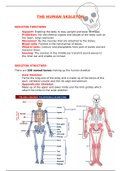
There are 206 named bones making up the human skeleton
- Axial Skeleton:
Forms the long axis of the body and is made up of the bones of the
skull, vertebral column and the rib cage and sternum.
- Appendicular Skeleton:
Made up of the upper and lower limbs and the limb girdles which
attach the limbs to the axial skeleton.
Pectoral girdle
Bony Thorax
Upper limb
Lower limb
,AXIAL SKELETON:
- Provides central support for the body.
- Protects the internal organs such as the brain, spinal chord and the
organs in the thorax.
Composed of 3 regions:
- Skull
- Vertebral column: spine or spinal column (33 vertebrae)
- Bony thorax(rib cage and sternum)
SKULL STRUCTURE:
- Most skull bones are flat bones which are immovably joined
together.
- The mandible(lower jaw) is an exception in that it can move.
The skull is formed by 2 sets of bones:
- Cranial bones form the cranium
- Facial bones form the face
CRANIAL BONES:
- The cranium is made up of 8 flat bones which form a helmet-
shaped structure.
- The immovable fibrous joints between the bones are called
sutures and are dove-tailed together.
- Like an eggshell, the curved upper part is self-bracing which allows
the bones to be thin and very strong so they can protect the
brain.
Fontanelles:
At birth, membrane-filled spaces called fontanelles, exist between the
bones of the cranium.
- Allow the baby’s head to be slightly compressed during birth.
- Allow the size of the brain to grow rapidly during infancy.
- The bones grow gradually and all the fontanelles should be replaced
by bone by the age of 2 years.
CRANIAL FUNCTIONS:
- Protects the fragile brain.
- Protects the sense organs of small, sight and hearing.
- Provides attachment for the muscles of the head.
At the base of the skull there is a large opening, the foramen
magnum, through which the medulla oblongata(lowest part of the
brain) connects with the spinal chord.
, On the other side of this opening, the atlas and axis are found,
which allows the nodding and sideways movement.
CONCUSSION
- A severe bump on the head may cause concussion.
- Causing a loss of balance, dizziness and vomiting.
FACIAL BONES:
- There are 14 bones, mainly paired, making up this part of the skull.
FACIAL FUNCTIONS:
- Form the structure of the face.
- Protect the sense organs of smell, sight and taste.
- Provide openings for the passage of food and air.
- Provide attachment for the facial muscles which create
expressions.
- Secure teeth.
Role of the teeth and jaws:
- The teeth lie in sockets in the gum-covered jaws.
- The role of the teeth, together with the jaws, is to masticate/chew
food.
- As the jaws are opened and closed and moved from side to side, the
teeth tear and grind the food, breaking it down into smaller
fragments.
- During chewing, the upper and lower molars lock together: the
cusps of the upper teeth fitting into the hollows in the lower teeth.
- This action generates tremendous crushing force.
HUMAN SKULL VS APE SKULL: Cranial and Facial Bones
APE HUMAN
Big strong protruding brow and jaw Less protruding brow and jaw bones:
bones: Chomping and eating raw Chopped up, soft food.
food.
Wide maxilla and large mandible Narrower maxilla and smaller
mandible
Larger and more teeth: herbivore Smaller and fewer teeth: omnivore
SKELETON FUNCTIONS:
- Support: Enabling the body to stay upright and keep its shape.
- Protection: For the internal organs and tissues of the body such as
the heart, lungs and brain.
- Movement: By the muscles that are attached to the bones.
- Blood cells: Formed in the red marrow of bones.
- Mineral salts: Calcium and phosphates form part of bones and are
stored in them.
- Hearing: The ossicles in the middle ear transmit sound waves to
the inner ear and enable us to hear.
SKELETON STRUCTURE:
There are 206 named bones making up the human skeleton
- Axial Skeleton:
Forms the long axis of the body and is made up of the bones of the
skull, vertebral column and the rib cage and sternum.
- Appendicular Skeleton:
Made up of the upper and lower limbs and the limb girdles which
attach the limbs to the axial skeleton.
Pectoral girdle
Bony Thorax
Upper limb
Lower limb
,AXIAL SKELETON:
- Provides central support for the body.
- Protects the internal organs such as the brain, spinal chord and the
organs in the thorax.
Composed of 3 regions:
- Skull
- Vertebral column: spine or spinal column (33 vertebrae)
- Bony thorax(rib cage and sternum)
SKULL STRUCTURE:
- Most skull bones are flat bones which are immovably joined
together.
- The mandible(lower jaw) is an exception in that it can move.
The skull is formed by 2 sets of bones:
- Cranial bones form the cranium
- Facial bones form the face
CRANIAL BONES:
- The cranium is made up of 8 flat bones which form a helmet-
shaped structure.
- The immovable fibrous joints between the bones are called
sutures and are dove-tailed together.
- Like an eggshell, the curved upper part is self-bracing which allows
the bones to be thin and very strong so they can protect the
brain.
Fontanelles:
At birth, membrane-filled spaces called fontanelles, exist between the
bones of the cranium.
- Allow the baby’s head to be slightly compressed during birth.
- Allow the size of the brain to grow rapidly during infancy.
- The bones grow gradually and all the fontanelles should be replaced
by bone by the age of 2 years.
CRANIAL FUNCTIONS:
- Protects the fragile brain.
- Protects the sense organs of small, sight and hearing.
- Provides attachment for the muscles of the head.
At the base of the skull there is a large opening, the foramen
magnum, through which the medulla oblongata(lowest part of the
brain) connects with the spinal chord.
, On the other side of this opening, the atlas and axis are found,
which allows the nodding and sideways movement.
CONCUSSION
- A severe bump on the head may cause concussion.
- Causing a loss of balance, dizziness and vomiting.
FACIAL BONES:
- There are 14 bones, mainly paired, making up this part of the skull.
FACIAL FUNCTIONS:
- Form the structure of the face.
- Protect the sense organs of smell, sight and taste.
- Provide openings for the passage of food and air.
- Provide attachment for the facial muscles which create
expressions.
- Secure teeth.
Role of the teeth and jaws:
- The teeth lie in sockets in the gum-covered jaws.
- The role of the teeth, together with the jaws, is to masticate/chew
food.
- As the jaws are opened and closed and moved from side to side, the
teeth tear and grind the food, breaking it down into smaller
fragments.
- During chewing, the upper and lower molars lock together: the
cusps of the upper teeth fitting into the hollows in the lower teeth.
- This action generates tremendous crushing force.
HUMAN SKULL VS APE SKULL: Cranial and Facial Bones
APE HUMAN
Big strong protruding brow and jaw Less protruding brow and jaw bones:
bones: Chomping and eating raw Chopped up, soft food.
food.
Wide maxilla and large mandible Narrower maxilla and smaller
mandible
Larger and more teeth: herbivore Smaller and fewer teeth: omnivore



