

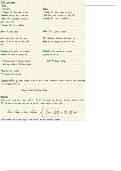
Acids and bases
Acids :
-
Corrosive Buses :
Changes blue litmus paper red Changes red litmus to blue
-
-
to
paper
-
Neutralizes buses to form a salt +Heo
-
Neutralizes acids to form a salt + He o
-
Reacts with carbonates to form a
-
ProvidesOf ions in solution
salt + H20 + (O2
-
Provides HgOt ions in solution
Acid- 1s A proton donor Bage -
A proton acceptor
Acids ionize when in Heo . The acids Bases expierence dissociation. When bases are
+
donate H ions to Heo to form Hzot dissolved the ions separate and formOH ions .
ions .
Ionisation - The reaction of a molecular Dissociation -
The splitting of an ionic
substance with water to
produce ions .
compound into it's ions .
HzS04rag) Hz0re)-H30Tag + +
HyOtrage NaOH D Natrage +
OH rage
HS04rag) + HzOre) - D
SO4-jag) +
HyOtrage
*
Always show full ionisation
-
So if diprotic must show both
rbasef
Exception : Ammonia gas (NH3) dissolves in H20 to form a base .
Molecules of ammonia ionize to form ammonium (NHa
ions and
hydroxide (oHY ions .
NHorge tHeOres = NH4traq) OHTagi
+
Neutralization
When acid reacts base the H+ and Of ions the acid and to form
an with a
, provide by base combine
H20 .
The cation of the base and anion of the acid remain in solution to form a
sult.
{ son", ->
Acid Buse sult
H 2S02 + 2 NaOH -D 2H20 + 2 NuSOL + 500- 2
products
ปี ที่All have neutral charges sult and base have neutralized eachother
* as the
, Strength of an acid and base
The strength of an acid or base is an indication of the extent to which it is ionized in solution.
strong acids/bases ionize/dissociate fully in
aqueous solution whilst weak acids/bases ionizerdissociate partially.
strong acids/bases : (Single arrows
strong acid
H
Cerage + Heres-H30 Trag +
Chrage
The Clions
solution contains a
large number of Host and . Thus there are
very few unionized
Hee molecules
.
HCR is a
strong
acid
,
because of the
large number of ions in solution ,
the solution is a
good conductor of electricity and a
good electrolyte
Weak acids/bases: (Double arrows
Weak acid
CH3C0oHraq) + Hz8res * HyOtrag) + CH z100 rage
There are
very few Hz0+ and CHy200 ions
produced ,
hence there is a
large ammount of unionized CHylooH
molecules . Thus ethanoic acid is a weak acid and the solution is a weak electrolyte .
Electrolyte - 1
A substance that can conduct electricity by forming free moving ions when molten or dissolved in
solution .
weak
Strong acids : Weak a cidsi
strong bases : bases :
H Cl -
Hydrochloric acid HF -
Hydroflouricazid Group I
hydroxides NHz-Ammonia
↓ 2504-Sulfuric acid Hap04-Phosphoric acid NH4OH-Ammonium hydroxide
HNOz-Nitric acid H2S0y-Sulfurous acid Metal carbonates
/cooH)2 Oxalic acid Metal hydrocarbonates
-
He [03 -
Carbonic acid
CH > COOH -
Ethanoic acid
Polyprofic acids - >
Acids that can donate more than one proton
Diagram of an acid
donating a protor
shared Donated aprotoeely
electrons
o
사 x x
↓ charged
H 1 Base
x
H 다
답다 ICer
→
{
H donated it's proton : <e
Acids :
-
Corrosive Buses :
Changes blue litmus paper red Changes red litmus to blue
-
-
to
paper
-
Neutralizes buses to form a salt +Heo
-
Neutralizes acids to form a salt + He o
-
Reacts with carbonates to form a
-
ProvidesOf ions in solution
salt + H20 + (O2
-
Provides HgOt ions in solution
Acid- 1s A proton donor Bage -
A proton acceptor
Acids ionize when in Heo . The acids Bases expierence dissociation. When bases are
+
donate H ions to Heo to form Hzot dissolved the ions separate and formOH ions .
ions .
Ionisation - The reaction of a molecular Dissociation -
The splitting of an ionic
substance with water to
produce ions .
compound into it's ions .
HzS04rag) Hz0re)-H30Tag + +
HyOtrage NaOH D Natrage +
OH rage
HS04rag) + HzOre) - D
SO4-jag) +
HyOtrage
*
Always show full ionisation
-
So if diprotic must show both
rbasef
Exception : Ammonia gas (NH3) dissolves in H20 to form a base .
Molecules of ammonia ionize to form ammonium (NHa
ions and
hydroxide (oHY ions .
NHorge tHeOres = NH4traq) OHTagi
+
Neutralization
When acid reacts base the H+ and Of ions the acid and to form
an with a
, provide by base combine
H20 .
The cation of the base and anion of the acid remain in solution to form a
sult.
{ son", ->
Acid Buse sult
H 2S02 + 2 NaOH -D 2H20 + 2 NuSOL + 500- 2
products
ปี ที่All have neutral charges sult and base have neutralized eachother
* as the
, Strength of an acid and base
The strength of an acid or base is an indication of the extent to which it is ionized in solution.
strong acids/bases ionize/dissociate fully in
aqueous solution whilst weak acids/bases ionizerdissociate partially.
strong acids/bases : (Single arrows
strong acid
H
Cerage + Heres-H30 Trag +
Chrage
The Clions
solution contains a
large number of Host and . Thus there are
very few unionized
Hee molecules
.
HCR is a
strong
acid
,
because of the
large number of ions in solution ,
the solution is a
good conductor of electricity and a
good electrolyte
Weak acids/bases: (Double arrows
Weak acid
CH3C0oHraq) + Hz8res * HyOtrag) + CH z100 rage
There are
very few Hz0+ and CHy200 ions
produced ,
hence there is a
large ammount of unionized CHylooH
molecules . Thus ethanoic acid is a weak acid and the solution is a weak electrolyte .
Electrolyte - 1
A substance that can conduct electricity by forming free moving ions when molten or dissolved in
solution .
weak
Strong acids : Weak a cidsi
strong bases : bases :
H Cl -
Hydrochloric acid HF -
Hydroflouricazid Group I
hydroxides NHz-Ammonia
↓ 2504-Sulfuric acid Hap04-Phosphoric acid NH4OH-Ammonium hydroxide
HNOz-Nitric acid H2S0y-Sulfurous acid Metal carbonates
/cooH)2 Oxalic acid Metal hydrocarbonates
-
He [03 -
Carbonic acid
CH > COOH -
Ethanoic acid
Polyprofic acids - >
Acids that can donate more than one proton
Diagram of an acid
donating a protor
shared Donated aprotoeely
electrons
o
사 x x
↓ charged
H 1 Base
x
H 다
답다 ICer
→
{
H donated it's proton : <e


