

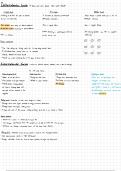
Intramolecular bonds of Bond which occurs between atoms within molecules
Covalent Bonds Ionic bonds Metallic bonds
A
sharing of at least one
pair of electrons A transfer of electrons and subsequent forces between a
positive kernel and a sea of
by two non-metal atoms . electrostatic attraction delocalised electrons .
forms
Polar covalent : Uneven sharing of electrons (AEN30 a
crystal lattice forms a
crystal lattice
Non-polar/Pure covalent : Even sharing of electrons (AEN = of
Conducts free able
electricity in
molten/aqueous state due
moving elections are to conduct
forms molecule to free
electricity
a moving ions ,
.
- -
-
+ + +
Giant molecules
-
-
-
-
+ + +
Have to many
-
high melting boiling points due
strong covalent
-
and bands -
-
No intermolecular forces
-
because
-
,
there are no molecules -
-
-
-
+ +
Graphite ,
diamond and silicon dioxide
Graphite conduct electricity due to it's
layers of carbon atoms
-
can
Intermolecular forces A force of attraction between molecules, ions , or atom of noble gas
Van Der waals forces :
London rispersion) forces Dipole-dipole forces Ion-dipole forces
Hydrogen bonds
-Stronger Stronger Special
- -
weakest the forces dipole-dipole
-
of all than London forces than forces case of dipole-dipole forces
-
Force between Between form between
-strongest
- -
2
non-polar molecules 2 polar molecules an ion and a
polar molecule intermolecular force
Induced dipoles Not bonds
-
-
>
Moving electrons examinable -Hydrogen exist between polar molecules in
will cause a temporary dipole where which hydrogen is bonded to a small atom of
,
one side of the molecule is Mora
high electronegativity with at least one lone pair
negative of electrons (N ,
0 and fr
Melting pointi-Temperature at which a solid changes to a liquid
Stronger
-
forces need
higher amounts of
energy to overcome these forces
Stronger have higher
-
forces
melting points
-A larger molar mass will also increase melting and boiling points due to an increase in elections.
Vapour pressure :
Pressure of contact form
liquid
-
a
vapour
in
with its
With intermolecular forces less able to break free from
stronger particles will be the liquid
substances
-
with stronger intermolecular forces will have lower vapour pressure.
Boiling point : -
Temperature at which the vapour pressure is
equal to the atmospheric pressure.
Lower vapour pressure results in higher boiling points
-Stronger intermolecular forces ,
the lover the vapour pressure , the
higher the boiling point.
Covalent Bonds Ionic bonds Metallic bonds
A
sharing of at least one
pair of electrons A transfer of electrons and subsequent forces between a
positive kernel and a sea of
by two non-metal atoms . electrostatic attraction delocalised electrons .
forms
Polar covalent : Uneven sharing of electrons (AEN30 a
crystal lattice forms a
crystal lattice
Non-polar/Pure covalent : Even sharing of electrons (AEN = of
Conducts free able
electricity in
molten/aqueous state due
moving elections are to conduct
forms molecule to free
electricity
a moving ions ,
.
- -
-
+ + +
Giant molecules
-
-
-
-
+ + +
Have to many
-
high melting boiling points due
strong covalent
-
and bands -
-
No intermolecular forces
-
because
-
,
there are no molecules -
-
-
-
+ +
Graphite ,
diamond and silicon dioxide
Graphite conduct electricity due to it's
layers of carbon atoms
-
can
Intermolecular forces A force of attraction between molecules, ions , or atom of noble gas
Van Der waals forces :
London rispersion) forces Dipole-dipole forces Ion-dipole forces
Hydrogen bonds
-Stronger Stronger Special
- -
weakest the forces dipole-dipole
-
of all than London forces than forces case of dipole-dipole forces
-
Force between Between form between
-strongest
- -
2
non-polar molecules 2 polar molecules an ion and a
polar molecule intermolecular force
Induced dipoles Not bonds
-
-
>
Moving electrons examinable -Hydrogen exist between polar molecules in
will cause a temporary dipole where which hydrogen is bonded to a small atom of
,
one side of the molecule is Mora
high electronegativity with at least one lone pair
negative of electrons (N ,
0 and fr
Melting pointi-Temperature at which a solid changes to a liquid
Stronger
-
forces need
higher amounts of
energy to overcome these forces
Stronger have higher
-
forces
melting points
-A larger molar mass will also increase melting and boiling points due to an increase in elections.
Vapour pressure :
Pressure of contact form
liquid
-
a
vapour
in
with its
With intermolecular forces less able to break free from
stronger particles will be the liquid
substances
-
with stronger intermolecular forces will have lower vapour pressure.
Boiling point : -
Temperature at which the vapour pressure is
equal to the atmospheric pressure.
Lower vapour pressure results in higher boiling points
-Stronger intermolecular forces ,
the lover the vapour pressure , the
higher the boiling point.


