The Atmosphere
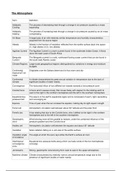
Term De nition
Adiabatic The process of decreasing heat through a change in air pressure caused by a mass
Cooling expanding
Adiabatic The process of increasing heat through a change in air pressure caused by an air mass
heating compressing
Air Mass A large body of air with relatively similar temperature and humidity characteristics
acquired from its source region
Albedo Albedo is the fraction of insolation re ected from the earths surface back into space
(1= high albedo vs 0= low albedo)
Agulhas Current The Agulhas Current is a warm current found in the southwest Indian Ocean. It ows
down the east coast of South Africa
Benguela The Benguela current is a cold, northward owing ocean current that can be found in
Current the south east Atlantic ocean
Climate Regions Large-scale geographical regions distinguished by variations in energy and moisture
budgets
Continental Originates over the Sahara desert and is thus warm and dry
tropical (cT) air
mass
Continental A climate characterised by great annual variation in temperature due to the lack of
climate signi cant bodies of water nearby
Convergence The horizontal in ow of two di erent air masses towards a low-pressure zone
Coriolis force A force which causes a body that moves freely with respect to the rotating earth to
veer to the right in the northern hemisphere and the left in the southern hemisphere
Equatorial low- The area is in the earth’s equatorial region and is composed of warm, light, ascending
pressure belt and converging air
Equinox Time of year when the sun crosses the equator, making day & night equal in length
Ferrel cell Atmospheric circulation sell between about 30° latitude and the polar front
Ferrel’s law A law stating that due to the Coriolis force, wins I de ect to the right in the northern
hemisphere and to the left in the southern hemisphere
Geostrophic Wind blowing more all this parallel to isobars, under the combined in uence of the
wind pressure gradient and the Coriolis force
Hadley cell Atmospheric circulation cell between the equator and about 30° latitude
Insolation Solar radiation falling on a unit area of the earths surface
Insolation angle The angle at which the suns rays strike the Earth's surface at noon
of incidence
Intertropical Equatorial low-pressure bolts along which we trade winds of the two hemispheres
convergence converge
zone
Jet streams Strong, geostrophic wins blowing from west to east in the upper atmosphere
Maritime climate Climate characterised by relatively narrow annual temperature range due to the
presence of signi cant bodies of water nearby
fi fi flfi ff fl fl fl fl fl
,Maritime tropical Originates over the Atlantic Ocean and is therefore warm, moist and unstable
(mT) air mass
Mozambican Warm surface waters in the Indian Ocean that ow south along the African east coast
current in the Mozambican channel, between Mozambique and Madagascar
Polar cell Atmospheric circulation cell between the polar front and the pole
Polar easterly The polar easterlies are the dry, cold prevailing winds that blow from the high-pressure
winds areas near the north and south poles towards the low-pressure areas within the
westerlies at high latitudes
Polar high an area of high pressure located at 90° N/S. The air in this belt is extremely cold and
pressure belt dry
Pressure The force producing air ow from regions of high-pressure to regions of low-pressure
gradient force
Radiation The balance of energy gain (from insolation) and energy loss (terrestrial radiation)
budget
Seasonal The pressure belts and wind systems migrate, either northwards or southwards, as the
migration ITCZ moves
Solstice Time of year when the Sun is at its greatest distance from the equator
Subtropical This is a zone of hot, dry air that forms as the warm a descending from the topics heat
high-pressure adiabatically
belt (horse
latitudes)
Sub-polar low A zone of cool, wet weather caused by the meeting of cold air masses from higher
pressure belt latitudes and warm air masses from lower latitudes
Subsidence Vertical descent of an air mass
Tropical easterly Warm, moist winds that ow from the east towards the west. They originate from the
winds (trade subtropical high-pressure belt and ow towards the equatorial low-pressure belt
winds)
Westerly Winds Warm prevailing winds in the middle latitudes that blow from the subtropical high-
pressure belt towards the sub-polar low-pressure belt. These prevailing winds blow
from the west to the east
flfl fl fl
, Earth’s Energy Balance
• Insolation is absorbed by the crust and the Earth surface then heats up the
overlying atmosphere through the transfer of sensible heat (conduction and
convection), latent heat and the release of long wave terrestrial radiation.
• The amount of heat in the atmosphere is directly dependent on the amount of
insolation an area receives.
• Earths energy balance = the balance between incoming solar radiation and
outgoing radiation from the Earth.
• Insolation is received unequally across the Earth surface:
1. The earths crust is made up of di erent substances, land and water which heat
and cool at di erent rates.
2. The latitudes are spread across the Earth’s spherical shape (lower, middle,
higher latitudes).
3. The Earth rotates on its own axis causing day and night time heating and
cooling as well as creating seasons.
4. The Earth revolves around the Sun causing di erent parts of the Earth to
experience di erent seasons at the same time.
5. Cloud cover varies across the Earth. Higher cloud cover results in more
insolation being re ected back to space and less insolation reaching the Earth.
- Temperature changes with latitude. It is generally higher nearer to the equator
and decreases toward the poles.
- Temperatures change throughout the year with the change in season.
- In January, the southern hemisphere has summer and is warm, while the
northern hemisphere has winter and is cold. The opposite occurs in July.
- Places in the lower latitudes do not have a large di erence in temperature from
January to July therefore they are situated closer to the equator.
- Places in the higher latitudes have a large di erence in temperature from
January to July therefore they are situated closer to the poles.
ff
ff fl ff ff ff ff
Term De nition
Adiabatic The process of decreasing heat through a change in air pressure caused by a mass
Cooling expanding
Adiabatic The process of increasing heat through a change in air pressure caused by an air mass
heating compressing
Air Mass A large body of air with relatively similar temperature and humidity characteristics
acquired from its source region
Albedo Albedo is the fraction of insolation re ected from the earths surface back into space
(1= high albedo vs 0= low albedo)
Agulhas Current The Agulhas Current is a warm current found in the southwest Indian Ocean. It ows
down the east coast of South Africa
Benguela The Benguela current is a cold, northward owing ocean current that can be found in
Current the south east Atlantic ocean
Climate Regions Large-scale geographical regions distinguished by variations in energy and moisture
budgets
Continental Originates over the Sahara desert and is thus warm and dry
tropical (cT) air
mass
Continental A climate characterised by great annual variation in temperature due to the lack of
climate signi cant bodies of water nearby
Convergence The horizontal in ow of two di erent air masses towards a low-pressure zone
Coriolis force A force which causes a body that moves freely with respect to the rotating earth to
veer to the right in the northern hemisphere and the left in the southern hemisphere
Equatorial low- The area is in the earth’s equatorial region and is composed of warm, light, ascending
pressure belt and converging air
Equinox Time of year when the sun crosses the equator, making day & night equal in length
Ferrel cell Atmospheric circulation sell between about 30° latitude and the polar front
Ferrel’s law A law stating that due to the Coriolis force, wins I de ect to the right in the northern
hemisphere and to the left in the southern hemisphere
Geostrophic Wind blowing more all this parallel to isobars, under the combined in uence of the
wind pressure gradient and the Coriolis force
Hadley cell Atmospheric circulation cell between the equator and about 30° latitude
Insolation Solar radiation falling on a unit area of the earths surface
Insolation angle The angle at which the suns rays strike the Earth's surface at noon
of incidence
Intertropical Equatorial low-pressure bolts along which we trade winds of the two hemispheres
convergence converge
zone
Jet streams Strong, geostrophic wins blowing from west to east in the upper atmosphere
Maritime climate Climate characterised by relatively narrow annual temperature range due to the
presence of signi cant bodies of water nearby
fi fi flfi ff fl fl fl fl fl
,Maritime tropical Originates over the Atlantic Ocean and is therefore warm, moist and unstable
(mT) air mass
Mozambican Warm surface waters in the Indian Ocean that ow south along the African east coast
current in the Mozambican channel, between Mozambique and Madagascar
Polar cell Atmospheric circulation cell between the polar front and the pole
Polar easterly The polar easterlies are the dry, cold prevailing winds that blow from the high-pressure
winds areas near the north and south poles towards the low-pressure areas within the
westerlies at high latitudes
Polar high an area of high pressure located at 90° N/S. The air in this belt is extremely cold and
pressure belt dry
Pressure The force producing air ow from regions of high-pressure to regions of low-pressure
gradient force
Radiation The balance of energy gain (from insolation) and energy loss (terrestrial radiation)
budget
Seasonal The pressure belts and wind systems migrate, either northwards or southwards, as the
migration ITCZ moves
Solstice Time of year when the Sun is at its greatest distance from the equator
Subtropical This is a zone of hot, dry air that forms as the warm a descending from the topics heat
high-pressure adiabatically
belt (horse
latitudes)
Sub-polar low A zone of cool, wet weather caused by the meeting of cold air masses from higher
pressure belt latitudes and warm air masses from lower latitudes
Subsidence Vertical descent of an air mass
Tropical easterly Warm, moist winds that ow from the east towards the west. They originate from the
winds (trade subtropical high-pressure belt and ow towards the equatorial low-pressure belt
winds)
Westerly Winds Warm prevailing winds in the middle latitudes that blow from the subtropical high-
pressure belt towards the sub-polar low-pressure belt. These prevailing winds blow
from the west to the east
flfl fl fl
, Earth’s Energy Balance
• Insolation is absorbed by the crust and the Earth surface then heats up the
overlying atmosphere through the transfer of sensible heat (conduction and
convection), latent heat and the release of long wave terrestrial radiation.
• The amount of heat in the atmosphere is directly dependent on the amount of
insolation an area receives.
• Earths energy balance = the balance between incoming solar radiation and
outgoing radiation from the Earth.
• Insolation is received unequally across the Earth surface:
1. The earths crust is made up of di erent substances, land and water which heat
and cool at di erent rates.
2. The latitudes are spread across the Earth’s spherical shape (lower, middle,
higher latitudes).
3. The Earth rotates on its own axis causing day and night time heating and
cooling as well as creating seasons.
4. The Earth revolves around the Sun causing di erent parts of the Earth to
experience di erent seasons at the same time.
5. Cloud cover varies across the Earth. Higher cloud cover results in more
insolation being re ected back to space and less insolation reaching the Earth.
- Temperature changes with latitude. It is generally higher nearer to the equator
and decreases toward the poles.
- Temperatures change throughout the year with the change in season.
- In January, the southern hemisphere has summer and is warm, while the
northern hemisphere has winter and is cold. The opposite occurs in July.
- Places in the lower latitudes do not have a large di erence in temperature from
January to July therefore they are situated closer to the equator.
- Places in the higher latitudes have a large di erence in temperature from
January to July therefore they are situated closer to the poles.
ff
ff fl ff ff ff ff