

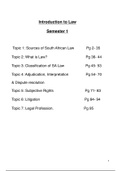
Introduction to Law
Semester 1
Topic 1: Sources of South African Law Pg 2- 35
Topic 2: What is Law? Pg 36- 44
Topic 3: Classification of SA Law Pg 45- 53
Topic 4: Adjudication, Interpretation Pg 54- 70
& Dispute resolution
Topic 5: Subjective Rights Pg 71- 83
Topic 6: Litigation Pg 84- 94
Topic 7: Legal Profession. Pg 95
1
,TOPIC 1: Theme 1: What is law? Classification of the law;
Purpose and Importance of Sources of law
What is Law?
• People need rules to regulate their interaction with each other and their interaction
with things:
- To maintain order in society
- To determine what is acceptable and what is not
- To know what is and what is not permissible
• Law: The body of rules and regulations governing human conduct recognised as
binding by people and enforced by public authorities (the state).
Rules of conduct
• Types:
- Religion
- Individual morality (norms the individual sets for themselves)
- Collective morality (societal norms)
- Law
• Some of the above may overlap because of history
- Christianity → common law → RD Law → cannon law originates in
Christianity
- CL is 17th/18th century RD law as influenced by English law
1.3 Law and Morality
Normative systems that influence our lives and determine conduct is :
Religion
Individual moraliity
Community mores
1.3.1 Religion
• Determines the relationship between an individual and a Supreme being
• The western state is based on a. Distinction between state authority and religious authority
2
,• Not the states responsibility to enforce religious norms, however they need to make religious
freedom possible
1.3.2 individual morality
• Concerns a private conflict between and individual and her conscience.
• Law doesn’t enforce morality as such
1.3.3 Community mores
• The norms of a whole community or group within that community
• They are collective morals
• The sanction for non-compliance is the varying degrees of disapproval by the members of
society.
• Found between law and morality, and change with public opinions and social convictions
Importance of law:
• Regulates relationships, tells us what we can and cannot do
• Provides sanctions for infringements of rights
• Regulates rights and obligations
• Provides for peace and order
• Objective of a legal system: law making
- Legal system must assist in interpreting and adjudicating in disputes
- Must be able to enforce the law
- Administration of justice
- Legal representation and legal advice
• Factors in determining whether law is effective
3
, - Public awareness, understanding and acceptance of law
- Enforcement of the law
- Clarity and drafting of the law
- Consistency of the law (levels of government need to comply with constitution
and with the levels above them)
- Changes (Sodomy & Inter-racial relationships) and stability in the law
Sources of law and legal authority
The law as rules:
• Law comprises authoritative rules that society has formulated to regulate the
relationship between people and between people and things
The reasons for recognising sources of law
• To tell us which institutions in society have the capacity to develop prescriptive
norms, which is rules that be bestow with the authoritative status of law. E.g. the
rights articulated in the Bill of Rights.
• Knowing which kinds of rules have the authority of law in a particular society assists
in creating legal certainty.
• Providing us with information on the content of law to explain and critique it
Primary Sources of Law
• Primary sources of law will tell you what the law is and where it originates from. This
source of law creates authority.
• They are binding and carry the most weight and persuasiveness in legal argument.
• E.g. Primary sources may include, Acts of Parliament, court cases, legislation,
government documents, etc.
Secondary Sources of Law
• Writing and opinions of authors and legal researchers about the primary sources of
law.
• Supplement primary sources (explain, describing, evaluating and criticising primary
sources of law)
• Do not create new law and are not binding authority
• They only have persuasive authority. Our law is not found in secondary sources, but
the judges and magistrates can be convinced by the opinions and arguments of
authors.
• Author’s opinions can thus lead to the development of new legislation.
4
Semester 1
Topic 1: Sources of South African Law Pg 2- 35
Topic 2: What is Law? Pg 36- 44
Topic 3: Classification of SA Law Pg 45- 53
Topic 4: Adjudication, Interpretation Pg 54- 70
& Dispute resolution
Topic 5: Subjective Rights Pg 71- 83
Topic 6: Litigation Pg 84- 94
Topic 7: Legal Profession. Pg 95
1
,TOPIC 1: Theme 1: What is law? Classification of the law;
Purpose and Importance of Sources of law
What is Law?
• People need rules to regulate their interaction with each other and their interaction
with things:
- To maintain order in society
- To determine what is acceptable and what is not
- To know what is and what is not permissible
• Law: The body of rules and regulations governing human conduct recognised as
binding by people and enforced by public authorities (the state).
Rules of conduct
• Types:
- Religion
- Individual morality (norms the individual sets for themselves)
- Collective morality (societal norms)
- Law
• Some of the above may overlap because of history
- Christianity → common law → RD Law → cannon law originates in
Christianity
- CL is 17th/18th century RD law as influenced by English law
1.3 Law and Morality
Normative systems that influence our lives and determine conduct is :
Religion
Individual moraliity
Community mores
1.3.1 Religion
• Determines the relationship between an individual and a Supreme being
• The western state is based on a. Distinction between state authority and religious authority
2
,• Not the states responsibility to enforce religious norms, however they need to make religious
freedom possible
1.3.2 individual morality
• Concerns a private conflict between and individual and her conscience.
• Law doesn’t enforce morality as such
1.3.3 Community mores
• The norms of a whole community or group within that community
• They are collective morals
• The sanction for non-compliance is the varying degrees of disapproval by the members of
society.
• Found between law and morality, and change with public opinions and social convictions
Importance of law:
• Regulates relationships, tells us what we can and cannot do
• Provides sanctions for infringements of rights
• Regulates rights and obligations
• Provides for peace and order
• Objective of a legal system: law making
- Legal system must assist in interpreting and adjudicating in disputes
- Must be able to enforce the law
- Administration of justice
- Legal representation and legal advice
• Factors in determining whether law is effective
3
, - Public awareness, understanding and acceptance of law
- Enforcement of the law
- Clarity and drafting of the law
- Consistency of the law (levels of government need to comply with constitution
and with the levels above them)
- Changes (Sodomy & Inter-racial relationships) and stability in the law
Sources of law and legal authority
The law as rules:
• Law comprises authoritative rules that society has formulated to regulate the
relationship between people and between people and things
The reasons for recognising sources of law
• To tell us which institutions in society have the capacity to develop prescriptive
norms, which is rules that be bestow with the authoritative status of law. E.g. the
rights articulated in the Bill of Rights.
• Knowing which kinds of rules have the authority of law in a particular society assists
in creating legal certainty.
• Providing us with information on the content of law to explain and critique it
Primary Sources of Law
• Primary sources of law will tell you what the law is and where it originates from. This
source of law creates authority.
• They are binding and carry the most weight and persuasiveness in legal argument.
• E.g. Primary sources may include, Acts of Parliament, court cases, legislation,
government documents, etc.
Secondary Sources of Law
• Writing and opinions of authors and legal researchers about the primary sources of
law.
• Supplement primary sources (explain, describing, evaluating and criticising primary
sources of law)
• Do not create new law and are not binding authority
• They only have persuasive authority. Our law is not found in secondary sources, but
the judges and magistrates can be convinced by the opinions and arguments of
authors.
• Author’s opinions can thus lead to the development of new legislation.
4


