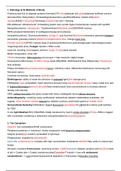
1. Histology & Its Methods of Study
Fixation(cross-link to degrade protiens) formalin(37% formaldehyde-LM; glutaraldehyde+buffered osmium
tetroxide-EM)->Dehydration->Embedding(denaturation) paraffin(infiltration melted-LM)/plastic
resins(LM/EM)-> Mounting/Trimming(microtome for LM)-> Staining
EM additional “ultrastructural”; Embedding plastic resin avoids higher temperatures needed with paraffin
Basophilic(anionic): Hematoxylin, Toluidine/Alcian/Methylene blue(DNA/RNA-nucleus,
RER-cytoplasm/GAG/matrix of cartilage/proteoglycan/nucleolus)
Acidophilic(cationic): Eosin(counterstain), orange G, acid fuchsin(Mitochondria/secretory granules/collagen)
Azurophilic granules produce Metachromasia(toluidine blue, change basic dye)
Periodic acid-Schiff(PAS): hexose rings of polysaccharides(mucin granules/glycogen deposits/glycocalyx),
magenta(purple pink), Feulgen reaction->DNA nuclei
Lipid-rich avoiding (heat/organic solvent): Sudan III black(lipid soluble)
Metal impregnation: silver salt
Virtual microscopy: slide-scanning microscope-> high resolution digital image
Fluorescence Microscopy: Acridine orange binds DNA/RNA; DAPI/Hoechst bind DNA(nuclei), Fluorescein
bind antibody
Phase-Contrast(without fixation/staining/dying): refractory index, differential interference microscopy(3D,
Nomarski optics)
Confocal microscopy: focal plane->pinhole plate
Birefringence: ability to rotate the direction of polarized light(Dark background)
TEM(plastic resin embedded): beam electrons focused using electromagnetic lenses, heavy metal ions add
in fixation/dehydration(osmium tetroxide/lead citrate/uranyl) bind macromolecule to increase electron
density and intensity
SEM: surface first dried and spray-coated with heavy metal(gold) which reflects electrons
Autoradiography: localizing newly synthesized radioactively labeled metabolites(nucleotides, AA,
sugars): silver bromide crystals reduced by radiation produce small black grains of metallic silver
Immunohistochemistry(Antibodies): tagged fluorescent peroxidase for LM/electron-dense gold particles
for TEM
In situ hybridization(ISH): DNA/RNA initially denatured by heat to single stranded->Probe cDNA is tagged
with nucleotides containing a radioactive isotope(localized by autoradiography)
2. The Cytoplasm
Integrins: link cytoskeleton/ECM components;
Peripheral proteins(salt solutions): mostly cytoplasmic side/bound to integral protein
Integral protein(lipid solution) embedded in lipid layer
Phagocytosis: engulfed by pseudopodia
Lipid rafts: protein/enzyme complex with high concentration cholesterol/saturated fatty acids to reduce lipid
fluidity
Receptor-mediated Endocytosis: peripheral protein: Clathrin/caveolin+adaptor proteins with Dynamin(neck
of pit)-> Coated pits-> Coated vesicle/vacuoles(Caveolae-T-tubule)-> fuse with endosomal
compartment-> 1.Late endosome(lysosomal degration) 2.Trancytosis 3.Receptor recycling
,endosome(ligand uncouplin)
Cell signaling membrane receptor proteins linked to kinases/adenylyl cyclase
Membrane trafficking(reduce blood lipid level): process of membrane become endocytosis and recycle in
exocytosis
Paracrine signaling: rapidly metabolized effect target near its source/same type cell(synapse)
Juxtacrine signaling(embryonic tissue interactions): signaling molecule on membrane need two cells make
direct physical contact.
Autocrine signaling: signals bind receptors on the same cells
Polyribosomes(Polysomes, mRNA+ribosome): mRNA(5’end) protein signal sequence(new translated
signal): 6 hydrophobic residues bound Signal recognition particle (SRP, stop polypeptide elongation)->
bound SRP receptors on ER membrane-> SRP releases Signal sequence allow translation continue as
new polypeptide transfer into Translocator/translocon complex(penetrate RER membrane)->signal
sequence removed by signal peptidase in RER
New proteins that cannot be folded/assembled properly by Chaperones(pull polypeptide through
translocon)-> ER-associated degradation (ERAD): transport back cytosol conjugated with ubiquitin->
ubiquitin recognized/attach by Regulatory particles(ATPase) in cylinder end of Proteasome-> unfolding by
ATPase and degraded by endopeptidase-> ubiquitin are released
Golgi apparatus: cis->Coat proteins COPII and COPI(retrograde movement)-> trans, transport vesicle-
>secretory vesicle
Lysosomes(pH 5): acid hydrolyases: proteases/nucleases/phosphatase/phospholipases/sulfatases/β-
glucuronidase
Vesicle fuses activates proton pumps acidify contents allowing digestion->Heterolysosome(Secondary
lysosomes, less electron-dense)
Lipofuscin(pale brown): long-lived cells: neurons/heart muscle
Autophagy: from SER membrane to removal of excess/nonfunctional organelles-> Autophagosome with
lysosome in nutrient stress(starvation), reused in cytoplasm
Proteasomes: cylindrical structure made of 4-stacked rings X 7 proteins including proteases.
Mitochondrial matrix(autonomous): small circular DNA/ribosomes/mRNA
Apoptosis: cytochrome c from inner membrane’s ETC
Porins: outer mitochondrial membrane transmembrane proteins for pyruvate
Inner membrane surface: oxidize pyruvate/fatty acids to form acetyl coenzyme A, Oxidative
phosphorylation(Chemiosmotic process)
Peroxisomes(from SER): 1.Oxidases 2.Catalase 3. inactivate toxic(liver/kidneys) 4. β-oxidation of fatty
acids(major process produce H2O2) 5.formation of bile acids/cholesterol, budding of precursor vesicles
from ER /growth and division of preexisting peroxisomes
Microtubules(Hollow tube of 13 parallel protofilaments polar, 25nm): Heterodimers α/β-tubulin, Maintain
cell’s shape/polarity/chromosome movement(mitotic spindle), arise from/concentrated at
centrosome(MTOCs): paired 2 cylindrical centrioles-> 9 microtubule triplets,
Dynamic instability: continue polymerization and depolymerization depend on concentration of
Tubulin/Ca/Mg/MAPs(associated protein): Tubulin GTP is added(+)->Tubulin GDP(-), stable in
axonemes(cilia/flagella)
,Kinesins: carry material from the MTOC near the nucleus to(+), anterograde
Dyneins: opposite direction, retrograde
Microfilaments(2 intertwined filaments of F-actin polymer, polar, 5-7nm): globular G-actin(42kDa)
monomers that assemble in the presence of K/Mg into a double-stranded helix F-actin, mobile cells/change
cell shape/cytokinesis/endocytosis, microvilli/concentrate beneath cell membrane(G-actin) as cell cortex, g-
actin monomers are added (+) with ATP hydrolysis, new filament for from pool of nucleating proteins
formin(microvilli), Anchor filaments at RBC inner surface of membrane(spectrin)
Intermediate Filament(4 intertwined protofibrils, 8-10nm): subunit: Antiparallel tetramers of 2 a-helical-rod-
like dimers, monomeric proteins: α-helical rod-like proteins, no polarity, dynamic stable, arrayed in
cytoplasm/Desmosome/Nuclear envelope
Class: compose for subunit 2 a-helical-rod-like-dimer
cytokeratins-I/II(acidic/basic, bundle called tonofibril): all epithelial cells, tonofibrils for junctions III:
Vimentin-embryonic mesenchyme, Desmin: smooth muscle GFAP: astrocytes proximal process marker
IV: Neurofilament(L/M/H)-in neurons perikaryon+processes, V:Lamins- nuclear lamin, VI:Nestin(embryonic)
Inclusions(temporary storage): naturally colored material
1Lipid droplets2.Glycogen(glucose stored)3.Melanin(dark brown) granules protect cells from UV
4.Lipofuscin(pale brown granule- residual bodies)6.hemosiderin(brown) aggregate of denatured ferritin
proteins results from phagocytosis of red blood cells
3. The Nucleus
Nuclear envelope: nuclear lamina V- inside inner nuclear membrane, core nucleoporins proteins-8 fold
symmetry, out:ribosomal subunits/RNA/protein ; In: chromatin protein/ribosomal protein/transcription
factors/enzymes/GTPases
Nucleosome: 150 bp, DNA + histones (basic proteins)= 8 histones (H2A,H2B,H3,H4)X2+H1- 50-80 bp
linker DNA connect to H1
DNA 2nm-> Nucleosomes 10nm-> helical folding packed nucleosomes 30nm->
scaffold(euchromatin)300nm/condensed chromosome heterochromatin, nonhistone proteins(condensin)
700nm-> Entire chromosome(sister chromatids) at metaphase 1400nm
Karyopyknosis–condensation; Karyorhexis–fragmentation
Euchromatin: dispesrsed granular EM, lightly basophilic LM, large neuron
Heterochromatin: Edense EM, basophilic clumps LM, Constitutive*- centromeres/telomeres region,
repetitive gene-poor DNA, Facultative*- variably inactivated, epigenetic mechanisms, abundant in
lymphocytes(little synthetic), heterochromatinis concentrated near nuclear lamina, except at nuclear pores,
Barr body/drumstick: facultative heterochromatin inactived X1 females
Chromosomal territories: individual chromosome occupy in cultured human fibroblast nuclei by ISH
Nucleolus: Edense/basophilic, concentrated rRNA transcription(fibrillar/FC) and ribosomal subunits
assembly(granular/GC) in TEM, heterochromatin surround
Cell Cycle(24 to 36h): G1(25h): active RNA/protein synthesis(accumulate the enzymes/nucleotides),
Longest period, daughter return cell size
S(8h): DNA replication+histone synthesis, centrosome duplication paired 4 centriole
, G2: protein accumulate for mitosis G2+Mitosis=2.5-3h
G0: cells to preserve important functions over a long period, muscle/nerve cells
Mitogens/growth factors: Protein signals from ECM activated postmitotic G0 cells then maintain at
restriction point(G1/S) boundary until sufficient nutrients for DNA replication -> S
Cyclins: cytoplasmic proteins-> activate cyclin-dependent Kinases (CDKs)-> then phosphorylates specific
proteins (enzymes, transcription factors, cytoskeletal subunits) for next phase -> cyclin controlling old cycle
phase removed by proteasomes
Early G1 point Cyclin D-CDK 4/6 G1 activities (transcription)+cycline A(S)
Late G1 point Cyclin E-CDK 2 p53
S point Cyclin A-CDK2 DNA polymerase+protein for replication
G2/M point Cyclin A-CDK 1 Phoshatase +Cyclin B(M)
M point: Cyclin B-CDK 1 Nuclear lamina/histone H1/chromatin/centrosome AP
Metaphase/Anaphase: prepare for cytokinesis
Mutations in growth factors+CDK: normal repair in G1/S -> tumor suppressor proteins p53->cell
suicide/apoptosis
Mitotic metaphase: Colchicine disrupt microtubules
Long prophase(1H):nucleolus disappear, replicated chromosome condense to be discrete, 2 centromsome
(pair centrioles) move to opposite poles + originate microtubule (mitotic spindle)
Late prophase: Inner nucleus membrame+ nuclear lamina phosphorylated
Metaphase: chromosomes with kinetochore(protein)
Anaphase: microtubule motor protein(kinesin/Dyneins)
Telephase: Separate chormatid to decondensed state, mitotic spindle depolymerized/nuclear envelope
reformed, ring of actin-filament develop in equator(prepare cytokinesis)
End telophase: cytokinesis constriction ring
Stem cell (niche/location): one daughter cell remain as stem cell, in rapid Renewing cell population:
blood/skin cells lining the digestive tract
Stable cell populations: connective tissues/cells lining blood vessels/nerve tissue/smooth muscle/cardiac
muscle(rare stem cells)
Progenitor cells/transit amplifying cells: commit to differentiated cells -> terminally differentiated
Meiosis I Prophase: homologous chromosome come together for Synapsis-double-stranded breaks
repairs(recombination/crossover), primary spermatocytes in Prophase I last for 3 week Oocytes last for 5Y
to 50 Y-> Metaphase I: homologous chromosome line up in the equator -> Anaphase I:homologous
chromosome separate without S -> chromatids separate as individual chromosome -> nuclear envelope
reform
Apoptosis: shrink as apoptotic bodies, undergo phagocytosis by neighbor cells/WBC
Monthly loss of luteal cells and remove of excess oocytes and follicle
Embryo: shape developing organs/body region of free space between embryonic fingers/toes
Apoptosis of excess nerve cells play role in final development of CNS
Cell injury/necrosis release cellular components triggers local inflammatory+immigration leukocytes
Bcl-2 family: cytoplasmic protein regulate the release death promoting factor from mitochondria,
activated by external signal/inreversible internal damage(B-cell lymphoma)
Fixation(cross-link to degrade protiens) formalin(37% formaldehyde-LM; glutaraldehyde+buffered osmium
tetroxide-EM)->Dehydration->Embedding(denaturation) paraffin(infiltration melted-LM)/plastic
resins(LM/EM)-> Mounting/Trimming(microtome for LM)-> Staining
EM additional “ultrastructural”; Embedding plastic resin avoids higher temperatures needed with paraffin
Basophilic(anionic): Hematoxylin, Toluidine/Alcian/Methylene blue(DNA/RNA-nucleus,
RER-cytoplasm/GAG/matrix of cartilage/proteoglycan/nucleolus)
Acidophilic(cationic): Eosin(counterstain), orange G, acid fuchsin(Mitochondria/secretory granules/collagen)
Azurophilic granules produce Metachromasia(toluidine blue, change basic dye)
Periodic acid-Schiff(PAS): hexose rings of polysaccharides(mucin granules/glycogen deposits/glycocalyx),
magenta(purple pink), Feulgen reaction->DNA nuclei
Lipid-rich avoiding (heat/organic solvent): Sudan III black(lipid soluble)
Metal impregnation: silver salt
Virtual microscopy: slide-scanning microscope-> high resolution digital image
Fluorescence Microscopy: Acridine orange binds DNA/RNA; DAPI/Hoechst bind DNA(nuclei), Fluorescein
bind antibody
Phase-Contrast(without fixation/staining/dying): refractory index, differential interference microscopy(3D,
Nomarski optics)
Confocal microscopy: focal plane->pinhole plate
Birefringence: ability to rotate the direction of polarized light(Dark background)
TEM(plastic resin embedded): beam electrons focused using electromagnetic lenses, heavy metal ions add
in fixation/dehydration(osmium tetroxide/lead citrate/uranyl) bind macromolecule to increase electron
density and intensity
SEM: surface first dried and spray-coated with heavy metal(gold) which reflects electrons
Autoradiography: localizing newly synthesized radioactively labeled metabolites(nucleotides, AA,
sugars): silver bromide crystals reduced by radiation produce small black grains of metallic silver
Immunohistochemistry(Antibodies): tagged fluorescent peroxidase for LM/electron-dense gold particles
for TEM
In situ hybridization(ISH): DNA/RNA initially denatured by heat to single stranded->Probe cDNA is tagged
with nucleotides containing a radioactive isotope(localized by autoradiography)
2. The Cytoplasm
Integrins: link cytoskeleton/ECM components;
Peripheral proteins(salt solutions): mostly cytoplasmic side/bound to integral protein
Integral protein(lipid solution) embedded in lipid layer
Phagocytosis: engulfed by pseudopodia
Lipid rafts: protein/enzyme complex with high concentration cholesterol/saturated fatty acids to reduce lipid
fluidity
Receptor-mediated Endocytosis: peripheral protein: Clathrin/caveolin+adaptor proteins with Dynamin(neck
of pit)-> Coated pits-> Coated vesicle/vacuoles(Caveolae-T-tubule)-> fuse with endosomal
compartment-> 1.Late endosome(lysosomal degration) 2.Trancytosis 3.Receptor recycling
,endosome(ligand uncouplin)
Cell signaling membrane receptor proteins linked to kinases/adenylyl cyclase
Membrane trafficking(reduce blood lipid level): process of membrane become endocytosis and recycle in
exocytosis
Paracrine signaling: rapidly metabolized effect target near its source/same type cell(synapse)
Juxtacrine signaling(embryonic tissue interactions): signaling molecule on membrane need two cells make
direct physical contact.
Autocrine signaling: signals bind receptors on the same cells
Polyribosomes(Polysomes, mRNA+ribosome): mRNA(5’end) protein signal sequence(new translated
signal): 6 hydrophobic residues bound Signal recognition particle (SRP, stop polypeptide elongation)->
bound SRP receptors on ER membrane-> SRP releases Signal sequence allow translation continue as
new polypeptide transfer into Translocator/translocon complex(penetrate RER membrane)->signal
sequence removed by signal peptidase in RER
New proteins that cannot be folded/assembled properly by Chaperones(pull polypeptide through
translocon)-> ER-associated degradation (ERAD): transport back cytosol conjugated with ubiquitin->
ubiquitin recognized/attach by Regulatory particles(ATPase) in cylinder end of Proteasome-> unfolding by
ATPase and degraded by endopeptidase-> ubiquitin are released
Golgi apparatus: cis->Coat proteins COPII and COPI(retrograde movement)-> trans, transport vesicle-
>secretory vesicle
Lysosomes(pH 5): acid hydrolyases: proteases/nucleases/phosphatase/phospholipases/sulfatases/β-
glucuronidase
Vesicle fuses activates proton pumps acidify contents allowing digestion->Heterolysosome(Secondary
lysosomes, less electron-dense)
Lipofuscin(pale brown): long-lived cells: neurons/heart muscle
Autophagy: from SER membrane to removal of excess/nonfunctional organelles-> Autophagosome with
lysosome in nutrient stress(starvation), reused in cytoplasm
Proteasomes: cylindrical structure made of 4-stacked rings X 7 proteins including proteases.
Mitochondrial matrix(autonomous): small circular DNA/ribosomes/mRNA
Apoptosis: cytochrome c from inner membrane’s ETC
Porins: outer mitochondrial membrane transmembrane proteins for pyruvate
Inner membrane surface: oxidize pyruvate/fatty acids to form acetyl coenzyme A, Oxidative
phosphorylation(Chemiosmotic process)
Peroxisomes(from SER): 1.Oxidases 2.Catalase 3. inactivate toxic(liver/kidneys) 4. β-oxidation of fatty
acids(major process produce H2O2) 5.formation of bile acids/cholesterol, budding of precursor vesicles
from ER /growth and division of preexisting peroxisomes
Microtubules(Hollow tube of 13 parallel protofilaments polar, 25nm): Heterodimers α/β-tubulin, Maintain
cell’s shape/polarity/chromosome movement(mitotic spindle), arise from/concentrated at
centrosome(MTOCs): paired 2 cylindrical centrioles-> 9 microtubule triplets,
Dynamic instability: continue polymerization and depolymerization depend on concentration of
Tubulin/Ca/Mg/MAPs(associated protein): Tubulin GTP is added(+)->Tubulin GDP(-), stable in
axonemes(cilia/flagella)
,Kinesins: carry material from the MTOC near the nucleus to(+), anterograde
Dyneins: opposite direction, retrograde
Microfilaments(2 intertwined filaments of F-actin polymer, polar, 5-7nm): globular G-actin(42kDa)
monomers that assemble in the presence of K/Mg into a double-stranded helix F-actin, mobile cells/change
cell shape/cytokinesis/endocytosis, microvilli/concentrate beneath cell membrane(G-actin) as cell cortex, g-
actin monomers are added (+) with ATP hydrolysis, new filament for from pool of nucleating proteins
formin(microvilli), Anchor filaments at RBC inner surface of membrane(spectrin)
Intermediate Filament(4 intertwined protofibrils, 8-10nm): subunit: Antiparallel tetramers of 2 a-helical-rod-
like dimers, monomeric proteins: α-helical rod-like proteins, no polarity, dynamic stable, arrayed in
cytoplasm/Desmosome/Nuclear envelope
Class: compose for subunit 2 a-helical-rod-like-dimer
cytokeratins-I/II(acidic/basic, bundle called tonofibril): all epithelial cells, tonofibrils for junctions III:
Vimentin-embryonic mesenchyme, Desmin: smooth muscle GFAP: astrocytes proximal process marker
IV: Neurofilament(L/M/H)-in neurons perikaryon+processes, V:Lamins- nuclear lamin, VI:Nestin(embryonic)
Inclusions(temporary storage): naturally colored material
1Lipid droplets2.Glycogen(glucose stored)3.Melanin(dark brown) granules protect cells from UV
4.Lipofuscin(pale brown granule- residual bodies)6.hemosiderin(brown) aggregate of denatured ferritin
proteins results from phagocytosis of red blood cells
3. The Nucleus
Nuclear envelope: nuclear lamina V- inside inner nuclear membrane, core nucleoporins proteins-8 fold
symmetry, out:ribosomal subunits/RNA/protein ; In: chromatin protein/ribosomal protein/transcription
factors/enzymes/GTPases
Nucleosome: 150 bp, DNA + histones (basic proteins)= 8 histones (H2A,H2B,H3,H4)X2+H1- 50-80 bp
linker DNA connect to H1
DNA 2nm-> Nucleosomes 10nm-> helical folding packed nucleosomes 30nm->
scaffold(euchromatin)300nm/condensed chromosome heterochromatin, nonhistone proteins(condensin)
700nm-> Entire chromosome(sister chromatids) at metaphase 1400nm
Karyopyknosis–condensation; Karyorhexis–fragmentation
Euchromatin: dispesrsed granular EM, lightly basophilic LM, large neuron
Heterochromatin: Edense EM, basophilic clumps LM, Constitutive*- centromeres/telomeres region,
repetitive gene-poor DNA, Facultative*- variably inactivated, epigenetic mechanisms, abundant in
lymphocytes(little synthetic), heterochromatinis concentrated near nuclear lamina, except at nuclear pores,
Barr body/drumstick: facultative heterochromatin inactived X1 females
Chromosomal territories: individual chromosome occupy in cultured human fibroblast nuclei by ISH
Nucleolus: Edense/basophilic, concentrated rRNA transcription(fibrillar/FC) and ribosomal subunits
assembly(granular/GC) in TEM, heterochromatin surround
Cell Cycle(24 to 36h): G1(25h): active RNA/protein synthesis(accumulate the enzymes/nucleotides),
Longest period, daughter return cell size
S(8h): DNA replication+histone synthesis, centrosome duplication paired 4 centriole
, G2: protein accumulate for mitosis G2+Mitosis=2.5-3h
G0: cells to preserve important functions over a long period, muscle/nerve cells
Mitogens/growth factors: Protein signals from ECM activated postmitotic G0 cells then maintain at
restriction point(G1/S) boundary until sufficient nutrients for DNA replication -> S
Cyclins: cytoplasmic proteins-> activate cyclin-dependent Kinases (CDKs)-> then phosphorylates specific
proteins (enzymes, transcription factors, cytoskeletal subunits) for next phase -> cyclin controlling old cycle
phase removed by proteasomes
Early G1 point Cyclin D-CDK 4/6 G1 activities (transcription)+cycline A(S)
Late G1 point Cyclin E-CDK 2 p53
S point Cyclin A-CDK2 DNA polymerase+protein for replication
G2/M point Cyclin A-CDK 1 Phoshatase +Cyclin B(M)
M point: Cyclin B-CDK 1 Nuclear lamina/histone H1/chromatin/centrosome AP
Metaphase/Anaphase: prepare for cytokinesis
Mutations in growth factors+CDK: normal repair in G1/S -> tumor suppressor proteins p53->cell
suicide/apoptosis
Mitotic metaphase: Colchicine disrupt microtubules
Long prophase(1H):nucleolus disappear, replicated chromosome condense to be discrete, 2 centromsome
(pair centrioles) move to opposite poles + originate microtubule (mitotic spindle)
Late prophase: Inner nucleus membrame+ nuclear lamina phosphorylated
Metaphase: chromosomes with kinetochore(protein)
Anaphase: microtubule motor protein(kinesin/Dyneins)
Telephase: Separate chormatid to decondensed state, mitotic spindle depolymerized/nuclear envelope
reformed, ring of actin-filament develop in equator(prepare cytokinesis)
End telophase: cytokinesis constriction ring
Stem cell (niche/location): one daughter cell remain as stem cell, in rapid Renewing cell population:
blood/skin cells lining the digestive tract
Stable cell populations: connective tissues/cells lining blood vessels/nerve tissue/smooth muscle/cardiac
muscle(rare stem cells)
Progenitor cells/transit amplifying cells: commit to differentiated cells -> terminally differentiated
Meiosis I Prophase: homologous chromosome come together for Synapsis-double-stranded breaks
repairs(recombination/crossover), primary spermatocytes in Prophase I last for 3 week Oocytes last for 5Y
to 50 Y-> Metaphase I: homologous chromosome line up in the equator -> Anaphase I:homologous
chromosome separate without S -> chromatids separate as individual chromosome -> nuclear envelope
reform
Apoptosis: shrink as apoptotic bodies, undergo phagocytosis by neighbor cells/WBC
Monthly loss of luteal cells and remove of excess oocytes and follicle
Embryo: shape developing organs/body region of free space between embryonic fingers/toes
Apoptosis of excess nerve cells play role in final development of CNS
Cell injury/necrosis release cellular components triggers local inflammatory+immigration leukocytes
Bcl-2 family: cytoplasmic protein regulate the release death promoting factor from mitochondria,
activated by external signal/inreversible internal damage(B-cell lymphoma)