

Chapter 10: Financial Function
FINANCIAL CONCEPTS IN A BUSINESS ENVIRONMENT
Income statement
The business receives income when services are rendered or when goods are sold. Also
known as the Statement of comprehensive Income
Examples of income
• sales
• Rent income
• Interest income
The business incurs expenses when it has to pay for a service rendered to the business
and are also shown on the Statement of Comprehensive Income.
Examples of expenses
• Water and electricity
• Advertising
• Repairs
• Insurance
• Telephone
• Salaries/wages
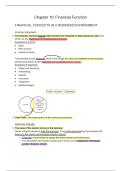
Profit= Income – Expenses
selling other
assets or
owner giving
income
capital or
borrowing
money
Cash Flow = the cash portion of the various transactions
Owners Equity
The value of the owners money in the business
Owner will give capital to start the business. Any profits generated by the business will
belong to the owner and increases Owner’s Equity.
- Drawings is any money or assets the owner takes out the business.
This decreases the owners’ equity and is shown In the statement of financial
position (balance sheet)
, Assets
The possessions of a business.
Assets are used by business to make money
2 types of assets:
- Non-current assets: long term (longer than 1 year) land and buildings, vehicles,
equipment
- Current assets: short term (shorter than 1 year) trading inventory, debtors and cash
assets
These are shown in the Statement of Financial position (balance sheet)
Liabilities
Debt of the business, this is what the business is liable to repay
2 types of liabilities:
- Non-current liabilities: long term (longer than 1 year) mortgage bond, loan from the
bank used to buy land or buildings
- Current liabilities: short term (shorter than 1 year) creditors and bank overdraft
This is all shown in the Statement of Financial position (balance sheet)
Assets = Owners Equity + Liabilities
Costs
2 types of costs
- Fixed costs
- Variable costs
Fixed costs
Costs that remain the same, irrespective of the output
- Insurance and rent expense
- Worker is paid a fixed salary; workers are not directly involved in production
process
Variable costs
Vary according to the output. They increase when production increases.
- Water and electricity
- Raw materials used to make product
- Wages of workers who are paid according to their output
Definition: Total cost
The sum of fixed costs and the variable costs
Definition: Cost per unit
Calculated by dividing the total costs by the number of units produced
FINANCIAL CONCEPTS IN A BUSINESS ENVIRONMENT
Income statement
The business receives income when services are rendered or when goods are sold. Also
known as the Statement of comprehensive Income
Examples of income
• sales
• Rent income
• Interest income
The business incurs expenses when it has to pay for a service rendered to the business
and are also shown on the Statement of Comprehensive Income.
Examples of expenses
• Water and electricity
• Advertising
• Repairs
• Insurance
• Telephone
• Salaries/wages
Profit= Income – Expenses
selling other
assets or
owner giving
income
capital or
borrowing
money
Cash Flow = the cash portion of the various transactions
Owners Equity
The value of the owners money in the business
Owner will give capital to start the business. Any profits generated by the business will
belong to the owner and increases Owner’s Equity.
- Drawings is any money or assets the owner takes out the business.
This decreases the owners’ equity and is shown In the statement of financial
position (balance sheet)
, Assets
The possessions of a business.
Assets are used by business to make money
2 types of assets:
- Non-current assets: long term (longer than 1 year) land and buildings, vehicles,
equipment
- Current assets: short term (shorter than 1 year) trading inventory, debtors and cash
assets
These are shown in the Statement of Financial position (balance sheet)
Liabilities
Debt of the business, this is what the business is liable to repay
2 types of liabilities:
- Non-current liabilities: long term (longer than 1 year) mortgage bond, loan from the
bank used to buy land or buildings
- Current liabilities: short term (shorter than 1 year) creditors and bank overdraft
This is all shown in the Statement of Financial position (balance sheet)
Assets = Owners Equity + Liabilities
Costs
2 types of costs
- Fixed costs
- Variable costs
Fixed costs
Costs that remain the same, irrespective of the output
- Insurance and rent expense
- Worker is paid a fixed salary; workers are not directly involved in production
process
Variable costs
Vary according to the output. They increase when production increases.
- Water and electricity
- Raw materials used to make product
- Wages of workers who are paid according to their output
Definition: Total cost
The sum of fixed costs and the variable costs
Definition: Cost per unit
Calculated by dividing the total costs by the number of units produced


