
Parasitology Ch. 3
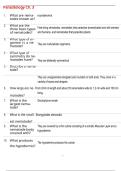
1. What are nema- roundworms
todes known as?
2. What are the
three basic types Free-living nematodes, nematodes that parasitize domesticated and wild animals
of nematodes? and humans, and nematodes that parasitize plants
3. What type of or-
ganism is a ne- They are multicellular organisms.
matode?
4. What type of
symmetry do ne-
matodes have? They are bilaterally symmetrical
5. Describe a nema-
tode?
They are unsegmented elongated and rounded on both ends. They come in a
variety of sizes and shapes.
6. How large are ne- From 2mm in length and about 35 nanometers wide to 1.2 cm wide and 100 cm
long.
matodes?
7. What is the Dioctophyma renale
largest nema-
tode?
8. What is the small- Strongyloides stercoralis
est nematode?
9. What is the They are covered by a thin cuticle consisting of a somatic Muscular Layer and a
nematode body hypodermis
covered with?
10. What produces
The hypodermis produces the cuticle
the hypodermis?
1/3
1. What are nema- roundworms
todes known as?
2. What are the
three basic types Free-living nematodes, nematodes that parasitize domesticated and wild animals
of nematodes? and humans, and nematodes that parasitize plants
3. What type of or-
ganism is a ne- They are multicellular organisms.
matode?
4. What type of
symmetry do ne-
matodes have? They are bilaterally symmetrical
5. Describe a nema-
tode?
They are unsegmented elongated and rounded on both ends. They come in a
variety of sizes and shapes.
6. How large are ne- From 2mm in length and about 35 nanometers wide to 1.2 cm wide and 100 cm
long.
matodes?
7. What is the Dioctophyma renale
largest nema-
tode?
8. What is the small- Strongyloides stercoralis
est nematode?
9. What is the They are covered by a thin cuticle consisting of a somatic Muscular Layer and a
nematode body hypodermis
covered with?
10. What produces
The hypodermis produces the cuticle
the hypodermis?
1/3


