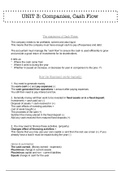
UNIT 3: Companies, Cash Flow
The statement of Cash Flows:
The company needs to be profitable, solvent and also liquid.
This means that the company must have enough cash to pay off expenses and debt.
The accountant must manage the “cash flow” to ensure the cash is used efficiently to grow
and provide a good return of investments for its shareholders.
It tells us:
- Where the cash came from
- Where it went to during the year
- Whether it caused an increase, or decrease for year in comparison to the prev. Yr.
How the Statement works basically:
1. You need to generate money.
You earn cash (+) and pay expenses (-)
The cash generated from operations = amount after paying expenses.
You still then need to pay interest and tax.
2. Generally money will then want to be invested in fixed assets or in a fixed deposit.
Investments = cash paid out (-)
Disposal of assets = cash received in (+)
The cash effects of investing activities =
cost of asset bought (-)
The proceeds of the sale (+)
Subtract the money placed in the fixed deposit (-)
Add any cash received from matured fixed deposits (+)
3. You may need to finance these activities. (property)
Changes effect of financing activities =
This means that you may use your own capital (-) and then the rest use a loan (+). If you
already have a load it must be repaid during the year (-)
Hence to summarise:
The cash earned, (Money earned - expenses)
Plus/minus change in current assets
Plus/minus capital and non - current liabilities
Equals change in cash for the year
, How to do the cash ow statement notes:
Note 1 : Reconciliation between net profit before taxation and cash generated
for operations.
NET PROFIT BEFORE TAX (Statement of comprehensive Income) or [1] x
Adjustments in respect of:
Depreciation (Statement of comprehensive Income) [2] x
Interest Expense (Statement of comprehensive Income) [3] x
Operating pro t before changes in working capital A xx
Cash e ects of changes in working capital (Can be a pos/neg no.). B xxx
Changes in inventory (Inc = neg / decr = pos) [4] x
Changes in receivables (Inc = neg / decr = pos) [5] x
Changes in payables (Inc = pos / decr = neg ) [6] x
Cash generated from operations A+B xxx
[1] Net pro t before taxation
- If not given in the statement of comprehensive income, then construct the appropriation
account to get figures.
- APPROPRIATION ACCOUNT +
Income Tax ( This amount is x ) Retained Income (Amount end of prev. year)
Dividends ( Amount re ected for the year, interim + Pro t and loss (net pro t before tax)
nal )
Retained Income (Amount beg. current year)
Balance Balance
xx xx
fi fi ff
fifi fl fi fl
The statement of Cash Flows:
The company needs to be profitable, solvent and also liquid.
This means that the company must have enough cash to pay off expenses and debt.
The accountant must manage the “cash flow” to ensure the cash is used efficiently to grow
and provide a good return of investments for its shareholders.
It tells us:
- Where the cash came from
- Where it went to during the year
- Whether it caused an increase, or decrease for year in comparison to the prev. Yr.
How the Statement works basically:
1. You need to generate money.
You earn cash (+) and pay expenses (-)
The cash generated from operations = amount after paying expenses.
You still then need to pay interest and tax.
2. Generally money will then want to be invested in fixed assets or in a fixed deposit.
Investments = cash paid out (-)
Disposal of assets = cash received in (+)
The cash effects of investing activities =
cost of asset bought (-)
The proceeds of the sale (+)
Subtract the money placed in the fixed deposit (-)
Add any cash received from matured fixed deposits (+)
3. You may need to finance these activities. (property)
Changes effect of financing activities =
This means that you may use your own capital (-) and then the rest use a loan (+). If you
already have a load it must be repaid during the year (-)
Hence to summarise:
The cash earned, (Money earned - expenses)
Plus/minus change in current assets
Plus/minus capital and non - current liabilities
Equals change in cash for the year
, How to do the cash ow statement notes:
Note 1 : Reconciliation between net profit before taxation and cash generated
for operations.
NET PROFIT BEFORE TAX (Statement of comprehensive Income) or [1] x
Adjustments in respect of:
Depreciation (Statement of comprehensive Income) [2] x
Interest Expense (Statement of comprehensive Income) [3] x
Operating pro t before changes in working capital A xx
Cash e ects of changes in working capital (Can be a pos/neg no.). B xxx
Changes in inventory (Inc = neg / decr = pos) [4] x
Changes in receivables (Inc = neg / decr = pos) [5] x
Changes in payables (Inc = pos / decr = neg ) [6] x
Cash generated from operations A+B xxx
[1] Net pro t before taxation
- If not given in the statement of comprehensive income, then construct the appropriation
account to get figures.
- APPROPRIATION ACCOUNT +
Income Tax ( This amount is x ) Retained Income (Amount end of prev. year)
Dividends ( Amount re ected for the year, interim + Pro t and loss (net pro t before tax)
nal )
Retained Income (Amount beg. current year)
Balance Balance
xx xx
fi fi ff
fifi fl fi fl