[
By
*
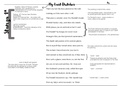
My Last Dutches
Speaker: Duke of Ferrara, recently
widowed. He is speaking to a That’s my last Duchess painted on the wall, The painting is behind the curtain
Stanza 1* representative of a count whose daughter
he intends to marry.
She has passed away. Odd phrase to use
Setting: 16th Century Italy Dramatic
Looking as if she were alive. I call as people generally appear alive in art.
monologue.
Based on historical fact – the dukes wife Fra Pandolf’s hand – means brother or
died under suspicious circumstances at age That piece a wonder, now; Fra Pandolf’s hands monk, refers to the painter
14
Lambic pentameter
Rhyming couplet
Enjambement – could be indicative of the
Dukes compulsive nature
Worked busily a day, and there she stands.
Will’t please you sit and look at her? I said
“ Fra Pandolf” by design, for never read
{ The Duke mentions the painter on purpose
because people want to capture such depth
and passion in her face
The pictured countenance = the painted face
Strangers like you that pictured countenance,
The depth and passion of its earnest glance,
But to myself they turned (since none puts by The duke controls the curtain and who sees
the painting
The curtain I have drawn for you, but I)
And seemed as they would ask me, if they durst, { “durst” - dare
People are afraid to ask the Duke what
How such a glance came there; so, not the first prompted the look of passion on her face
Look of depth and passion
The duke didn’t cause her to blush, Perhaps Are you to turn and ask thus. Sir, ’twas not Duke anticipates the representative’s
question
the artist did. By asking her to show a little
more flesh or his flattery made her flush
Her husband’s presence only, called that spot “spot” – red blush
Of joy into the Duchess’ cheek; perhaps
Fra Pandolf chanced to say, “Her mantle laps “mantel laps” = cloak covers
Over my lady’s wrist too much,” or “Paint
By
*
My Last Dutches
Speaker: Duke of Ferrara, recently
widowed. He is speaking to a That’s my last Duchess painted on the wall, The painting is behind the curtain
Stanza 1* representative of a count whose daughter
he intends to marry.
She has passed away. Odd phrase to use
Setting: 16th Century Italy Dramatic
Looking as if she were alive. I call as people generally appear alive in art.
monologue.
Based on historical fact – the dukes wife Fra Pandolf’s hand – means brother or
died under suspicious circumstances at age That piece a wonder, now; Fra Pandolf’s hands monk, refers to the painter
14
Lambic pentameter
Rhyming couplet
Enjambement – could be indicative of the
Dukes compulsive nature
Worked busily a day, and there she stands.
Will’t please you sit and look at her? I said
“ Fra Pandolf” by design, for never read
{ The Duke mentions the painter on purpose
because people want to capture such depth
and passion in her face
The pictured countenance = the painted face
Strangers like you that pictured countenance,
The depth and passion of its earnest glance,
But to myself they turned (since none puts by The duke controls the curtain and who sees
the painting
The curtain I have drawn for you, but I)
And seemed as they would ask me, if they durst, { “durst” - dare
People are afraid to ask the Duke what
How such a glance came there; so, not the first prompted the look of passion on her face
Look of depth and passion
The duke didn’t cause her to blush, Perhaps Are you to turn and ask thus. Sir, ’twas not Duke anticipates the representative’s
question
the artist did. By asking her to show a little
more flesh or his flattery made her flush
Her husband’s presence only, called that spot “spot” – red blush
Of joy into the Duchess’ cheek; perhaps
Fra Pandolf chanced to say, “Her mantle laps “mantel laps” = cloak covers
Over my lady’s wrist too much,” or “Paint