

Acids and Bases
Acid: Proton donor
Strong acid
An acid that ionises completely in an aqueous solution.
Examples
HCl - Hydrochloric acid (monoprotic)
H2SO4 - Sulfuric acid (diprotic)
HNO3 - Nitric acid (monoprotic)
Weak acid
An acid that only ionises partially in an aqueous solution.
Examples
H3PO4 - Phosphoric acid (triprotic)
HF - Hydrofluoric acid (monoprotic)
H2SO3 - Sulfurous acid (diprotic)
H2C2O4 - Oxalic acid (diprotic)
CH3COOH - Ethanoic acid (monoprotic)
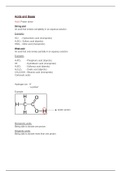
Carboxylic acids
Hydrogen ion - H+
Hydrogen ion - ‘a proton’
Example:
Acidic proton
Monoprotic acids:
Being able to donate one proton.
Polyprotic acids:
Being able to donate more than one proton.
, Ionisation: The reaction of a molecular substance with water to produce ions.
Single arrow = Fully ionises, strong acids
Double arrow = Partially ionises, weak acids
Examples:
HCl (aq) + H2O (l) → H3O+(aq) + Cl- (aq)
H2SO4 (aq) + 2H2O (l) → 2H3O+(aq) + SO42− (aq)
CH3COOH (aq) + H2O (l) ⇌ H3O+(aq) + CH3COO−(aq)
H3PO4 (aq) + 3H2O (l) ⇌ 3H3O+(aq) + PO43− (aq)
Note: H2O next to the arrow
Concentrated acid
= Consists of a large portion of solute, acid molecules, and a small portion of water.
Dilute acid
= Consists of a large portion of water and a small portion of solute, acid molecules.
Acid: Proton donor
Strong acid
An acid that ionises completely in an aqueous solution.
Examples
HCl - Hydrochloric acid (monoprotic)
H2SO4 - Sulfuric acid (diprotic)
HNO3 - Nitric acid (monoprotic)
Weak acid
An acid that only ionises partially in an aqueous solution.
Examples
H3PO4 - Phosphoric acid (triprotic)
HF - Hydrofluoric acid (monoprotic)
H2SO3 - Sulfurous acid (diprotic)
H2C2O4 - Oxalic acid (diprotic)
CH3COOH - Ethanoic acid (monoprotic)
Carboxylic acids
Hydrogen ion - H+
Hydrogen ion - ‘a proton’
Example:
Acidic proton
Monoprotic acids:
Being able to donate one proton.
Polyprotic acids:
Being able to donate more than one proton.
, Ionisation: The reaction of a molecular substance with water to produce ions.
Single arrow = Fully ionises, strong acids
Double arrow = Partially ionises, weak acids
Examples:
HCl (aq) + H2O (l) → H3O+(aq) + Cl- (aq)
H2SO4 (aq) + 2H2O (l) → 2H3O+(aq) + SO42− (aq)
CH3COOH (aq) + H2O (l) ⇌ H3O+(aq) + CH3COO−(aq)
H3PO4 (aq) + 3H2O (l) ⇌ 3H3O+(aq) + PO43− (aq)
Note: H2O next to the arrow
Concentrated acid
= Consists of a large portion of solute, acid molecules, and a small portion of water.
Dilute acid
= Consists of a large portion of water and a small portion of solute, acid molecules.


