

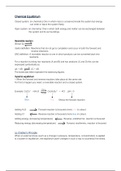
Chemical Equilibrium
Closed system: (in chemistry) One in which mass is conserved inside the system but energy
. can enter or leave the system freely.
Open system: (in chemistry) One in which both energy and matter can be exchanged between
. the system and its surroundings.
Reversible reaction
Shown by
Useful definition: Reactions that do not go to completion and occur in both the forward and
. reverse directions.
SAG definition: A reversible reaction is one in which products can be converted back into
. reactants.
For a reaction involving two reactants (A and B) and two products (C and D) this can be
expressed symbolically as:
aA + bB cC + dD
The lowercase letter represent the balancing figures.
Dynamic equilibrium
= When the forward and reverse reactions take place at the same rate
For this to happen you need: a reversible reaction and a closed system.
Exo
Example: CoCl42- + 6H2O Co(H20)62+ + 4Cl- ; ∆H < 0
Endo
Blue Pink Shows the forward reaction
Adding H2O Forward reaction is favoured (more pink in colour)
Adding Cl- Reverse reaction is favoured (more blue in colour)
Adding energy (increasing temperature) Reverse, endothermic, reaction is favoured
Reducing energy (decreasing temperature) Forward, exothermic, reaction is favoured
Le Chatlier’s Principle
When an external stress (such as a change in pressure, temperature, concentration) is applied
to a system in equilibrium, the equilibrium point changes in such a way to counteract the stress.
, Factors that affect chemical equilibrium position
= Temperature, pressure and concentration
Not surface area and the addition of a catalyst.
Graphs
Example: The reaction has reached equilibrium in a sealed 1dm3 container at a specific
temperature.
N2(g) + 3H2(g) 2NH3
One molecule represents one mol.
H2
N2
NH3
At time = 0 minutes At time = 7 minutes
Type 1: Concentration or mol vs time
14
12
Concentration or number of mol
10
8
H2
N2
6
NH3
4
2
1 2 3 4 5 6 7 8 9 10
Time
A reactant starts high and then lowers.
A product starts low and ends higher.
The gradient represents the rate of the reaction.
, Type 2: Rate vs time
Forward
Reaction rate
Dynamic equilibrium
Reverse
1 2 3 4 5 6 7 8 9 10
Time
Joint example:
Closed system: (in chemistry) One in which mass is conserved inside the system but energy
. can enter or leave the system freely.
Open system: (in chemistry) One in which both energy and matter can be exchanged between
. the system and its surroundings.
Reversible reaction
Shown by
Useful definition: Reactions that do not go to completion and occur in both the forward and
. reverse directions.
SAG definition: A reversible reaction is one in which products can be converted back into
. reactants.
For a reaction involving two reactants (A and B) and two products (C and D) this can be
expressed symbolically as:
aA + bB cC + dD
The lowercase letter represent the balancing figures.
Dynamic equilibrium
= When the forward and reverse reactions take place at the same rate
For this to happen you need: a reversible reaction and a closed system.
Exo
Example: CoCl42- + 6H2O Co(H20)62+ + 4Cl- ; ∆H < 0
Endo
Blue Pink Shows the forward reaction
Adding H2O Forward reaction is favoured (more pink in colour)
Adding Cl- Reverse reaction is favoured (more blue in colour)
Adding energy (increasing temperature) Reverse, endothermic, reaction is favoured
Reducing energy (decreasing temperature) Forward, exothermic, reaction is favoured
Le Chatlier’s Principle
When an external stress (such as a change in pressure, temperature, concentration) is applied
to a system in equilibrium, the equilibrium point changes in such a way to counteract the stress.
, Factors that affect chemical equilibrium position
= Temperature, pressure and concentration
Not surface area and the addition of a catalyst.
Graphs
Example: The reaction has reached equilibrium in a sealed 1dm3 container at a specific
temperature.
N2(g) + 3H2(g) 2NH3
One molecule represents one mol.
H2
N2
NH3
At time = 0 minutes At time = 7 minutes
Type 1: Concentration or mol vs time
14
12
Concentration or number of mol
10
8
H2
N2
6
NH3
4
2
1 2 3 4 5 6 7 8 9 10
Time
A reactant starts high and then lowers.
A product starts low and ends higher.
The gradient represents the rate of the reaction.
, Type 2: Rate vs time
Forward
Reaction rate
Dynamic equilibrium
Reverse
1 2 3 4 5 6 7 8 9 10
Time
Joint example:


