

Chemical Bonding
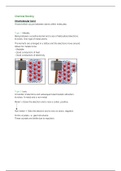
Intramolecular bond
A bond which occurs between atoms within molecules.
Type 1: Metallic
Being between a positive kernel and a sea of delocalised electrons.
Involves: One type of metal atoms
The kernel’s are arranged in a lattice and the electrons move around.
Allows for metals to be:
- Mailable
- Good conductors of heat
- Good conductors of electricity
Type 2: Ionic
A transfer of electrons and subsequent electrostatic attraction.
Involves: A metal and a non-metal
Metal → Gives the electron and is now a cation, positive.
Non-metal → Gets the electron and is now an anion, negative.
Forms crystals, i.e. giant structures.
These crystals are brittle due to repulsion.
, Type 3: Covalent
A sharing of at least one pair of electrons by two non-metal atoms.
Involves: Two non-metals
Results in molecules, small groups of atoms.
May be:
- Small molecules
- Giant molecules, i.e. Network covalent structures
- Examples - Diamond, Graphite, Quartz sand
Type of covalent:
- Single, Example H2O
- Double, Example O2
- Trible, Example N2
- Dative or coordinate
- When one atom brings a one pair and the other brings no electrons, to form a bond.
Example: Ammonia and Hydrogen Ion
NH3 H+
H X•
. H N ••
X
• [ H ]+
X•
. H
+
H
[
.
X•
H N• •• H
X
[ = NH4 (Ammonium Ion)
•
X
. H
Intramolecular bond
A bond which occurs between atoms within molecules.
Type 1: Metallic
Being between a positive kernel and a sea of delocalised electrons.
Involves: One type of metal atoms
The kernel’s are arranged in a lattice and the electrons move around.
Allows for metals to be:
- Mailable
- Good conductors of heat
- Good conductors of electricity
Type 2: Ionic
A transfer of electrons and subsequent electrostatic attraction.
Involves: A metal and a non-metal
Metal → Gives the electron and is now a cation, positive.
Non-metal → Gets the electron and is now an anion, negative.
Forms crystals, i.e. giant structures.
These crystals are brittle due to repulsion.
, Type 3: Covalent
A sharing of at least one pair of electrons by two non-metal atoms.
Involves: Two non-metals
Results in molecules, small groups of atoms.
May be:
- Small molecules
- Giant molecules, i.e. Network covalent structures
- Examples - Diamond, Graphite, Quartz sand
Type of covalent:
- Single, Example H2O
- Double, Example O2
- Trible, Example N2
- Dative or coordinate
- When one atom brings a one pair and the other brings no electrons, to form a bond.
Example: Ammonia and Hydrogen Ion
NH3 H+
H X•
. H N ••
X
• [ H ]+
X•
. H
+
H
[
.
X•
H N• •• H
X
[ = NH4 (Ammonium Ion)
•
X
. H


