

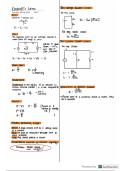
EEE1007 Study notes
This bundle is a must-have for any student looking to build a strong foundation in circuit theory. From fundamental laws to advanced analysis techniques and component behavior, these notes provide clear, step-by-step explanations and solved examples for every key topic. The clean, handwritten format is designed for easy reading and quick revision. What you will find in this comprehensive bundle: 1. Foundational Concepts & Circuit Laws: Kirchhoff's Laws (KCL & KVL): A clear breakdown of the fundamental principles for analyzing any circuit. Ohm's Law, Power, and Conductance: Essential definitions and formulas with practical context. Network Topology: Learn the language of circuits with definitions for nodes, branches, and loops. 2. Core Circuit Analysis Techniques: Nodal Analysis: A complete, step-by-step guide to solving circuits using the nodal voltage method, including a detailed example with a Supernode. Mesh Analysis: Master the mesh current method with solved examples and an explanation of the Supermesh concept. Superposition Theorem: Learn how to analyze circuits with multiple independent sources by considering each source individually. 3. Circuit Simplification Theorems: Thevenin's Theorem: Simplify any linear circuit into a single voltage source and a series resistance 4. Time-Domain Circuit Analysis (First-Order Circuits): RL and RC Circuits: A deep dive into the behavior of first-order circuits, including the source-free response and the step response. The Unit Step Function: Understand this critical tool for modeling abrupt changes in circuit inputs. 5. AC Steady-State Analysis & Phasors: Sinusoids and Phasors: A graphical and mathematical approach to understanding sinusoidal signals. Learn how to convert between time-domain and phasor-domain representations. Impedance & Admittance: Define and apply these key concepts for resistors, inductors, and capacitors in the frequency domain. Graphical Approach to Phasors: A visual method for determining which signal "leads" or "lags" another. 6. Component-Specific Information: Inductors: Learn the characteristics of inductors, including their energy storage properties and series/parallel equivalent circuits. Op-Amps: Detailed notes on the ideal characteristics of operational amplifiers and their pin configurations.
Document information
- Uploaded on
- September 16, 2025
- Number of pages
- 14
- Written in
- 2024/2025
- Type
- Other
- Person
- Unknown


