

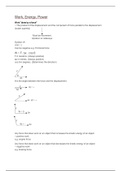
Work, Energy, Power
Work “done by a force”
= The product of the displacement and the component of force parallel to the displacement
(scalar quantity)
Must be movement.
Up/down or sideways.
Symbol: W
Unit = J
Can be negative e.g. Frictional force
W = F. ∆x . cos θ
F in newtons. (Always positive)
∆x in metres. (Always positive)
cos θ in degrees. (Determines the direction)
F
θ
∆x
θ is the angle between the force and the displacement.
F W=+
∆x
F
∆x W = +
F
W=0 ∆x
F
W=- ∆x
Any force that does work on an object that increases the kinetic energy of an object
= positive work
e.g. engine force
Any force that does work on an object that decreases the kinetic energy of an object
= negative work
e.g. braking force
, Work example
2kg is pulled 12m horizontally by a 10N force. There is a notable 3N frictional force.
FN
Fnet = 7N
∆x
F = 10N
Ff = 3N
Fg
WFg = Fg . ∆x . cosθ or Wnet = Fnet . ∆x . cosθ
.. = Fg . ∆x . cos(90°) = 7 x 12 x cos(0)
.. = 0 J = 7 x 12 x 1
.. = 84 J
WFN = FN. ∆x . cosθ
.. = FN . ∆x . cos(90°)
.. = 19.6 x 12 x 0
.. = 0 J
WF = F. ∆x . cosθ
.. = F. ∆x . cos(0°)
.. = 10 x 12 x 1
.. = 120 J
WFf = Ff. ∆x . cosθ
.. = F. ∆x . cos(180°)
.. = 3 x 12 x -1
.. = -36 J
Wnet = 0 + 0 + 120 + (-36)
.. = 84 J
Or
∆Ek = Ekf – Eki
Vf = ??
Vi = 4
Δx = 12
a= Fnet = ma
.. 7=2xa
.. .. a = 3.5
Vf2 = Vi2 + 2aΔx
… = (4)2 + 2(3.5)(12)
.. = 100
Vf = 10 m/s
Work “done by a force”
= The product of the displacement and the component of force parallel to the displacement
(scalar quantity)
Must be movement.
Up/down or sideways.
Symbol: W
Unit = J
Can be negative e.g. Frictional force
W = F. ∆x . cos θ
F in newtons. (Always positive)
∆x in metres. (Always positive)
cos θ in degrees. (Determines the direction)
F
θ
∆x
θ is the angle between the force and the displacement.
F W=+
∆x
F
∆x W = +
F
W=0 ∆x
F
W=- ∆x
Any force that does work on an object that increases the kinetic energy of an object
= positive work
e.g. engine force
Any force that does work on an object that decreases the kinetic energy of an object
= negative work
e.g. braking force
, Work example
2kg is pulled 12m horizontally by a 10N force. There is a notable 3N frictional force.
FN
Fnet = 7N
∆x
F = 10N
Ff = 3N
Fg
WFg = Fg . ∆x . cosθ or Wnet = Fnet . ∆x . cosθ
.. = Fg . ∆x . cos(90°) = 7 x 12 x cos(0)
.. = 0 J = 7 x 12 x 1
.. = 84 J
WFN = FN. ∆x . cosθ
.. = FN . ∆x . cos(90°)
.. = 19.6 x 12 x 0
.. = 0 J
WF = F. ∆x . cosθ
.. = F. ∆x . cos(0°)
.. = 10 x 12 x 1
.. = 120 J
WFf = Ff. ∆x . cosθ
.. = F. ∆x . cos(180°)
.. = 3 x 12 x -1
.. = -36 J
Wnet = 0 + 0 + 120 + (-36)
.. = 84 J
Or
∆Ek = Ekf – Eki
Vf = ??
Vi = 4
Δx = 12
a= Fnet = ma
.. 7=2xa
.. .. a = 3.5
Vf2 = Vi2 + 2aΔx
… = (4)2 + 2(3.5)(12)
.. = 100
Vf = 10 m/s


