

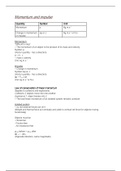
Momentum and impulse
Quantity Symbol Unit
Momentum p Kg.m.s-1
Change in momentum ∆p or J Kg.m.s-1 or N.s
or impulse
Momentum
“Difficult to stop”
= The momentum of an object is the product of its mass and velocity
Symbol: p
(Vector quantity - has a direction)
p=m.v
= mass x velocity
Unit: kg.m.s-1
Impulse
= Change in momentum
Symbol: ∆p or J
(Vector quantity - has a direction)
∆p = Fnet x ∆t
Unit: kg.m.s-1 or N.s
Law of conservation of linear momentum
(Applies to collisions and explosions)
Collisions: 2 objects move into one another
Explosions: 1 object breaks into 2
= The total linear momentum of an isolated system remains constant
Isolated system
= no net external forces act on it
(Weight and Normal force act vertically and yield no vertical net force for objects moving
horizontally)
Objects must be:
- Horizontal
- Friction free
- Air resistance free
ptotal before = ptotal after
∆p a = - ∆p b
(Opposite direction, same magnitude)
, e.g. of collision
A small car, with a mass of 1084kg, is moving east on a road travelling at 33 m/s.
A large SUV, with a mass of 3437kg, is moving west on a road travelling at 28 m/s.
The 2 vehicles collide head on. (Friction can be ignored)
Immediately after the collision, the small car is moving west at 15 m/s.
Determine the velocity of the SUV immediately after the collision.
Before + After
V = + 33 V = - 28 V = - 15 V=?
car SUV car SUV
m = 1084 kg m = 3437 kg m = 1084 kg m = 3437 kg
ptotal before = ptotal after
m.v + m.v = m.v + m.v
(1084)(33) + (3437)(-28) = (1084)(-15) + (3437).v
-60 464 = -16 240 + 3437.v
v = - 12. 86121
v = 12.86 m/s west
e.g. of explosion
A cannon, with a mass of 700 kg, recoils at 4 m/s when it shoots a cannon ball, with a mass of 5
kg, horizontally.
Determine the velocity of the cannon ball as it leaves the cannon.
Before + After
V=0 V=-4 V=?
car SUV
m = 700 + 5 kg m = 700 kg m = 5 kg
ptotal before = ptotal after
m.v = m.v + m.v
(705)(00) = (700)(- 4) + (5).v
0 = -2800 + 5.v
v = 560 m/s right
Steps:
1. Diagram of both objects, including masses (before and after)
2. Chose a positive direction
3. Add in velocities, based on positive direction
4. Apply the law of conservation of linear momentum
5. Sub and solve
6. Interpret answer and include direction
Quantity Symbol Unit
Momentum p Kg.m.s-1
Change in momentum ∆p or J Kg.m.s-1 or N.s
or impulse
Momentum
“Difficult to stop”
= The momentum of an object is the product of its mass and velocity
Symbol: p
(Vector quantity - has a direction)
p=m.v
= mass x velocity
Unit: kg.m.s-1
Impulse
= Change in momentum
Symbol: ∆p or J
(Vector quantity - has a direction)
∆p = Fnet x ∆t
Unit: kg.m.s-1 or N.s
Law of conservation of linear momentum
(Applies to collisions and explosions)
Collisions: 2 objects move into one another
Explosions: 1 object breaks into 2
= The total linear momentum of an isolated system remains constant
Isolated system
= no net external forces act on it
(Weight and Normal force act vertically and yield no vertical net force for objects moving
horizontally)
Objects must be:
- Horizontal
- Friction free
- Air resistance free
ptotal before = ptotal after
∆p a = - ∆p b
(Opposite direction, same magnitude)
, e.g. of collision
A small car, with a mass of 1084kg, is moving east on a road travelling at 33 m/s.
A large SUV, with a mass of 3437kg, is moving west on a road travelling at 28 m/s.
The 2 vehicles collide head on. (Friction can be ignored)
Immediately after the collision, the small car is moving west at 15 m/s.
Determine the velocity of the SUV immediately after the collision.
Before + After
V = + 33 V = - 28 V = - 15 V=?
car SUV car SUV
m = 1084 kg m = 3437 kg m = 1084 kg m = 3437 kg
ptotal before = ptotal after
m.v + m.v = m.v + m.v
(1084)(33) + (3437)(-28) = (1084)(-15) + (3437).v
-60 464 = -16 240 + 3437.v
v = - 12. 86121
v = 12.86 m/s west
e.g. of explosion
A cannon, with a mass of 700 kg, recoils at 4 m/s when it shoots a cannon ball, with a mass of 5
kg, horizontally.
Determine the velocity of the cannon ball as it leaves the cannon.
Before + After
V=0 V=-4 V=?
car SUV
m = 700 + 5 kg m = 700 kg m = 5 kg
ptotal before = ptotal after
m.v = m.v + m.v
(705)(00) = (700)(- 4) + (5).v
0 = -2800 + 5.v
v = 560 m/s right
Steps:
1. Diagram of both objects, including masses (before and after)
2. Chose a positive direction
3. Add in velocities, based on positive direction
4. Apply the law of conservation of linear momentum
5. Sub and solve
6. Interpret answer and include direction


