The neutrality of money
Over time, the price level increases, and the effects of a monetary expansion on output and on the interest
rate disappear.
Also known as the neutrality of money.
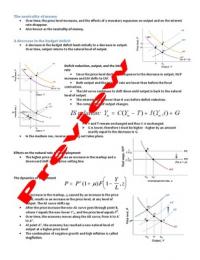
A decrease in the budget deficit
A decrease in the budget deficit leads initially to a decrease in output.
Over time, output returns to the natural level of output.
Deficit reduction, output, and the interest
rate
Since the price level declines in response to the decrease in output, M/P
increases and LM shifts to LM’.
Both output and the interest rate are lower than before the fiscal
contraction.
The LM curve continues to shift down until output is back to the natural
level of output.
The interest rate is lower than it was before deficit reduction.
The composition of output changes.
Y and T remain unchanged and thus C is unchanged.
G is lower; therefore I must be higher - higher by an amount
exactly equal to the decrease in G.
In the medium run, reverse crowding out takes place.
Effects on the natural rate of unemployment
The higher price of oil causes an increase in the markup and a
downward shift of the price-setting line.
The dynamics of adjustment
Y
P P (1 ) F 1 , z
e
L
An increase in the markup, ,caused by an increase in the price
of oil, results in an increase in the price level, at any level of
output. The AS curve shifts up.
After the price increase the new AS curve goes through point B,
where Y equals the new lower Y'n, and the price level equals Pe.
Over time, the economy moves along the AD curve, from A to A’
to A”.
At point A”, the economy has reached a new natural level of
output at a higher price level
The combination of negative growth and high inflation is called
stagflation.
,Chapter 6 - Labour Market
The working-age population is the number of people between the ages of 15 and 65.
The workforce is all working age who are willing to work.
In South Africa there are two definitions of the labour force used:
According to the broad definition, the labour force includes all that say they
would accept a "proper job".
According to the narrow definition, the labour force consists of everyone who
actively sought work in the previous 4 weeks
Those who are neither able nor willing to work are out of the labour force (economically inactive).
The participation rate is the ratio of the labour force to the population of working age.
The unemployment rate is the ratio of the unemployed to the labour force.
Changes in unemployment
Fluctuations in the aggregate unemployment rate affects:
The welfare of individual workers
Wages (w)
Higher unemployment affects workers:
Decline in new appointments make it harder for the unemployed to find a job.
More people are fired, the risk of working people to lose jobs increases.
Wage Determination
We consider two theories of wage determination:
Collective bargaining
o Collective bargaining is bargaining between firms and unions.
o Firms want to keep costs (wages) low, whereas workers want to increase income (wages).
o Determined wages will be higher when unions have more bargaining power, and lower if unions
have less bargaining power.
o The bargaining power of workers depend on
how difficult it would be for a worker to find a different job, and
how difficult it would be for firms to find new workers
o Unemployment rate is high = workers little bargaining power = wages tend to be lower
Bargaining power depends on two factors
o Nature of the profession
o Labour market conditions
o Key concept - the reservation wage
the wage where a worker is indifferent whether to work or not
Efficiency Wages
Efficiency wage theories link the productivity or the efficiency of workers to the wage they are
paid.
The higher the unemployment rate in the economy, the harder workers will work (because they
are scared of losing their jobs).
Workers who are paid higher wages are more likely to work hard.
When unemployment is high, firms can employ workers at a very low wage. If unemployment is
low, firms must pay a very high wage to ensure that workers are productive.
Both theories state that wages will be lower when the unemployment rate is high.
, Economics 214: Macro
Summary for Exam
Chapters 0-8
Chapter 0
Industrial revolution changed everything. Income per
person grew exponentially since 1700s.
Macro economy can be divided into growth
theory and business cycle theory.
Growth theory
Growth theory is the long-term growth rate of
the economy
214 Macro focus not on long-term, rather on:
short and medium run fluctuations in
trends (business cycle theory)
Accumulation of factors of production will
increase this growth rate:
o Labour
o Capital
o Technology
o Natural Resources
Extensive research indicates that higher LT output growth per capita can be achieved by:
Responsible economic policy implementation:
o Inflation under control
o Debt / budget deficit under control
o Encouraging high investment rates
o Educated / healthy workforce
o Open to international trade
o Strong financial sector
Good institutions:
o Private property rights
o Democratic institutions
o Business-friendly regulations
o Protection against rent-seeking
Element of luck:
o Neighbouring countries that grow fast
o Having a coastline
o Not located in the tropics
Other:
o Low population growth
Over time, the price level increases, and the effects of a monetary expansion on output and on the interest
rate disappear.
Also known as the neutrality of money.
A decrease in the budget deficit
A decrease in the budget deficit leads initially to a decrease in output.
Over time, output returns to the natural level of output.
Deficit reduction, output, and the interest
rate
Since the price level declines in response to the decrease in output, M/P
increases and LM shifts to LM’.
Both output and the interest rate are lower than before the fiscal
contraction.
The LM curve continues to shift down until output is back to the natural
level of output.
The interest rate is lower than it was before deficit reduction.
The composition of output changes.
Y and T remain unchanged and thus C is unchanged.
G is lower; therefore I must be higher - higher by an amount
exactly equal to the decrease in G.
In the medium run, reverse crowding out takes place.
Effects on the natural rate of unemployment
The higher price of oil causes an increase in the markup and a
downward shift of the price-setting line.
The dynamics of adjustment
Y
P P (1 ) F 1 , z
e
L
An increase in the markup, ,caused by an increase in the price
of oil, results in an increase in the price level, at any level of
output. The AS curve shifts up.
After the price increase the new AS curve goes through point B,
where Y equals the new lower Y'n, and the price level equals Pe.
Over time, the economy moves along the AD curve, from A to A’
to A”.
At point A”, the economy has reached a new natural level of
output at a higher price level
The combination of negative growth and high inflation is called
stagflation.
,Chapter 6 - Labour Market
The working-age population is the number of people between the ages of 15 and 65.
The workforce is all working age who are willing to work.
In South Africa there are two definitions of the labour force used:
According to the broad definition, the labour force includes all that say they
would accept a "proper job".
According to the narrow definition, the labour force consists of everyone who
actively sought work in the previous 4 weeks
Those who are neither able nor willing to work are out of the labour force (economically inactive).
The participation rate is the ratio of the labour force to the population of working age.
The unemployment rate is the ratio of the unemployed to the labour force.
Changes in unemployment
Fluctuations in the aggregate unemployment rate affects:
The welfare of individual workers
Wages (w)
Higher unemployment affects workers:
Decline in new appointments make it harder for the unemployed to find a job.
More people are fired, the risk of working people to lose jobs increases.
Wage Determination
We consider two theories of wage determination:
Collective bargaining
o Collective bargaining is bargaining between firms and unions.
o Firms want to keep costs (wages) low, whereas workers want to increase income (wages).
o Determined wages will be higher when unions have more bargaining power, and lower if unions
have less bargaining power.
o The bargaining power of workers depend on
how difficult it would be for a worker to find a different job, and
how difficult it would be for firms to find new workers
o Unemployment rate is high = workers little bargaining power = wages tend to be lower
Bargaining power depends on two factors
o Nature of the profession
o Labour market conditions
o Key concept - the reservation wage
the wage where a worker is indifferent whether to work or not
Efficiency Wages
Efficiency wage theories link the productivity or the efficiency of workers to the wage they are
paid.
The higher the unemployment rate in the economy, the harder workers will work (because they
are scared of losing their jobs).
Workers who are paid higher wages are more likely to work hard.
When unemployment is high, firms can employ workers at a very low wage. If unemployment is
low, firms must pay a very high wage to ensure that workers are productive.
Both theories state that wages will be lower when the unemployment rate is high.
, Economics 214: Macro
Summary for Exam
Chapters 0-8
Chapter 0
Industrial revolution changed everything. Income per
person grew exponentially since 1700s.
Macro economy can be divided into growth
theory and business cycle theory.
Growth theory
Growth theory is the long-term growth rate of
the economy
214 Macro focus not on long-term, rather on:
short and medium run fluctuations in
trends (business cycle theory)
Accumulation of factors of production will
increase this growth rate:
o Labour
o Capital
o Technology
o Natural Resources
Extensive research indicates that higher LT output growth per capita can be achieved by:
Responsible economic policy implementation:
o Inflation under control
o Debt / budget deficit under control
o Encouraging high investment rates
o Educated / healthy workforce
o Open to international trade
o Strong financial sector
Good institutions:
o Private property rights
o Democratic institutions
o Business-friendly regulations
o Protection against rent-seeking
Element of luck:
o Neighbouring countries that grow fast
o Having a coastline
o Not located in the tropics
Other:
o Low population growth