KRM 310 Chapter 9
Erin Polyblank
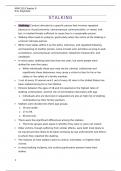
STALKING
Stalking: Conduct directed at a specific person that involves repeated
physical or visual proximity, nonconsensual communication, or verbal, writ-
ten, or implied threats sufficient to cause fear in a reasonable person.
Stalking often leads to violence, particularly when the victim of the stalking is
a former intimate partner.
While most states define it as the wilful, malicious, and repeated following
and harassing of another person, some include such activities as lying-in-wait,
surveillance, nonconsensual communication, telephone harassment, and
vandalism.
In most cases, stalking lasts less than one year, but some people were
stalked for over five years.
o While individually these acts may not be criminal, collectively and
repetitively these behaviours may cause a victim to fear for his or her
safety or the safety of a family member.
1 out of every 12 women and 1 out of every 45 men in the United States has
been stalked during his or her lifetime.
Persons between the ages of 18 and 24 experience the highest rates of
stalking victimization, and the risk of victimization decreases with age.
o Individuals who are divorced or separated are also at high risk of stalking
victimization by their former partners.
Stalkers were divided into three age groups:
o 16 and under.
o 17 to 59.
o 60 and over.
There were few significant differences among the stalkers.
o The three groups were equal in whether they were or were not violent.
Older victims, though suffering from similar effects, were both most likely to
be injured and less likely to be taken seriously by law enforcement and others
to whom they reported the stalking.
The motives of most stalkers were to control, intimidate, or frighten their
victims.
In most stalking incidents, the victims (particularly women) knew their
stalker.
1
,KRM 310 Chapter 9
Erin Polyblank
About 1 in 10 victims were stalked by a stranger.
o In about one-third of the cases, stalkers vandalized the victim’s property,
and about 10% of the time, the stalker killed or threatened to kill the
victim’s pet.
Half of all victims reported the stalking to the police, and about one-quarter of
the female victims obtained a restraining order.
o 70% of all restraining orders were violated by the assailant.
Although most of the stalking stopped within two years, the emotional and
social effects of being stalked continued for many victims long after the
incident.
o About one-third of the stalking victims sought psychological treatment
because of the emotional and social trauma that resulted from the
stalking episodes.
Stalkers rarely cause serious physical injury to their victims, threaten them
with weapons, or use weapons.
Victims were often injured:
o 29% of victims of the mid-group of stalkers (ages 17–59) were injured.
o 43.1% of victims of older stalkers (60 and over) were injured.
o About half of the younger stalker group (under 17) threatened their
victims physically, though just over 7% of their victims were injured.
CATEGORIES OF STALKING
The four-category classification proposed by Beatty (2001) :
1. Simple obsession stalking: The form in which the stalker seeks power
and control after a failed relationship with the victim; often associated
with past domestic violence.
- Accounts for the majority of stalking.
- Perhaps the most dangerous to the victim since it is often motivated by
the stalker’s conclusion that “If I can’t have you, nobody will.”
2. Love obsession stalking: The stalker and victim are strangers or casual
acquaintances.
- The stalker seeks a love relationship with the object of his or her
obsession.
2
, KRM 310 Chapter 9
Erin Polyblank
- Characterized by low self-esteem and tend to select victims they
perceive to have certain qualities they believe will raise their self-
esteem.
3. Erotomania stalking: The stalker usually has serious mental disorders
and is considered delusional.
- Public figures are typically the targets.
- Appears to be relatively rare, and normally the stalker is not violent.
4. Vengeance stalking: Stalkers do not seek a relationship with their
victims but rather are trying to elicit a response or change of behaviour
from the victim.
Other researchers have classified stalkers according to their relationship with
the victim.
o Intimate stalkers.
o Acquaintance stalkers.
o Public figure stalkers.
o Private stranger stalkers.
CYBERSTALKING
Cyberstalking: Threatening behaviour or unwanted advances directed at
another using the Internet or other forms of on-line communications.
Cyberharassment: Sending messages electronically to torment another
person.
o Compared with cyberstalking, not considered a credible threat when
statutes distinguish between the two.
o Pertains to threatening or harassing email messages, instant messages or
blog entries, or websites dedicated solely to tormenting an individual.
Although harassment is a milder form of behaviour and generally subject to
lesser criminal penalties, the effect on the recipient may be substantial, and
from a psychological perspective there is little difference between the two
activities.
Online and electronic stalking and harassment may take many forms, but in
many ways they are similar to offline stalking.
3
Erin Polyblank
STALKING
Stalking: Conduct directed at a specific person that involves repeated
physical or visual proximity, nonconsensual communication, or verbal, writ-
ten, or implied threats sufficient to cause fear in a reasonable person.
Stalking often leads to violence, particularly when the victim of the stalking is
a former intimate partner.
While most states define it as the wilful, malicious, and repeated following
and harassing of another person, some include such activities as lying-in-wait,
surveillance, nonconsensual communication, telephone harassment, and
vandalism.
In most cases, stalking lasts less than one year, but some people were
stalked for over five years.
o While individually these acts may not be criminal, collectively and
repetitively these behaviours may cause a victim to fear for his or her
safety or the safety of a family member.
1 out of every 12 women and 1 out of every 45 men in the United States has
been stalked during his or her lifetime.
Persons between the ages of 18 and 24 experience the highest rates of
stalking victimization, and the risk of victimization decreases with age.
o Individuals who are divorced or separated are also at high risk of stalking
victimization by their former partners.
Stalkers were divided into three age groups:
o 16 and under.
o 17 to 59.
o 60 and over.
There were few significant differences among the stalkers.
o The three groups were equal in whether they were or were not violent.
Older victims, though suffering from similar effects, were both most likely to
be injured and less likely to be taken seriously by law enforcement and others
to whom they reported the stalking.
The motives of most stalkers were to control, intimidate, or frighten their
victims.
In most stalking incidents, the victims (particularly women) knew their
stalker.
1
,KRM 310 Chapter 9
Erin Polyblank
About 1 in 10 victims were stalked by a stranger.
o In about one-third of the cases, stalkers vandalized the victim’s property,
and about 10% of the time, the stalker killed or threatened to kill the
victim’s pet.
Half of all victims reported the stalking to the police, and about one-quarter of
the female victims obtained a restraining order.
o 70% of all restraining orders were violated by the assailant.
Although most of the stalking stopped within two years, the emotional and
social effects of being stalked continued for many victims long after the
incident.
o About one-third of the stalking victims sought psychological treatment
because of the emotional and social trauma that resulted from the
stalking episodes.
Stalkers rarely cause serious physical injury to their victims, threaten them
with weapons, or use weapons.
Victims were often injured:
o 29% of victims of the mid-group of stalkers (ages 17–59) were injured.
o 43.1% of victims of older stalkers (60 and over) were injured.
o About half of the younger stalker group (under 17) threatened their
victims physically, though just over 7% of their victims were injured.
CATEGORIES OF STALKING
The four-category classification proposed by Beatty (2001) :
1. Simple obsession stalking: The form in which the stalker seeks power
and control after a failed relationship with the victim; often associated
with past domestic violence.
- Accounts for the majority of stalking.
- Perhaps the most dangerous to the victim since it is often motivated by
the stalker’s conclusion that “If I can’t have you, nobody will.”
2. Love obsession stalking: The stalker and victim are strangers or casual
acquaintances.
- The stalker seeks a love relationship with the object of his or her
obsession.
2
, KRM 310 Chapter 9
Erin Polyblank
- Characterized by low self-esteem and tend to select victims they
perceive to have certain qualities they believe will raise their self-
esteem.
3. Erotomania stalking: The stalker usually has serious mental disorders
and is considered delusional.
- Public figures are typically the targets.
- Appears to be relatively rare, and normally the stalker is not violent.
4. Vengeance stalking: Stalkers do not seek a relationship with their
victims but rather are trying to elicit a response or change of behaviour
from the victim.
Other researchers have classified stalkers according to their relationship with
the victim.
o Intimate stalkers.
o Acquaintance stalkers.
o Public figure stalkers.
o Private stranger stalkers.
CYBERSTALKING
Cyberstalking: Threatening behaviour or unwanted advances directed at
another using the Internet or other forms of on-line communications.
Cyberharassment: Sending messages electronically to torment another
person.
o Compared with cyberstalking, not considered a credible threat when
statutes distinguish between the two.
o Pertains to threatening or harassing email messages, instant messages or
blog entries, or websites dedicated solely to tormenting an individual.
Although harassment is a milder form of behaviour and generally subject to
lesser criminal penalties, the effect on the recipient may be substantial, and
from a psychological perspective there is little difference between the two
activities.
Online and electronic stalking and harassment may take many forms, but in
many ways they are similar to offline stalking.
3