

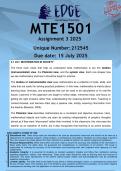
MTE1501 Assignment 3 2025
Unique Number: 212545
Due date: 15 July 2025
3.1 LU1: MATHEMATICS IN SOCIETY
The three main views that help us understand what mathematics is are the toolbox
(instrumentalist) view, the Platonist view, and the system view. Each one shapes how
we see mathematics and how it should be taught in schools.
The toolbox or instrumentalist view sees mathematics as a collection of tools, skills, and
rules that are useful for solving practical problems. In this view, mathematics is mainly about
learning facts, formulas, and procedures that can be used to do calculations or fix real-life
issues. Learners in this approach are taught to follow steps, memorise facts, and focus on
getting the right answers rather than understanding the meaning behind them. Teaching is
content-focused, and learners often play a passive role, simply receiving information from
the teacher (Beswick, 2005).
The Platonist view describes mathematics as a consistent and objective structure. Here,
mathematical objects and truths are seen as existing independently of people’s thoughts
almost as if they were “discovered” rather than invented. In the classroom, this view sees the
teacher as an explainer of truths, but it also recognises that learning is an active process
DISCLAIMER & TERMS OF USE
Educational Aid: These study notes are intended to be used as educational resources and should not be seen as a
replacement for individual research, critical analysis, or professional consultation. Students are encouraged to perform
their own research and seek advice from their instructors or academic advisors for specific assignment guidelines.
Personal Responsibility: While every effort has been made to ensure the accuracy and reliability of the information in
these study notes, the seller does not guarantee the completeness or correctness of all content. The buyer is
responsible for verifying the accuracy of the information and exercising their own judgment when applying it to their
assignments.
Academic Integrity: It is essential for students to maintain academic integrity and follow their institution's policies
regarding plagiarism, citation, and referencing. These study notes should be used as learning tools and sources of
inspiration. Any direct reproduction of the content without proper citation and acknowledgment may be considered
academic misconduct.
Limited Liability: The seller shall not be liable for any direct or indirect damages, losses, or consequences arising from
the use of these notes. This includes, but is not limited to, poor academic performance, penalties, or any other negative
consequences resulting from the application or misuse of the information provided.
, For additional support +27 81 278 3372
3.1 LU1: MATHEMATICS IN SOCIETY
The three main views that help us understand what mathematics is are the toolbox
(instrumentalist) view, the Platonist view, and the system view. Each one shapes
how we see mathematics and how it should be taught in schools.
The toolbox or instrumentalist view sees mathematics as a collection of tools,
skills, and rules that are useful for solving practical problems. In this view,
mathematics is mainly about learning facts, formulas, and procedures that can be
used to do calculations or fix real-life issues. Learners in this approach are taught to
follow steps, memorise facts, and focus on getting the right answers rather than
understanding the meaning behind them. Teaching is content-focused, and learners
often play a passive role, simply receiving information from the teacher (Beswick,
2005).
The Platonist view describes mathematics as a consistent and objective structure.
Here, mathematical objects and truths are seen as existing independently of
people’s thoughts almost as if they were “discovered” rather than invented. In the
classroom, this view sees the teacher as an explainer of truths, but it also recognises
that learning is an active process where learners build their own understanding. The
focus is on understanding mathematical ideas, seeing the connections between
them, and knowing that mathematical truths don’t change, regardless of our opinions
(Plato, 1952).
The system view sees mathematics as an organised and logical system.
Mathematics, in this view, is about building and proving statements within a set of
logical rules or axioms. The system view values the importance of reasoning, proof,
and showing why things are true, rather than just accepting facts. This approach
helps learners understand the deeper structure of mathematics, see how different
ideas are connected, and develop strong problem-solving and critical thinking skills.
In summary, the toolbox view is about using maths as practical skills, the Platonist
view sees maths as discovering unchanging truths, and the system view values
maths as a logical, deductive system where reasoning and proof are important.
3.2 LU2: TEACHING AND LEARNING MATHEMATICS
, For additional support +27 81 278 3372
3.2.1
One topic that demonstrates connections across multiple mathematics content areas
is “Fractions in Everyday Life.” This topic can be used to show knowledge and
understanding of the following three content areas: Number, Operations and
Relationships; Measurement; and Data Handling.
First, fractions are a key concept under Number, Operations and Relationships.
Learners need to understand what fractions are, how to represent them, and how to
perform basic operations like addition and subtraction of fractions. This provides a
solid number foundation (DBE, 2011).
Secondly, fractions have practical connections with Measurement. For example,
when learners use rulers marked in halves, quarters, or centimeters, or when they
measure ingredients in cooking, they encounter fractions. Activities such as dividing
a length, measuring liquids, or sharing food help learners apply fraction knowledge in
real-world measurement contexts.
Thirdly, the topic connects with Data Handling. Learners can collect data about
favourite fruits, colours, or sports, and use fractions to represent results (for
example, “half the class likes apples”). They can display this data in pie charts, which
require understanding of fractions and their visual representation.
By exploring fractions through real-life examples, learners see the relationships
between numbers, measurement, and data. These connections help them apply
mathematical thinking to different situations, deepening their understanding and
making maths more meaningful.
3.2.3
a. Representation and Number Sentences
Representation 1 (Group each box’s apples):
Each box has 5 red apples and 4 green apples, which is a total of 9 apples per box.
Since there are 7 boxes:
Number sentence:
(5 + 4) × 7 = 9 × 7 = 63
Unique Number: 212545
Due date: 15 July 2025
3.1 LU1: MATHEMATICS IN SOCIETY
The three main views that help us understand what mathematics is are the toolbox
(instrumentalist) view, the Platonist view, and the system view. Each one shapes how
we see mathematics and how it should be taught in schools.
The toolbox or instrumentalist view sees mathematics as a collection of tools, skills, and
rules that are useful for solving practical problems. In this view, mathematics is mainly about
learning facts, formulas, and procedures that can be used to do calculations or fix real-life
issues. Learners in this approach are taught to follow steps, memorise facts, and focus on
getting the right answers rather than understanding the meaning behind them. Teaching is
content-focused, and learners often play a passive role, simply receiving information from
the teacher (Beswick, 2005).
The Platonist view describes mathematics as a consistent and objective structure. Here,
mathematical objects and truths are seen as existing independently of people’s thoughts
almost as if they were “discovered” rather than invented. In the classroom, this view sees the
teacher as an explainer of truths, but it also recognises that learning is an active process
DISCLAIMER & TERMS OF USE
Educational Aid: These study notes are intended to be used as educational resources and should not be seen as a
replacement for individual research, critical analysis, or professional consultation. Students are encouraged to perform
their own research and seek advice from their instructors or academic advisors for specific assignment guidelines.
Personal Responsibility: While every effort has been made to ensure the accuracy and reliability of the information in
these study notes, the seller does not guarantee the completeness or correctness of all content. The buyer is
responsible for verifying the accuracy of the information and exercising their own judgment when applying it to their
assignments.
Academic Integrity: It is essential for students to maintain academic integrity and follow their institution's policies
regarding plagiarism, citation, and referencing. These study notes should be used as learning tools and sources of
inspiration. Any direct reproduction of the content without proper citation and acknowledgment may be considered
academic misconduct.
Limited Liability: The seller shall not be liable for any direct or indirect damages, losses, or consequences arising from
the use of these notes. This includes, but is not limited to, poor academic performance, penalties, or any other negative
consequences resulting from the application or misuse of the information provided.
, For additional support +27 81 278 3372
3.1 LU1: MATHEMATICS IN SOCIETY
The three main views that help us understand what mathematics is are the toolbox
(instrumentalist) view, the Platonist view, and the system view. Each one shapes
how we see mathematics and how it should be taught in schools.
The toolbox or instrumentalist view sees mathematics as a collection of tools,
skills, and rules that are useful for solving practical problems. In this view,
mathematics is mainly about learning facts, formulas, and procedures that can be
used to do calculations or fix real-life issues. Learners in this approach are taught to
follow steps, memorise facts, and focus on getting the right answers rather than
understanding the meaning behind them. Teaching is content-focused, and learners
often play a passive role, simply receiving information from the teacher (Beswick,
2005).
The Platonist view describes mathematics as a consistent and objective structure.
Here, mathematical objects and truths are seen as existing independently of
people’s thoughts almost as if they were “discovered” rather than invented. In the
classroom, this view sees the teacher as an explainer of truths, but it also recognises
that learning is an active process where learners build their own understanding. The
focus is on understanding mathematical ideas, seeing the connections between
them, and knowing that mathematical truths don’t change, regardless of our opinions
(Plato, 1952).
The system view sees mathematics as an organised and logical system.
Mathematics, in this view, is about building and proving statements within a set of
logical rules or axioms. The system view values the importance of reasoning, proof,
and showing why things are true, rather than just accepting facts. This approach
helps learners understand the deeper structure of mathematics, see how different
ideas are connected, and develop strong problem-solving and critical thinking skills.
In summary, the toolbox view is about using maths as practical skills, the Platonist
view sees maths as discovering unchanging truths, and the system view values
maths as a logical, deductive system where reasoning and proof are important.
3.2 LU2: TEACHING AND LEARNING MATHEMATICS
, For additional support +27 81 278 3372
3.2.1
One topic that demonstrates connections across multiple mathematics content areas
is “Fractions in Everyday Life.” This topic can be used to show knowledge and
understanding of the following three content areas: Number, Operations and
Relationships; Measurement; and Data Handling.
First, fractions are a key concept under Number, Operations and Relationships.
Learners need to understand what fractions are, how to represent them, and how to
perform basic operations like addition and subtraction of fractions. This provides a
solid number foundation (DBE, 2011).
Secondly, fractions have practical connections with Measurement. For example,
when learners use rulers marked in halves, quarters, or centimeters, or when they
measure ingredients in cooking, they encounter fractions. Activities such as dividing
a length, measuring liquids, or sharing food help learners apply fraction knowledge in
real-world measurement contexts.
Thirdly, the topic connects with Data Handling. Learners can collect data about
favourite fruits, colours, or sports, and use fractions to represent results (for
example, “half the class likes apples”). They can display this data in pie charts, which
require understanding of fractions and their visual representation.
By exploring fractions through real-life examples, learners see the relationships
between numbers, measurement, and data. These connections help them apply
mathematical thinking to different situations, deepening their understanding and
making maths more meaningful.
3.2.3
a. Representation and Number Sentences
Representation 1 (Group each box’s apples):
Each box has 5 red apples and 4 green apples, which is a total of 9 apples per box.
Since there are 7 boxes:
Number sentence:
(5 + 4) × 7 = 9 × 7 = 63



