Chapter 12
Income Inequality and
Poverty
FACTS ABOUT INCOME INEQUALITY
Income inequality in SA is among the highest in the world
Distribution by income category
A way to measure income inequality is to divide the total number of individuals, households or families into 10
numerically equal groups, or deciles, and examine the percentage of total (before-tax) income received by
each decile
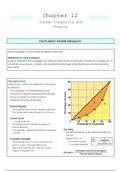
The Lorenz Curve
Lorenz Curve - shows the distribution of income in
an economy
- The cumulative % of households (income
receivers) is measured along the horizontal axis
- The accumulated % of their income is
measured along the vertical axis
- Perfect Equality:
- Each point along the line 0e indicates a particular
% of households receive the same % of income
- Lorenz Curve:
Actual distribution
- The orange area (A) indicates the degree of
income inequality
- If no inequality - diagonal and Lorenz curve would Gini Ratio
coincide - Numerical measure of the overall dispersion of
income
- Complete Inequality: - Values from 0 to 1
- Horizontal axis from 0 to point f and then from - 0: complete equality
point f to point e along the vertical axis - 1: complete inequality
- Where all households but 1 has zero income
- Degree of inequality: 0ef
,Income Mobility
- Movement of individuals or households from one income decile to another over time
- Usually, income starts at a relatively low level, reaches a peak during middle age and then declines
- If we change the Lorenz curve from “snapshot” for one year, to an overtime picture - considerable
movement of income receivers among income classes
Effect of Government Redistribution
Government redistributes tax in SA through its progressive income tax system where an individual will pay a
higher percentage of its income in tax if it earns more income
CAUSES OF INCOME INEQUALITY
- Ability - Unequal distribution of wealth
- Education and training - Market power
- Discrimination - Luck, connections and misfortune
- Preferences and risks
Causes of Growing Inequality
- Greater demand for highly skilled workers
- Computer software, business consulting, biotechnology, health care and internet industries
- High-skilled workers remain scarce - their wages are bid up - consequently the wage difference increases
- Demographic changes
- Because of sudden openness in the markets after 1994 in SA, more people from all races were appointed different
jobs with different income levels. Prior to 1994 most South Africans had limited access to the job market
- International trade and immigration
- Stronger international competition from imports has reduced the demand for and employment of less-skilled (but
highly paid) workers in industries as the automobile and steel industries
- First caution - both the rich and the poor experience rises in real income - incomes have risen in all deciles, income
growth has been the fastest in the top decile
- Second caution - increased income inequality is not solely a SA phenomenon
, EQUALITY VS EFFICIENCY
The case for Equality: Maximising Total Utility
Income equality maximises total consumer satisfaction (utility) from any particular level of output and income
The case for Inequality: Incentives and Efficiency
The way in which income is distributed is an important determinant of the amount of output or income that is
produced and is available for distribution
The Equality-Efficiency Tradeoff
- Income equality-inequality debate is a trade-off between equality and efficiency
- Greater income equality comes at the opportunity cost of reduced production and income
- Greater production and income comes at the expense of less equality of income
, THE ECONOMICS OF POVERTY
What is poverty?
- A condition in which a person or a family does not have the means to satisfy basic needs for food, clothing,
shelter and transportation
- Means include earned income, transfer payments, past savings and property owned
- Determinants of basic needs: family size, health and age of its members
Incidence of Poverty
- Poor are heterogeneous: found in all parts of the nation, all races and ethnicities, rural and urban, young
and old
- The actual proportion of people living in poverty has not changed drastically in SA but those living in
poverty have sunk deeper into poverty and the gap between rich and poor has widened
WHAT IS THE GOVERNMENT DOIING TO CHANGE THE SITUATION?
- Social programmes - Unemployment compensation
- Old age pension - UIF
- Disability pension
- Grants - Public works programmes
- Work for water
Income Inequality and
Poverty
FACTS ABOUT INCOME INEQUALITY
Income inequality in SA is among the highest in the world
Distribution by income category
A way to measure income inequality is to divide the total number of individuals, households or families into 10
numerically equal groups, or deciles, and examine the percentage of total (before-tax) income received by
each decile
The Lorenz Curve
Lorenz Curve - shows the distribution of income in
an economy
- The cumulative % of households (income
receivers) is measured along the horizontal axis
- The accumulated % of their income is
measured along the vertical axis
- Perfect Equality:
- Each point along the line 0e indicates a particular
% of households receive the same % of income
- Lorenz Curve:
Actual distribution
- The orange area (A) indicates the degree of
income inequality
- If no inequality - diagonal and Lorenz curve would Gini Ratio
coincide - Numerical measure of the overall dispersion of
income
- Complete Inequality: - Values from 0 to 1
- Horizontal axis from 0 to point f and then from - 0: complete equality
point f to point e along the vertical axis - 1: complete inequality
- Where all households but 1 has zero income
- Degree of inequality: 0ef
,Income Mobility
- Movement of individuals or households from one income decile to another over time
- Usually, income starts at a relatively low level, reaches a peak during middle age and then declines
- If we change the Lorenz curve from “snapshot” for one year, to an overtime picture - considerable
movement of income receivers among income classes
Effect of Government Redistribution
Government redistributes tax in SA through its progressive income tax system where an individual will pay a
higher percentage of its income in tax if it earns more income
CAUSES OF INCOME INEQUALITY
- Ability - Unequal distribution of wealth
- Education and training - Market power
- Discrimination - Luck, connections and misfortune
- Preferences and risks
Causes of Growing Inequality
- Greater demand for highly skilled workers
- Computer software, business consulting, biotechnology, health care and internet industries
- High-skilled workers remain scarce - their wages are bid up - consequently the wage difference increases
- Demographic changes
- Because of sudden openness in the markets after 1994 in SA, more people from all races were appointed different
jobs with different income levels. Prior to 1994 most South Africans had limited access to the job market
- International trade and immigration
- Stronger international competition from imports has reduced the demand for and employment of less-skilled (but
highly paid) workers in industries as the automobile and steel industries
- First caution - both the rich and the poor experience rises in real income - incomes have risen in all deciles, income
growth has been the fastest in the top decile
- Second caution - increased income inequality is not solely a SA phenomenon
, EQUALITY VS EFFICIENCY
The case for Equality: Maximising Total Utility
Income equality maximises total consumer satisfaction (utility) from any particular level of output and income
The case for Inequality: Incentives and Efficiency
The way in which income is distributed is an important determinant of the amount of output or income that is
produced and is available for distribution
The Equality-Efficiency Tradeoff
- Income equality-inequality debate is a trade-off between equality and efficiency
- Greater income equality comes at the opportunity cost of reduced production and income
- Greater production and income comes at the expense of less equality of income
, THE ECONOMICS OF POVERTY
What is poverty?
- A condition in which a person or a family does not have the means to satisfy basic needs for food, clothing,
shelter and transportation
- Means include earned income, transfer payments, past savings and property owned
- Determinants of basic needs: family size, health and age of its members
Incidence of Poverty
- Poor are heterogeneous: found in all parts of the nation, all races and ethnicities, rural and urban, young
and old
- The actual proportion of people living in poverty has not changed drastically in SA but those living in
poverty have sunk deeper into poverty and the gap between rich and poor has widened
WHAT IS THE GOVERNMENT DOIING TO CHANGE THE SITUATION?
- Social programmes - Unemployment compensation
- Old age pension - UIF
- Disability pension
- Grants - Public works programmes
- Work for water