1
Lecture 1, Treaty structure of the EU
Treaty on European Economic Community (1957)
- Articles on the institutions
- Qualified majority voting exists but often unanimity required in Council
- Common customs’s tariff towards third countries, common agriculture, transport and
competition policy
When the Council votes on a proposal by the Commission or the High Representative of the
Union for Foreign Affairs and Security Policy, the proposal is adopted if a qualified majority is
reached. A qualified majority is reached if two conditions are simultaneously met:
● 55% of member states vote in favor - in practice this means 15 out of 27
● the proposal is supported by member states representing at least 65% of the total EU
population
This procedure is also known as the 'double majority rule'.
Single European Act (1986)
- Often qualified majority voting in Council instead of unanimity
- Introduction of the Court of First Instance
- New policy areas introduced (e.g. environment)
31 December 1992: deadline creation single market
Treaty on European Union (1992)
- Three pillared structure introduced:
- 1: EC
- 2: Foreign Policy and Security
- 3: Justice and Home Affairs
- New policy areas such as: Culture, Public Health, Consumer protection and Trans-
European networks
- Introduction of co-decision for EP as a decision-making instrument
- European Central Bank and Committee of the Regions introduced
Treaty of Amsterdam (1997)
, 2
- Recognition that EU is based on respect for fundamental rights, democracy and the
rule of law
- More power to the EP: co-decision expanded
- Part of Justice and Home Affairs incorporated in EC pillar (Asylum)
Treaty of Lisbon (2007)
- High representative for foreign and security policy and President of the European
Council
- Introduction citizens, initiative, increased role of national parliaments
- EC treaty becomes Treaty on the Functioning of the EU (TFEU) and three pillars
merged into one single EU
Legislative framework of the European Union
Primary legislation:
- Treaty on European Union (TEU)
- Treaty on the Function of the Euro[ean Union (TFEU)
- Fundamental Rights Charter (FRC)
Secondary legislation (always based on primary legislation):
- Regulations
- Directives
- Decisions
All European legislations has a legal basis
Seminar 1
Exercise 1
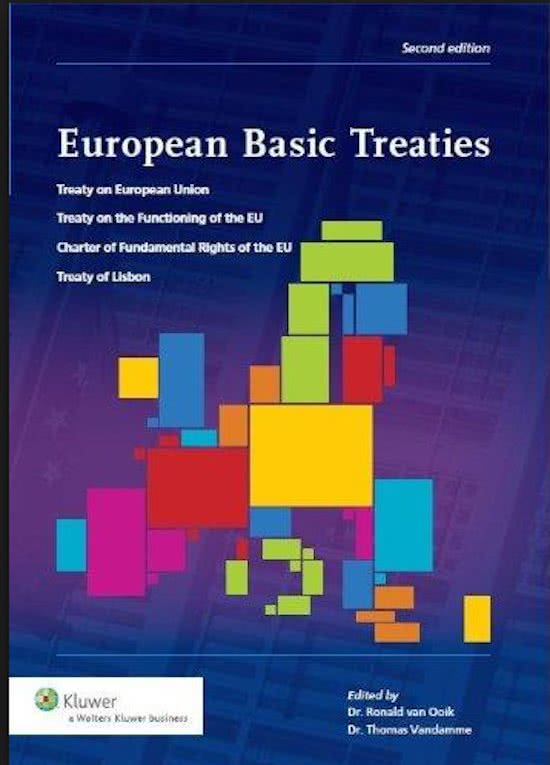
Which Treaties are in your Basic Treaties Book?
TEU (1) and TFEU (2)
Exercise 2
Browse through the Treaty on the Functioning of the EU (TFEU). What is the correct order in
the TFEU? From big to small.
A part, title, article, chapter
B part, title, chapter, paragraph, article
C part, title, chapter, article, paragraph
, 3
Exercise 3
Turn to page 32. Article 38 TFEU shows between brackets (ex Article
TEC). What does the number between brackets mean?
It's an ex-article number (oud artikel). It refers to the Old number in the Treaty of the
European Union.
Exercise 4
Carlos is a Spanish national, who lives in Scheveningen. He would like to stand as a
candidate for the local party ‘Politieke Partij Scheveningen’ during the Local Council
Elections. The chair of the party informed Carlos that unfortunately he could not put Carlos
name on the candidate’s list because he does not have Dutch nationality. Is the
Is the assumption of the Chair correct? Please motivate your answer based on the TFEU.
Go to the index: number refers to which treaty it is.
- Art. 22 (1) TFEU: no, the chair is not correct as every EU citizen has the right to
stand as a candidate in the municipal elections. Indicate a specific paragraph!
- Or Art. 20(2)B TEFU
Exercise 5
Miss Theroux, a French national, who works for ‘France Telecom’ as a telecommunications
specialist. After some thorough investigations she discovers that her salary and that of her
other female colleagues is some 10% lower than that of the male co-workers doing the
same work. Miss Theroux has some knowledge of EU law and is convinced this is violating
basic rules. Give Miss Theroux your advice in this case, based on the TFEU.
Miss Theroux should go to a French national court and claim that ther rights absed on Art.
157 (1)(2) TFEU have been infringed. Not only does the government need to respect the
Treaty but also private employers. See horizontal direct effect.
Exercise 6
Where in the TFEU can you find the article that allows the European Commission to propose
environmental legislation (the legal basis for environmental legislation)?
Art 191 TFEU; Union policy on the environemnt shall contribute to pursuit of the following
objecaives; - preserving, protecting and improving the quality of the environment …
Exercise 7
Where in the TFEU can you find the Treaty article on the ordinary legislative decision-
making procedure, better known as ‘co-decision’?
, 4
Art 294 TFEU
Exercise 8
Where in the TEU and TFEU can you find the articles that list the powers and tasks of the
Court of Justice of the European Union?
Art. 19 TEU
Art. 253 (251 - 281) TFEU
Exercise 9
Please read art 101 TFEU. A large Dutch firm together with an Italian and German company
in construction materials decides to fix their selling prices for concrete. Is this allowed under
European Union law?
Not allowed: Art. 101 (1A) TFEU
ESCS - Paris
EEC - Rome
SEA
ESCS + EEC (Euratom) + SEA → EC
TEU - Maastricht, Amsterdam
TFEU - Lisbon (mistakes of treaty of Rome)
Four freedoms: capital, goods, persons, services
Primary and secondary legislations
How to answer questions:
- Start broadly: what overarching topic of the course does this concern
- State relevant articles (the one that forbids or allows it, the ones that give definitions
- Say whether this meets the criteria to fall under this treaty/case
- Say whether it is generally allowed or not
- Say if it falls under the exception
Lecture 2, fundamental principles of the EU’s legal
order
Introduction to “direct effect” and supremacy
Lecture 1, Treaty structure of the EU
Treaty on European Economic Community (1957)
- Articles on the institutions
- Qualified majority voting exists but often unanimity required in Council
- Common customs’s tariff towards third countries, common agriculture, transport and
competition policy
When the Council votes on a proposal by the Commission or the High Representative of the
Union for Foreign Affairs and Security Policy, the proposal is adopted if a qualified majority is
reached. A qualified majority is reached if two conditions are simultaneously met:
● 55% of member states vote in favor - in practice this means 15 out of 27
● the proposal is supported by member states representing at least 65% of the total EU
population
This procedure is also known as the 'double majority rule'.
Single European Act (1986)
- Often qualified majority voting in Council instead of unanimity
- Introduction of the Court of First Instance
- New policy areas introduced (e.g. environment)
31 December 1992: deadline creation single market
Treaty on European Union (1992)
- Three pillared structure introduced:
- 1: EC
- 2: Foreign Policy and Security
- 3: Justice and Home Affairs
- New policy areas such as: Culture, Public Health, Consumer protection and Trans-
European networks
- Introduction of co-decision for EP as a decision-making instrument
- European Central Bank and Committee of the Regions introduced
Treaty of Amsterdam (1997)
, 2
- Recognition that EU is based on respect for fundamental rights, democracy and the
rule of law
- More power to the EP: co-decision expanded
- Part of Justice and Home Affairs incorporated in EC pillar (Asylum)
Treaty of Lisbon (2007)
- High representative for foreign and security policy and President of the European
Council
- Introduction citizens, initiative, increased role of national parliaments
- EC treaty becomes Treaty on the Functioning of the EU (TFEU) and three pillars
merged into one single EU
Legislative framework of the European Union
Primary legislation:
- Treaty on European Union (TEU)
- Treaty on the Function of the Euro[ean Union (TFEU)
- Fundamental Rights Charter (FRC)
Secondary legislation (always based on primary legislation):
- Regulations
- Directives
- Decisions
All European legislations has a legal basis
Seminar 1
Exercise 1
Which Treaties are in your Basic Treaties Book?
TEU (1) and TFEU (2)
Exercise 2
Browse through the Treaty on the Functioning of the EU (TFEU). What is the correct order in
the TFEU? From big to small.
A part, title, article, chapter
B part, title, chapter, paragraph, article
C part, title, chapter, article, paragraph
, 3
Exercise 3
Turn to page 32. Article 38 TFEU shows between brackets (ex Article
TEC). What does the number between brackets mean?
It's an ex-article number (oud artikel). It refers to the Old number in the Treaty of the
European Union.
Exercise 4
Carlos is a Spanish national, who lives in Scheveningen. He would like to stand as a
candidate for the local party ‘Politieke Partij Scheveningen’ during the Local Council
Elections. The chair of the party informed Carlos that unfortunately he could not put Carlos
name on the candidate’s list because he does not have Dutch nationality. Is the
Is the assumption of the Chair correct? Please motivate your answer based on the TFEU.
Go to the index: number refers to which treaty it is.
- Art. 22 (1) TFEU: no, the chair is not correct as every EU citizen has the right to
stand as a candidate in the municipal elections. Indicate a specific paragraph!
- Or Art. 20(2)B TEFU
Exercise 5
Miss Theroux, a French national, who works for ‘France Telecom’ as a telecommunications
specialist. After some thorough investigations she discovers that her salary and that of her
other female colleagues is some 10% lower than that of the male co-workers doing the
same work. Miss Theroux has some knowledge of EU law and is convinced this is violating
basic rules. Give Miss Theroux your advice in this case, based on the TFEU.
Miss Theroux should go to a French national court and claim that ther rights absed on Art.
157 (1)(2) TFEU have been infringed. Not only does the government need to respect the
Treaty but also private employers. See horizontal direct effect.
Exercise 6
Where in the TFEU can you find the article that allows the European Commission to propose
environmental legislation (the legal basis for environmental legislation)?
Art 191 TFEU; Union policy on the environemnt shall contribute to pursuit of the following
objecaives; - preserving, protecting and improving the quality of the environment …
Exercise 7
Where in the TFEU can you find the Treaty article on the ordinary legislative decision-
making procedure, better known as ‘co-decision’?
, 4
Art 294 TFEU
Exercise 8
Where in the TEU and TFEU can you find the articles that list the powers and tasks of the
Court of Justice of the European Union?
Art. 19 TEU
Art. 253 (251 - 281) TFEU
Exercise 9
Please read art 101 TFEU. A large Dutch firm together with an Italian and German company
in construction materials decides to fix their selling prices for concrete. Is this allowed under
European Union law?
Not allowed: Art. 101 (1A) TFEU
ESCS - Paris
EEC - Rome
SEA
ESCS + EEC (Euratom) + SEA → EC
TEU - Maastricht, Amsterdam
TFEU - Lisbon (mistakes of treaty of Rome)
Four freedoms: capital, goods, persons, services
Primary and secondary legislations
How to answer questions:
- Start broadly: what overarching topic of the course does this concern
- State relevant articles (the one that forbids or allows it, the ones that give definitions
- Say whether this meets the criteria to fall under this treaty/case
- Say whether it is generally allowed or not
- Say if it falls under the exception
Lecture 2, fundamental principles of the EU’s legal
order
Introduction to “direct effect” and supremacy