circuld r + 10w
Introduction Vortices
·
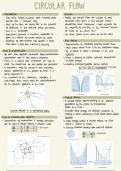
Flow often follows a curved path -
normal state ·
Almost all natural flows are circular at some
·
Circular flow--'vortical' flow structural level ,
and it is this circular motion -
·
Most of the time we
ignore this in the interests alternatively called 'turbulence' that accounts for
-
of simplicity. If this does not affect our results , the majority of viscosity i e
.
.
the internal friction
then it is acceptable of fluids at the micro level
·
Sometimes ,
however , it becomes impossible to ·
We often ignore them when we do our calcs
ignore the effects of motion eg : super-
curved ,
elevation of open channel flow around a pend , Free Vortex
flow down a plug-hole turbulent viscosity
,
·
Approximates to naturally occuring circular flows
·
Takes place when there is no ext additional energy .
Flow in a curved path ·
Eg :
in bends in ducts 3 channels ,
in the sink
·
Up until now , equations developed apply fundamental Equation
conservation laws to flow along a streamline ↳ Flow is allowed to rotate without intervention
· Flows in a curved path introduces ID flow in or input energy
which the streamlines are not parallel but concentric ↳ Velocity increases towards vortex center
·
A streamline may be curved in any arbitrary Vo = k (or C =
constant) * Derivation
fashion depending on the pattern of forces it is
being subjected to
·
The curvature of the streamlines introduce a
centrifugal force which must be counterbalanced
by the pressure gradient in the fluid
Forced Vortex
·
A circular motion approximating to the pattern
generated by the action of mechanical
motor on a fluid
Circular motion in a horizontal plane ·
External input energy via rotating impellers or
rotating a vessel containing a fluid causes vortex motion
Flow in a curved path equation Equation :
· Conservation of momentum energy principles ↳
Input energy causes a circular motion on fluid
can be used to obtain velocity 3 pressure head which is 'forced' to rotate
(AV-V)
from Center of rotation
at =
* Derivation ↳ Velocity increases linearly
dH Zwr * Derivation a
=
I
Introduction Vortices
·
Flow often follows a curved path -
normal state ·
Almost all natural flows are circular at some
·
Circular flow--'vortical' flow structural level ,
and it is this circular motion -
·
Most of the time we
ignore this in the interests alternatively called 'turbulence' that accounts for
-
of simplicity. If this does not affect our results , the majority of viscosity i e
.
.
the internal friction
then it is acceptable of fluids at the micro level
·
Sometimes ,
however , it becomes impossible to ·
We often ignore them when we do our calcs
ignore the effects of motion eg : super-
curved ,
elevation of open channel flow around a pend , Free Vortex
flow down a plug-hole turbulent viscosity
,
·
Approximates to naturally occuring circular flows
·
Takes place when there is no ext additional energy .
Flow in a curved path ·
Eg :
in bends in ducts 3 channels ,
in the sink
·
Up until now , equations developed apply fundamental Equation
conservation laws to flow along a streamline ↳ Flow is allowed to rotate without intervention
· Flows in a curved path introduces ID flow in or input energy
which the streamlines are not parallel but concentric ↳ Velocity increases towards vortex center
·
A streamline may be curved in any arbitrary Vo = k (or C =
constant) * Derivation
fashion depending on the pattern of forces it is
being subjected to
·
The curvature of the streamlines introduce a
centrifugal force which must be counterbalanced
by the pressure gradient in the fluid
Forced Vortex
·
A circular motion approximating to the pattern
generated by the action of mechanical
motor on a fluid
Circular motion in a horizontal plane ·
External input energy via rotating impellers or
rotating a vessel containing a fluid causes vortex motion
Flow in a curved path equation Equation :
· Conservation of momentum energy principles ↳
Input energy causes a circular motion on fluid
can be used to obtain velocity 3 pressure head which is 'forced' to rotate
(AV-V)
from Center of rotation
at =
* Derivation ↳ Velocity increases linearly
dH Zwr * Derivation a
=
I