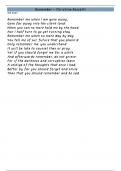
Remember – Christina Rossetti
IEB 2025
Remember me when I am gone away,
Gone far away into the silent land;
When you can no more hold me by the hand,
Nor I half turn to go yet turning stay.
Remember me when no more day by day
You tell me of our future that you plann'd:
Only remember me; you understand
It will be late to counsel then or pray.
Yet if you should forget me for a while
And afterwards remember, do not grieve:
For if the darkness and corruption leave
A vestige of the thoughts that once I had,
Better by far you should forget and smile
Than that you should remember and be sad.
, - This opening line introduces the central theme of the
poem: remembrance after death.
- The phrase "gone away" is a euphemism for death,
softening its harsh reality and adding a tender tone.
- The repetition of “Remember me” reflects the speaker's
Remember me when I am plea for emotional connection, even in absence.
gone away, - The use of the comma at the end of the line signals a
pause, inviting the reader to reflect on the speaker's
request.
- This pause also sets a contemplative rhythm.
- The line’s simple yet poignant structure evokes the
inevitability of parting and establishes the speaker’s
vulnerability.
- The "silent land" is a metaphor for death or the
afterlife, emphasizing its stillness and isolation.
- This imagery conveys a sense of mystery and finality,
as "silent" suggests a place devoid of life, sound, and
communication.
Gone far away into the - The repetition of "gone far away" reinforces the
silent land; distance and separation between the speaker and the
listener.
- The semicolon at the end of the line connects it to the
following line, signifying that the thought continues.
- This punctuation choice creates a meditative tone,
allowing the reader to linger on the idea of the
afterlife’s inescapable silence.
- This line shifts to a personal and tactile image of loss,
emphasizing the physical separation caused by death.
- The act of holding hands symbolizes intimacy, comfort,
and human connection, which will no longer be possible.
When you can no more hold - The use of “no more” intensifies the finality of death,
me by the hand, underscoring the permanence of the speaker’s absence.
- The straightforward structure mirrors the simplicity
of the sentiment, while the lack of punctuation at the
end propels the reader into the next line, suggesting an
emotional continuation of thought.
- This line reflects the speaker's internal conflict and
hesitation about leaving.
- The phrase "half turn to go yet turning stay" is
paradoxical, illustrating a moment of indecision and
lingering attachment.
Nor I half turn to go yet - The imagery suggests a reluctance to part, reinforcing
turning stay. the speaker’s emotional bond with the listener.
- The lack of punctuation within the line creates a
flowing rhythm, mimicking the fluidity of the speaker’s
conflicted emotions.
- This tension between leaving and staying adds depth to
the speaker’s longing to remain connected, even in
death.
IEB 2025
Remember me when I am gone away,
Gone far away into the silent land;
When you can no more hold me by the hand,
Nor I half turn to go yet turning stay.
Remember me when no more day by day
You tell me of our future that you plann'd:
Only remember me; you understand
It will be late to counsel then or pray.
Yet if you should forget me for a while
And afterwards remember, do not grieve:
For if the darkness and corruption leave
A vestige of the thoughts that once I had,
Better by far you should forget and smile
Than that you should remember and be sad.
, - This opening line introduces the central theme of the
poem: remembrance after death.
- The phrase "gone away" is a euphemism for death,
softening its harsh reality and adding a tender tone.
- The repetition of “Remember me” reflects the speaker's
Remember me when I am plea for emotional connection, even in absence.
gone away, - The use of the comma at the end of the line signals a
pause, inviting the reader to reflect on the speaker's
request.
- This pause also sets a contemplative rhythm.
- The line’s simple yet poignant structure evokes the
inevitability of parting and establishes the speaker’s
vulnerability.
- The "silent land" is a metaphor for death or the
afterlife, emphasizing its stillness and isolation.
- This imagery conveys a sense of mystery and finality,
as "silent" suggests a place devoid of life, sound, and
communication.
Gone far away into the - The repetition of "gone far away" reinforces the
silent land; distance and separation between the speaker and the
listener.
- The semicolon at the end of the line connects it to the
following line, signifying that the thought continues.
- This punctuation choice creates a meditative tone,
allowing the reader to linger on the idea of the
afterlife’s inescapable silence.
- This line shifts to a personal and tactile image of loss,
emphasizing the physical separation caused by death.
- The act of holding hands symbolizes intimacy, comfort,
and human connection, which will no longer be possible.
When you can no more hold - The use of “no more” intensifies the finality of death,
me by the hand, underscoring the permanence of the speaker’s absence.
- The straightforward structure mirrors the simplicity
of the sentiment, while the lack of punctuation at the
end propels the reader into the next line, suggesting an
emotional continuation of thought.
- This line reflects the speaker's internal conflict and
hesitation about leaving.
- The phrase "half turn to go yet turning stay" is
paradoxical, illustrating a moment of indecision and
lingering attachment.
Nor I half turn to go yet - The imagery suggests a reluctance to part, reinforcing
turning stay. the speaker’s emotional bond with the listener.
- The lack of punctuation within the line creates a
flowing rhythm, mimicking the fluidity of the speaker’s
conflicted emotions.
- This tension between leaving and staying adds depth to
the speaker’s longing to remain connected, even in
death.