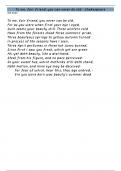
To me, fair friend, you can never be old - Shakespeare
IEB 2025
To me, fair friend, you never can be old,
For as you were when first your eye I eyed,
Such seems your beauty still. Three winters cold
Have from the forests shook three summers’ pride,
Three beauteous springs to yellow autumn turned
In process of the seasons have I seen,
Three April perfumes in three hot Junes burned,
Since first I saw you fresh, which yet are green.
Ah, yet doth beauty, like a dial-hand,
Steal from his figure, and no pace perceived;
So your sweet hue, which methinks still doth stand,
Hath motion, and mine eye may be deceived:
For fear of which, hear this, thou age unbred, -
Ere you were born was beauty’s summer dead.
, - The speaker begins with a direct address to a "fair
friend," emphasizing their eternal youth in his eyes.
- The phrase "you never can be old" conveys an unchanging
admiration and affection, suggesting that time cannot
diminish the friend’s beauty or essence.
- The repetition of "fair" underscores their physical or
To me, fair friend, you never moral attractiveness.
can be old, - The line uses hyperbole, as the claim of defying aging is
an exaggeration.
- The comma after "To me" introduces a pause,
personalizing the statement and inviting reflection.
- This punctuation subtly emphasizes the speaker's
subjective perspective, making it clear that this view
may not align with objective reality.
- This line reflects nostalgia, recalling the first moment
the speaker saw their friend's eyes.
- The phrase "first your eye I eyed" plays with the
repetition of "eye" as a subtle form of alliteration,
emphasizing the mutual act of seeing and being seen.
For as you were when first - The word order feels archaic, creating a poetic rhythm
your eye I eyed, and drawing attention to the importance of this initial
gaze.
- The line suggests the friend’s beauty has remained
constant.
- The absence of punctuation within the line creates a
flowing, continuous thought, highlighting the enduring
memory of this moment and its lasting impact on the
speaker.
- The speaker affirms that the friend’s beauty has not
faded, using "still" to suggest constancy and
timelessness.
- "Three winters cold" introduces a metaphor for the
passage of time, with winters representing hardship or
Such seems your beauty the starkness of aging.
still. Three winters cold - The alliteration of "s" in "such seems" and "still" adds a
lyrical quality, reinforcing the meditative tone.
- The full stop after "still" creates a pause, emphasizing
the finality and certainty of the statement.
- This punctuation allows the reader to absorb the
permanence of the friend's beauty before transitioning
to the imagery of seasonal cycles.
IEB 2025
To me, fair friend, you never can be old,
For as you were when first your eye I eyed,
Such seems your beauty still. Three winters cold
Have from the forests shook three summers’ pride,
Three beauteous springs to yellow autumn turned
In process of the seasons have I seen,
Three April perfumes in three hot Junes burned,
Since first I saw you fresh, which yet are green.
Ah, yet doth beauty, like a dial-hand,
Steal from his figure, and no pace perceived;
So your sweet hue, which methinks still doth stand,
Hath motion, and mine eye may be deceived:
For fear of which, hear this, thou age unbred, -
Ere you were born was beauty’s summer dead.
, - The speaker begins with a direct address to a "fair
friend," emphasizing their eternal youth in his eyes.
- The phrase "you never can be old" conveys an unchanging
admiration and affection, suggesting that time cannot
diminish the friend’s beauty or essence.
- The repetition of "fair" underscores their physical or
To me, fair friend, you never moral attractiveness.
can be old, - The line uses hyperbole, as the claim of defying aging is
an exaggeration.
- The comma after "To me" introduces a pause,
personalizing the statement and inviting reflection.
- This punctuation subtly emphasizes the speaker's
subjective perspective, making it clear that this view
may not align with objective reality.
- This line reflects nostalgia, recalling the first moment
the speaker saw their friend's eyes.
- The phrase "first your eye I eyed" plays with the
repetition of "eye" as a subtle form of alliteration,
emphasizing the mutual act of seeing and being seen.
For as you were when first - The word order feels archaic, creating a poetic rhythm
your eye I eyed, and drawing attention to the importance of this initial
gaze.
- The line suggests the friend’s beauty has remained
constant.
- The absence of punctuation within the line creates a
flowing, continuous thought, highlighting the enduring
memory of this moment and its lasting impact on the
speaker.
- The speaker affirms that the friend’s beauty has not
faded, using "still" to suggest constancy and
timelessness.
- "Three winters cold" introduces a metaphor for the
passage of time, with winters representing hardship or
Such seems your beauty the starkness of aging.
still. Three winters cold - The alliteration of "s" in "such seems" and "still" adds a
lyrical quality, reinforcing the meditative tone.
- The full stop after "still" creates a pause, emphasizing
the finality and certainty of the statement.
- This punctuation allows the reader to absorb the
permanence of the friend's beauty before transitioning
to the imagery of seasonal cycles.