

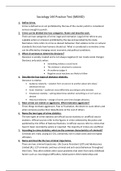
Sociology 144 Practice Test (MEMO)
1. Define Crime.
Crime is defined as an act prohibited by the law of the country which is considered
serious enough to punish.
2. Crime can be divided into two categories. Name and describe each.
There are two categories of crime: legal and normative. Legal crime refers to any
culpable action or omission prohibited by the law and punished by the state.
Normative crime refers to crime as deviant behaviour that violates norms or cultural
standards that state how humans should act. What is considered a normative crime
can be affected by changing social, economic and political conditions.
3. What circumstances determine deviance?
Deviance is socially created and is not always negative (it can create social change).
Deviance only exists when:
• Something violates a social norm
• The violation is attached to someone
• An audience judges it
• Negative social reactions are likely to follow
4. Describe the four types of deviance relativity.
Deviance is relative.
• Audience relativity – violation from on person to another about who does/
witnesses the act
• Actor relativity – audiences react differently according to who deviates
• Situational relativity – setting determines whether something is or isn’t seen as
deviant
• Historical relativity – change of norms over time changes deviancy
5. Most crimes are violent or aggressive. What motivates aggression?
Three things motivate aggression. Fear or frustration, the desire to scare others and
when someone pushes their ideas/desires at the cost of others.
6. Name the two types of crime statistics.
The two types of crime statistics are official source statistics or unofficial source
statistics. Official sources refer to the figures in crime collected by the police and
published by the Office of National Statistics. Unofficial sources refer to crimes that
haven’t been recorded by police or reported. The majority of crimes are unofficial.
7. According to crime statistics, what are the common characteristics of criminals?
Criminals are: male, young (15-25), unmarried, live in urban cities and not repeat
offenders
8. Name and describe the two criminal trajectories.
There are two criminal trajectories: Life Course Persistent (LCP) and Adolescence
Limited (AL). LCP criminals continue criminal and anti-social behaviour throughout
their lives. They often exhibit other social problems that stem from early childhood
factors such as: neurological difficulties, failed parent-child relationships and
1. Define Crime.
Crime is defined as an act prohibited by the law of the country which is considered
serious enough to punish.
2. Crime can be divided into two categories. Name and describe each.
There are two categories of crime: legal and normative. Legal crime refers to any
culpable action or omission prohibited by the law and punished by the state.
Normative crime refers to crime as deviant behaviour that violates norms or cultural
standards that state how humans should act. What is considered a normative crime
can be affected by changing social, economic and political conditions.
3. What circumstances determine deviance?
Deviance is socially created and is not always negative (it can create social change).
Deviance only exists when:
• Something violates a social norm
• The violation is attached to someone
• An audience judges it
• Negative social reactions are likely to follow
4. Describe the four types of deviance relativity.
Deviance is relative.
• Audience relativity – violation from on person to another about who does/
witnesses the act
• Actor relativity – audiences react differently according to who deviates
• Situational relativity – setting determines whether something is or isn’t seen as
deviant
• Historical relativity – change of norms over time changes deviancy
5. Most crimes are violent or aggressive. What motivates aggression?
Three things motivate aggression. Fear or frustration, the desire to scare others and
when someone pushes their ideas/desires at the cost of others.
6. Name the two types of crime statistics.
The two types of crime statistics are official source statistics or unofficial source
statistics. Official sources refer to the figures in crime collected by the police and
published by the Office of National Statistics. Unofficial sources refer to crimes that
haven’t been recorded by police or reported. The majority of crimes are unofficial.
7. According to crime statistics, what are the common characteristics of criminals?
Criminals are: male, young (15-25), unmarried, live in urban cities and not repeat
offenders
8. Name and describe the two criminal trajectories.
There are two criminal trajectories: Life Course Persistent (LCP) and Adolescence
Limited (AL). LCP criminals continue criminal and anti-social behaviour throughout
their lives. They often exhibit other social problems that stem from early childhood
factors such as: neurological difficulties, failed parent-child relationships and


