I XII IIII A
nin
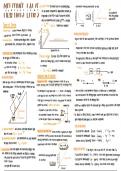
o static friction : frictional force on a
stationary object · acceleration inversely proportional to mass
T
note :
As the parallel component of applied force increases the
the smaller the
: a
,
magnitude of the force of static friction will increase, mass the greater
constant net force acceleration
until the maximum force of friction (ffsmax) is reached
musica
max-Msfn
Types of forces measured in newsa
· o
m (19-)
contact forces : exerted between objects in contact
connected objects :
↳ applied force tension friction
,
, normal forces.
Kinetic friction (Fk) >
objects have the same acceleration treat each object in the system as separate
< non contact forces : exerted between objects over a distance ,
note :
↳ gravitational force electrostatic force
,
,
magnetic force
> · magnitude of the force exerted on different objects by a single rope ,
bar or
Applied Force (N)
the normal force the perpendicular force exerted by a surface
:
string is the same on all objects
& Kinetic friction : frictional force that opposses the
contact with It. An applied force only acts on one object (not transferred to a connected objects
object
·
on an in
motion of a moving object and is constant while object
-
on horizontal surface :
FN =
Fg , ·
easiest to take direction of acceleration as positive
is in motion
>
pull force at an
angle :
Fr =
Fg-Fuertical example :
·
ffl =
MK FNmeasured in newtons 10kg 15kg
<
push force at an
angle
:
FN =
Fg + Fvertical Ff- IN
>
FA =
108N
&
10y
Newton's laws of motion
& Ff =
inclined plane :
10199 :
Ef
15 kg :
FA 180N
Newton's first law An object continues state of rest or
=
N T T =
:
in a
↳ When an object rests on an inclined plane the force of gravity , · 3 - ⑳ 3
uniform Velocity unless It is acted upon by a net or resultant force
FF ION
vertically down-thus force
=
acts of gravity is broken into two
7 this law applies to any object with inertia which is the property
* when a pulley is used between an object on a surface and a hanging object
components ,
Ffriction
normal
to resist any change in its state of rest motion take the direction of the hanging object as positive for the object on the surface and
T
of an object or
force
Cany object with mass has inertia -
the greater the mass the downwards as positive for the hanging object
greater the inertial -
inertia is Not a force . normal (FN) * When two hanging objects are connected by a pulley take direction of the larger
8 &
#9
[perpendicular 1 .e A seatbelt in a car exerts a net force Force (f) mass as positive
J Of ⑨
on a passenger to oppose their inevtla , seatbelt For
* objects in direct contact usings newtons third law objects exert
, ,
a force of
weight Fg// (parallel
(89) so that they don't flyout of the Windsheld J
equal magnitude and opposite in direction on eachother
o
> weight (fg)
freebody diagram
-
this is a <
lift problems :
① parallel component :
acts parallel to the slope and pulls object
Newton's second law :
When force
>
Acceleration upwards :
Tension <
Gravity ; T-Fg =
Ma
a net is applied to an object
down the incline . Fall =
Easing It accelerates in the direction of the net force . The acceleration is Acceleration downwards Tension < :
Gravity : Fg-T =
ma
② perpendicular component :
acts perpendicular to slope and pushes
directly proportional to the net force applied and inversely Gravity
< Constant Velocity/stationary :
Tension =
; Fg =
T
the object into the incline . Fg EgcosO
D
=
proportional to the mass of the object
frictional force force that opposes the motion of an object and Objects in a lift :
if an object is on a scale in a lift ,
the scale reads Fr
7
acts parallel to the surface with which the object is in contact
acceleration directly proportional
>
Acceleration upwards :
For gravity : scale reads greater than actual
weight
:
·
> the greater the coefficient of friction the greater the force constant mass
to net force > Acceleration downwards :
En > gravity ; scale reads less than actual
weight
force of friction
in Velocity/stationary FN ; scale reads actual
weight
:
< Constant =
gravity
> two types of frictional force
em
nin
o static friction : frictional force on a
stationary object · acceleration inversely proportional to mass
T
note :
As the parallel component of applied force increases the
the smaller the
: a
,
magnitude of the force of static friction will increase, mass the greater
constant net force acceleration
until the maximum force of friction (ffsmax) is reached
musica
max-Msfn
Types of forces measured in newsa
· o
m (19-)
contact forces : exerted between objects in contact
connected objects :
↳ applied force tension friction
,
, normal forces.
Kinetic friction (Fk) >
objects have the same acceleration treat each object in the system as separate
< non contact forces : exerted between objects over a distance ,
note :
↳ gravitational force electrostatic force
,
,
magnetic force
> · magnitude of the force exerted on different objects by a single rope ,
bar or
Applied Force (N)
the normal force the perpendicular force exerted by a surface
:
string is the same on all objects
& Kinetic friction : frictional force that opposses the
contact with It. An applied force only acts on one object (not transferred to a connected objects
object
·
on an in
motion of a moving object and is constant while object
-
on horizontal surface :
FN =
Fg , ·
easiest to take direction of acceleration as positive
is in motion
>
pull force at an
angle :
Fr =
Fg-Fuertical example :
·
ffl =
MK FNmeasured in newtons 10kg 15kg
<
push force at an
angle
:
FN =
Fg + Fvertical Ff- IN
>
FA =
108N
&
10y
Newton's laws of motion
& Ff =
inclined plane :
10199 :
Ef
15 kg :
FA 180N
Newton's first law An object continues state of rest or
=
N T T =
:
in a
↳ When an object rests on an inclined plane the force of gravity , · 3 - ⑳ 3
uniform Velocity unless It is acted upon by a net or resultant force
FF ION
vertically down-thus force
=
acts of gravity is broken into two
7 this law applies to any object with inertia which is the property
* when a pulley is used between an object on a surface and a hanging object
components ,
Ffriction
normal
to resist any change in its state of rest motion take the direction of the hanging object as positive for the object on the surface and
T
of an object or
force
Cany object with mass has inertia -
the greater the mass the downwards as positive for the hanging object
greater the inertial -
inertia is Not a force . normal (FN) * When two hanging objects are connected by a pulley take direction of the larger
8 &
#9
[perpendicular 1 .e A seatbelt in a car exerts a net force Force (f) mass as positive
J Of ⑨
on a passenger to oppose their inevtla , seatbelt For
* objects in direct contact usings newtons third law objects exert
, ,
a force of
weight Fg// (parallel
(89) so that they don't flyout of the Windsheld J
equal magnitude and opposite in direction on eachother
o
> weight (fg)
freebody diagram
-
this is a <
lift problems :
① parallel component :
acts parallel to the slope and pulls object
Newton's second law :
When force
>
Acceleration upwards :
Tension <
Gravity ; T-Fg =
Ma
a net is applied to an object
down the incline . Fall =
Easing It accelerates in the direction of the net force . The acceleration is Acceleration downwards Tension < :
Gravity : Fg-T =
ma
② perpendicular component :
acts perpendicular to slope and pushes
directly proportional to the net force applied and inversely Gravity
< Constant Velocity/stationary :
Tension =
; Fg =
T
the object into the incline . Fg EgcosO
D
=
proportional to the mass of the object
frictional force force that opposes the motion of an object and Objects in a lift :
if an object is on a scale in a lift ,
the scale reads Fr
7
acts parallel to the surface with which the object is in contact
acceleration directly proportional
>
Acceleration upwards :
For gravity : scale reads greater than actual
weight
:
·
> the greater the coefficient of friction the greater the force constant mass
to net force > Acceleration downwards :
En > gravity ; scale reads less than actual
weight
force of friction
in Velocity/stationary FN ; scale reads actual
weight
:
< Constant =
gravity
> two types of frictional force
em