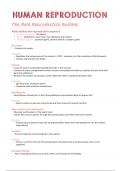
HUMAN REPRODUCTION
The Male Reproductive System:
What makes the reproductive organs?
‣ Primary sex organs - the testes
‣ Ducts - epididymis, sperm duct (vas deferens) and urethra
‣ Accessory glands - prostate gland, seminal vesicle, Cowpers gland
Scrotum:
- Contains the testes
Functions
• Regulates the temperature of the testes (+/- 35º) - necessary for the production of fertile sperm
• Houses and protects the testes
Testes:
- 2 oval structures suspended outside the body in the scrotum
- Consists of many compartments which contain convoluted seminiferous tubules that are lined with
germinal epithelium
- Between the tubules are groups of cells called the cells of Leydig (interstitial cells)
Functions
• germinal layer produces sperm
• Interstitial cells produce testosterone
Epididymis:
- Seminiferous tubules join to form the epididymis (convoluted tubule of approx 5m)
Function
• Sperm mature to become more fertile and then stored for several months (
Sperm Duct (vas deferens):
- Muscular continuation of the sperm duct
- Leaves the scrotum passes through the prostate gland and then enters the urethra
Function
• Pushes mature sperm forward by strong peristaltic waves from the epididymis into the urethra
(ejaculation)
Urethra
- End of urogenital system leading to the exterior
Function
• Forms a common duct for the transportation of semen and urine (processes never occur
together)
Prostate Gland
- Plum sized gland that surround the urethra at the bases of the bladder
The Male Reproductive System:
What makes the reproductive organs?
‣ Primary sex organs - the testes
‣ Ducts - epididymis, sperm duct (vas deferens) and urethra
‣ Accessory glands - prostate gland, seminal vesicle, Cowpers gland
Scrotum:
- Contains the testes
Functions
• Regulates the temperature of the testes (+/- 35º) - necessary for the production of fertile sperm
• Houses and protects the testes
Testes:
- 2 oval structures suspended outside the body in the scrotum
- Consists of many compartments which contain convoluted seminiferous tubules that are lined with
germinal epithelium
- Between the tubules are groups of cells called the cells of Leydig (interstitial cells)
Functions
• germinal layer produces sperm
• Interstitial cells produce testosterone
Epididymis:
- Seminiferous tubules join to form the epididymis (convoluted tubule of approx 5m)
Function
• Sperm mature to become more fertile and then stored for several months (
Sperm Duct (vas deferens):
- Muscular continuation of the sperm duct
- Leaves the scrotum passes through the prostate gland and then enters the urethra
Function
• Pushes mature sperm forward by strong peristaltic waves from the epididymis into the urethra
(ejaculation)
Urethra
- End of urogenital system leading to the exterior
Function
• Forms a common duct for the transportation of semen and urine (processes never occur
together)
Prostate Gland
- Plum sized gland that surround the urethra at the bases of the bladder