

SCIENCE CENTRE LESSON 1a
--------------------------------------------------------------------------------------------------------------------------------------------------------------------------------------
Biodiversity & Classification of Microorganisms
--------------------------------------------------------------------------------------------------------------------------------------------------------------------------------------
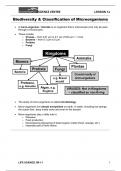
• A micro-organism / microbe is an organism that is microscopic (can only be seen
through a microscope).
• These include:
o Viruses – from 0,01 µm to 0,1 µm (1000 µm = 1 mm)
o Bacteria – from 0,1 µm to 5 µm
o Protista
o Fungi
• The study of micro-organisms is called microbiology.
• Micro-organisms live almost everywhere on earth. In water, including hot springs,
the ocean floor, deep inside rocks and even in the dessert.
• Micro-organisms play a daily role in:
o Diseases
o Food production
o Decomposing (decaying) of dead organic matter (food, sewage, etc.)
o Important part of food chains
--------------------------------------------------------------------------------------------------------------------------------------------------------------------------------------
LIFE SCIENCE GR 11 1
, SCIENCE CENTRE LESSON 1a
VIRUSES
• Viruses are inert / dormant = only active when they are inside living cells.
• Therefore, they are considered to be non-living.
• ALL viruses are pathogenic / parasites = since they cause diseases.
• Viruses only have one function, and that is to reproduce.
• Viruses are transported passively by air, water, physical touch, body fluids and
food.
STRUCTURE:
o Viruses are extremely small and
are only visible under an electron
microscope.
o The body consist of
- a protein coat /
capsid which enclose
- a nucleic acid: DNA
OR RNA (never both)
o Shapes range from cylindrical to
spherical.
o Bacteriophage (a virus that infects & kill bacteria):
LIFE SCIENCE GR 11 2
--------------------------------------------------------------------------------------------------------------------------------------------------------------------------------------
Biodiversity & Classification of Microorganisms
--------------------------------------------------------------------------------------------------------------------------------------------------------------------------------------
• A micro-organism / microbe is an organism that is microscopic (can only be seen
through a microscope).
• These include:
o Viruses – from 0,01 µm to 0,1 µm (1000 µm = 1 mm)
o Bacteria – from 0,1 µm to 5 µm
o Protista
o Fungi
• The study of micro-organisms is called microbiology.
• Micro-organisms live almost everywhere on earth. In water, including hot springs,
the ocean floor, deep inside rocks and even in the dessert.
• Micro-organisms play a daily role in:
o Diseases
o Food production
o Decomposing (decaying) of dead organic matter (food, sewage, etc.)
o Important part of food chains
--------------------------------------------------------------------------------------------------------------------------------------------------------------------------------------
LIFE SCIENCE GR 11 1
, SCIENCE CENTRE LESSON 1a
VIRUSES
• Viruses are inert / dormant = only active when they are inside living cells.
• Therefore, they are considered to be non-living.
• ALL viruses are pathogenic / parasites = since they cause diseases.
• Viruses only have one function, and that is to reproduce.
• Viruses are transported passively by air, water, physical touch, body fluids and
food.
STRUCTURE:
o Viruses are extremely small and
are only visible under an electron
microscope.
o The body consist of
- a protein coat /
capsid which enclose
- a nucleic acid: DNA
OR RNA (never both)
o Shapes range from cylindrical to
spherical.
o Bacteriophage (a virus that infects & kill bacteria):
LIFE SCIENCE GR 11 2


