

16 System Life Cycle
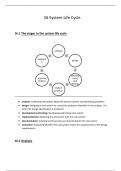
16.1 The stages in the system life cycle
analysis
evaluaio
design
n
develop
docume ment
ntation and
testing
implem
entation
analysis: Collecting information about the present system and identifying problems
design: Designing a new system to correct the problems identified in the analysis, it is
when the design specification is produced
development and testing: Developing and testing new system
implementation: Replacing the old system with the new system
documentation: Creating technical and user documentation for new system
evaluation: Evaluating whether the new system meets the requirements of the design
requirements
16.2 Analysis
,Analysis involves finding out how the current system works and what the requirements of the
client are for the new system
Methods of Research
Questionnaires:
questionnaires are used when there is a large number of users making it a larger
sample, conducting interviews becomes impractical and hence the questionnaires are
used as the results can be quantified and compared
they aren’t suitable when there’s a small number of users size since the sample size isn’t
large enough to gauge different onions and its much easier conduct their interviews
rather than spending time creating an appropriate questionnaire
an exception of this would be when there’s a continuous clash between the user and
analyzer to arrange an appointment
the disadvantage of questionnaires is that it doesn’t let the analyzer the opportunity to
ask the users to elaborate on their answer without having to contact them again
It’s important for questions to be asked in a way in which the required information can
be elicited from users and those responses can be analyzed and quantified collectively
this could be done by providing appropriate multiple choices so that each response is
counted
the questionnaire shouldn’t be long otherwise not many responses will be returned
A mixture of multiple choice questions, opinion ratings and open questions should be
used to allow a balance of quantitative analysis of closed questions and a qualitative
analysis of open questions where users are able to suggest alternative ideas to those
presented by the questionnaire
Questions should also be written in a way which doesn’t threaten the users and the way
they currently do their work
Users should also be given the opportunity to submit their questionnaires anonymously
as it allows for more honest answers to be given
It Is also ideal for them to be held online as it allows results to be immediately stored
and readily available for detailed analysis in the form of graphs and tables
Filters can be applied to the results and responses can be compared based on the
answers given to another question
,Interviews:
Interviews involve a direct conversation between the client and analysis
Where there is a single end user or small group of end users then interviews are the
perfect solution because questions can be asked of the users and conversation can take
place which can expand upon answers that are given with follow up questions searching
for further detail
In large organizations, interviews can be used with key stakeholders or representatives
of user groups.
Questions to be asked should be planned and designed to elicit the required
information from the client, they could also vary depending on who is being
interviewed. Eg; if management is, then questions will focus on requirements of the
organization, if end users are being interviewed, then questions will be aimed at finding
out what users need to make their jobs more efficient
However it could be difficult to hold an interview due to unavailability of the clients
Clients could also answer dishonestly as interviews tend not to be anonymous, and they
are afraid they might be judged by their answers
The analyst also has to be fully involved with each interview which could result in a lot
of cost and time being drained up early in the project.
Observation:
Observation involves the analyst watching the processes that take place within an
organization to find out how everyday tasks are completed
this can involve sitting with the users to understand the tasks they have to complete,
with an opportunity to ask questions of the users to elicit further information that could
be needed for a requirements specification
one disadvantage of this method is that user might do things differently from normal or
they be more efficient when they know they r being observed, hence this doesn’t give a
true picture of what is happening
this method can take up a lot of time however it is the most insightful method of finding
out how an organization works
Document analysis:
, Existing documents within an organization an tell an analyst a lot about the information
that is currently being used
The analyst will need to see examples of any documents that show output information
or five an indication of what data is being collected for input to a system
The analyst can sometimes also identify processes that take place by looking at
documents
Its also possible to estimate the amount of data that Is likely to be required if the
volume of the documents is known
This method is not to be used on its own but must be used in conjunction with other
analysis methods because its difficult to identify the processes just by looking at the
documents
Examination of the documents also only shows data that is currently output and doesn’t
give the opportunity to find out what additional data an organization might need or not
need
This information can be found out by following up documentation analysis with
interviews.
User Requirements Specification
It’s a contract between the developer and the client
Its created by the analyst in consultation with the client who will approve it
It specifies what the client needs the system to do so that developer can produce a
system that meets the client’s needs
Contents:
The purpose of the system
The main objectives of the system
Data that must be output from the system (for example; invoices, sales report)
Data that needs to be input to the system to generate the outputs, including any
screens or data collection forms
Validation and verification that is need for input data
Processes that need to take place to convert inputs into outputs or to store data
Data that need to be stored
Functional requirements such as performance measures
Deadlines for each milestone within the project
16.1 The stages in the system life cycle
analysis
evaluaio
design
n
develop
docume ment
ntation and
testing
implem
entation
analysis: Collecting information about the present system and identifying problems
design: Designing a new system to correct the problems identified in the analysis, it is
when the design specification is produced
development and testing: Developing and testing new system
implementation: Replacing the old system with the new system
documentation: Creating technical and user documentation for new system
evaluation: Evaluating whether the new system meets the requirements of the design
requirements
16.2 Analysis
,Analysis involves finding out how the current system works and what the requirements of the
client are for the new system
Methods of Research
Questionnaires:
questionnaires are used when there is a large number of users making it a larger
sample, conducting interviews becomes impractical and hence the questionnaires are
used as the results can be quantified and compared
they aren’t suitable when there’s a small number of users size since the sample size isn’t
large enough to gauge different onions and its much easier conduct their interviews
rather than spending time creating an appropriate questionnaire
an exception of this would be when there’s a continuous clash between the user and
analyzer to arrange an appointment
the disadvantage of questionnaires is that it doesn’t let the analyzer the opportunity to
ask the users to elaborate on their answer without having to contact them again
It’s important for questions to be asked in a way in which the required information can
be elicited from users and those responses can be analyzed and quantified collectively
this could be done by providing appropriate multiple choices so that each response is
counted
the questionnaire shouldn’t be long otherwise not many responses will be returned
A mixture of multiple choice questions, opinion ratings and open questions should be
used to allow a balance of quantitative analysis of closed questions and a qualitative
analysis of open questions where users are able to suggest alternative ideas to those
presented by the questionnaire
Questions should also be written in a way which doesn’t threaten the users and the way
they currently do their work
Users should also be given the opportunity to submit their questionnaires anonymously
as it allows for more honest answers to be given
It Is also ideal for them to be held online as it allows results to be immediately stored
and readily available for detailed analysis in the form of graphs and tables
Filters can be applied to the results and responses can be compared based on the
answers given to another question
,Interviews:
Interviews involve a direct conversation between the client and analysis
Where there is a single end user or small group of end users then interviews are the
perfect solution because questions can be asked of the users and conversation can take
place which can expand upon answers that are given with follow up questions searching
for further detail
In large organizations, interviews can be used with key stakeholders or representatives
of user groups.
Questions to be asked should be planned and designed to elicit the required
information from the client, they could also vary depending on who is being
interviewed. Eg; if management is, then questions will focus on requirements of the
organization, if end users are being interviewed, then questions will be aimed at finding
out what users need to make their jobs more efficient
However it could be difficult to hold an interview due to unavailability of the clients
Clients could also answer dishonestly as interviews tend not to be anonymous, and they
are afraid they might be judged by their answers
The analyst also has to be fully involved with each interview which could result in a lot
of cost and time being drained up early in the project.
Observation:
Observation involves the analyst watching the processes that take place within an
organization to find out how everyday tasks are completed
this can involve sitting with the users to understand the tasks they have to complete,
with an opportunity to ask questions of the users to elicit further information that could
be needed for a requirements specification
one disadvantage of this method is that user might do things differently from normal or
they be more efficient when they know they r being observed, hence this doesn’t give a
true picture of what is happening
this method can take up a lot of time however it is the most insightful method of finding
out how an organization works
Document analysis:
, Existing documents within an organization an tell an analyst a lot about the information
that is currently being used
The analyst will need to see examples of any documents that show output information
or five an indication of what data is being collected for input to a system
The analyst can sometimes also identify processes that take place by looking at
documents
Its also possible to estimate the amount of data that Is likely to be required if the
volume of the documents is known
This method is not to be used on its own but must be used in conjunction with other
analysis methods because its difficult to identify the processes just by looking at the
documents
Examination of the documents also only shows data that is currently output and doesn’t
give the opportunity to find out what additional data an organization might need or not
need
This information can be found out by following up documentation analysis with
interviews.
User Requirements Specification
It’s a contract between the developer and the client
Its created by the analyst in consultation with the client who will approve it
It specifies what the client needs the system to do so that developer can produce a
system that meets the client’s needs
Contents:
The purpose of the system
The main objectives of the system
Data that must be output from the system (for example; invoices, sales report)
Data that needs to be input to the system to generate the outputs, including any
screens or data collection forms
Validation and verification that is need for input data
Processes that need to take place to convert inputs into outputs or to store data
Data that need to be stored
Functional requirements such as performance measures
Deadlines for each milestone within the project


