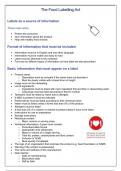
The Food Labelling Act
Labels as a source of information
Three main aims:
• Protect the consumer
• Give information about the product
• Help with healthy food choices
Format of information that must be included
• Information must be in English and one other language
• Information must be visible and easy to read
• Label must be attached to the container
• Font size for different types of information on food label are also prescribed
Basic information that must appear on a label
• Product name:
o Description must be included if the name does not describe it
o Must be clearly visible with at least 4mm in height
• Image must not be misleading
• List of ingredients:
o Ingredients must be listed with main ingredient first and then in descending order
o Colourings must be listed according to their E number
• Tartrazine must be listed by name due to allergies
• If MSG is present it must be indicated
• Preservatives must be listed according to their chemical name
• Water must be listed unless it forms less than 5% of the product
• Allergens must be listed
• If less than 2% of a vitamin or mineral is present doesn’t have to be listed
• Instructions for use or preparation
• Storage instructions
• Net/actual content
o Mass, volume or serving sizes
• Nutritional information, if given must contain:
o Prescribed table format
o Appropriate units (kilojoules)
o Mass or volume of a single serving
o Total fat, protein, carbohydrate and fibre content
o Inclusion of QUID
o Must specify if irradiated
• The logo of an organisation that endorses the product e.g. heart foundation or SABS
• Warning if the content is pressurised
• The name and address of the manufacturer
• Date stamps:
o Date of manufacturing
o Best before date
o Sell by date
, o Use by date
o Format: day-month-year
• Country of origin
• Batch identification number
• Client service helpline
• Barcode or price of product
• If nutritional claims are made they must be in compliance with
regulations
• If a product has less than 3kg of fat it must be labelled low fat
Misleading claims
• The department of health makes efforts to provide legislation regarding food labelling
regarding:
o Providing facts
o Avoid confusion through words or implication
o Providing information
• Any references to the department of health
• Words, pictures or descriptions that the product is supported by health professionals
• Organisations, associations or foundations that haven’t been approved by the department
of health
• Any endorsement regarding the nutritional or safety properties of the product unless it is
valid
• The words “healthy” or “wholesome” or any other word implying the product has health-
giving properties
• Claims such as “complete” or “balanced” that claim the food will give complete or balanced
nutrition
• The word “cure” or other medical claims
• The word “wild” for fish unless qualified
• Claims that nutritional value has been added when an ingredient has been added for a
different reason
• Claims that an ingredient is contained but is not in the packaging
• “no sugar added” if sugar has been added
• Frozen food that has been defrosted cannot be described as fresh
• Any word that does not comply with legal regulation
• Any word or statement that implies the product is healthier, additive free or claiming that the
product is free range unless registered by law
, Organic Food
• Food that has not been grown or treated with pesticides, fertilisers or hormones
• Agricultural farming involves growing produce in safe soil and no
modifications can occur to the crops
• Have slightly more antioxidants
• 25% of organic food carries synthetic pesticide residues in comparison to
77% of conventional food
• People that have certain allergies to foods, chemicals or preservatives feel
that if they eat only organic foods their symptoms lessen
• May deteriorate faster than conventionally grown products as they are preservative free
Feeding soils naturally
• Good, natural compost, together with kraal or chicken manure is correctly used to feed the
soil naturally instead of applying chemical fertilisers
• Release of greenhouse gases is reduced because well-cultivated fields retain them
• Plants growing in healthy soils have better defence against pests and diseases, reducing
the need for herbicides and pesticides
Effective use of the soil
• Fields are given time to recover through crop rotation and rest periods
• Fields are prepared and cultivated so that soil erosion will not take place
• Water is used sparingly and conserved
Biological pest and weed control is implemented
• Predator insets are used to control pest insects
• Some shrubs or plats can be planted to deter insects or pests
Crops suited to the climate and soil type are cultivated
• Encourages the best possible use of natural growth cycles
Taking care of animal welfare
• Animals are not kept in cages but allowed to roam freely, breathe in fresh air, graze freely,
choose their food and have the opportunity to socialise with other animals
• Animals are not fed GMO’s, growth stimulants or feed additives
• Animals do not receive medications or antibiotics
Where to buy from
• One of the problems in South Africa is that it is not always easy to obtain organic produce
• Woolworths has quite a substantial organic range
• Pick ‘n Pay is slowly introducing more organic produce to their shelves
• Local farmers markets often sell organic produce
, Advantages
Products are cultivated or reared without use of chemical pesticides, herbicides, fertilisers or
GMO’s
• Food is natural reducing health risks
Organically produced foods are probably more nutritious
• Vitamin and mineral content is probably higher
• Chemicals causing crops to ripe more quickly remove nutrients that would normally be
synthesises in food products during the natural ripening process
Organically produced food tastes better
• Taste of fruit and vegetables is directly related to their sugar content which in turn depends
on richness of their soil
Organically produced foods do not contain chemical preservatives or artificial additives
• Such as colourings or waxy substances
• Healthy plants grown in balanced soil are more resistant to diseases, pests, and droughts
Organic farming methods require less energy
• Fuels are not needed to manufacture or apply chemical fertilisers
Organic products are used to feed animals
• Animals do not use antibiotics or growth hormones
Less pollution
• No chemicals causing air or water pollution are used
More employment opportunities available
• Organic farming is labour intensive practice
Disadvantages
• Productivity can dwindle because it relies on living soil to build fertility
• GMO crops cannot be used – some are engineered to resist pests and tolerate herbicides
hence a larger yield
• May generate high greenhouse gasses with the production of certain produce
Organically produced foods are more expensive
• Production costs are higher due to labour intensive farming practices
• Risk of diseases, pets and weeds is higher
• Yields are lower
• Fewer shops stock organically produced foods so transport costs to farm markets can make
product more expensive
Fruit and vegetables have shorter shelf life
• No preservatives, waxy substances, or irradiation are used
Labels as a source of information
Three main aims:
• Protect the consumer
• Give information about the product
• Help with healthy food choices
Format of information that must be included
• Information must be in English and one other language
• Information must be visible and easy to read
• Label must be attached to the container
• Font size for different types of information on food label are also prescribed
Basic information that must appear on a label
• Product name:
o Description must be included if the name does not describe it
o Must be clearly visible with at least 4mm in height
• Image must not be misleading
• List of ingredients:
o Ingredients must be listed with main ingredient first and then in descending order
o Colourings must be listed according to their E number
• Tartrazine must be listed by name due to allergies
• If MSG is present it must be indicated
• Preservatives must be listed according to their chemical name
• Water must be listed unless it forms less than 5% of the product
• Allergens must be listed
• If less than 2% of a vitamin or mineral is present doesn’t have to be listed
• Instructions for use or preparation
• Storage instructions
• Net/actual content
o Mass, volume or serving sizes
• Nutritional information, if given must contain:
o Prescribed table format
o Appropriate units (kilojoules)
o Mass or volume of a single serving
o Total fat, protein, carbohydrate and fibre content
o Inclusion of QUID
o Must specify if irradiated
• The logo of an organisation that endorses the product e.g. heart foundation or SABS
• Warning if the content is pressurised
• The name and address of the manufacturer
• Date stamps:
o Date of manufacturing
o Best before date
o Sell by date
, o Use by date
o Format: day-month-year
• Country of origin
• Batch identification number
• Client service helpline
• Barcode or price of product
• If nutritional claims are made they must be in compliance with
regulations
• If a product has less than 3kg of fat it must be labelled low fat
Misleading claims
• The department of health makes efforts to provide legislation regarding food labelling
regarding:
o Providing facts
o Avoid confusion through words or implication
o Providing information
• Any references to the department of health
• Words, pictures or descriptions that the product is supported by health professionals
• Organisations, associations or foundations that haven’t been approved by the department
of health
• Any endorsement regarding the nutritional or safety properties of the product unless it is
valid
• The words “healthy” or “wholesome” or any other word implying the product has health-
giving properties
• Claims such as “complete” or “balanced” that claim the food will give complete or balanced
nutrition
• The word “cure” or other medical claims
• The word “wild” for fish unless qualified
• Claims that nutritional value has been added when an ingredient has been added for a
different reason
• Claims that an ingredient is contained but is not in the packaging
• “no sugar added” if sugar has been added
• Frozen food that has been defrosted cannot be described as fresh
• Any word that does not comply with legal regulation
• Any word or statement that implies the product is healthier, additive free or claiming that the
product is free range unless registered by law
, Organic Food
• Food that has not been grown or treated with pesticides, fertilisers or hormones
• Agricultural farming involves growing produce in safe soil and no
modifications can occur to the crops
• Have slightly more antioxidants
• 25% of organic food carries synthetic pesticide residues in comparison to
77% of conventional food
• People that have certain allergies to foods, chemicals or preservatives feel
that if they eat only organic foods their symptoms lessen
• May deteriorate faster than conventionally grown products as they are preservative free
Feeding soils naturally
• Good, natural compost, together with kraal or chicken manure is correctly used to feed the
soil naturally instead of applying chemical fertilisers
• Release of greenhouse gases is reduced because well-cultivated fields retain them
• Plants growing in healthy soils have better defence against pests and diseases, reducing
the need for herbicides and pesticides
Effective use of the soil
• Fields are given time to recover through crop rotation and rest periods
• Fields are prepared and cultivated so that soil erosion will not take place
• Water is used sparingly and conserved
Biological pest and weed control is implemented
• Predator insets are used to control pest insects
• Some shrubs or plats can be planted to deter insects or pests
Crops suited to the climate and soil type are cultivated
• Encourages the best possible use of natural growth cycles
Taking care of animal welfare
• Animals are not kept in cages but allowed to roam freely, breathe in fresh air, graze freely,
choose their food and have the opportunity to socialise with other animals
• Animals are not fed GMO’s, growth stimulants or feed additives
• Animals do not receive medications or antibiotics
Where to buy from
• One of the problems in South Africa is that it is not always easy to obtain organic produce
• Woolworths has quite a substantial organic range
• Pick ‘n Pay is slowly introducing more organic produce to their shelves
• Local farmers markets often sell organic produce
, Advantages
Products are cultivated or reared without use of chemical pesticides, herbicides, fertilisers or
GMO’s
• Food is natural reducing health risks
Organically produced foods are probably more nutritious
• Vitamin and mineral content is probably higher
• Chemicals causing crops to ripe more quickly remove nutrients that would normally be
synthesises in food products during the natural ripening process
Organically produced food tastes better
• Taste of fruit and vegetables is directly related to their sugar content which in turn depends
on richness of their soil
Organically produced foods do not contain chemical preservatives or artificial additives
• Such as colourings or waxy substances
• Healthy plants grown in balanced soil are more resistant to diseases, pests, and droughts
Organic farming methods require less energy
• Fuels are not needed to manufacture or apply chemical fertilisers
Organic products are used to feed animals
• Animals do not use antibiotics or growth hormones
Less pollution
• No chemicals causing air or water pollution are used
More employment opportunities available
• Organic farming is labour intensive practice
Disadvantages
• Productivity can dwindle because it relies on living soil to build fertility
• GMO crops cannot be used – some are engineered to resist pests and tolerate herbicides
hence a larger yield
• May generate high greenhouse gasses with the production of certain produce
Organically produced foods are more expensive
• Production costs are higher due to labour intensive farming practices
• Risk of diseases, pets and weeds is higher
• Yields are lower
• Fewer shops stock organically produced foods so transport costs to farm markets can make
product more expensive
Fruit and vegetables have shorter shelf life
• No preservatives, waxy substances, or irradiation are used