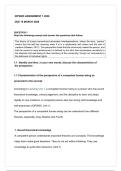
COMPULSORY ASSIGNMENT FOR SEMESTER 2: ASSIGNMENT 01
Total: 50
Study material: Lessons 1, 2 and 3
Weight: 25%
Due date: 26 August 2024
Unique number: 710960
Note: This is a written assignment that must be submitted on myUnisa, in PDF only.
QUESTION 1
Answer the following questions based on the excerpt below:
This perspective of a competent human being states that individuals are motivated by
internal needs and not external needs, such as rewards and punishment. According to this
perspective, motivation covers concepts such as desires, needs, wishes, drives and
interests.
1.1 Identify the perspective of a competent human being presented in the
excerpt.
The perspective presented in the excerpt is Abraham Maslow's Self-Actualisation
Theory. This theory emphasizes that individuals are motivated by internal needs, such
as desires, wishes, and interests, rather than external factors like rewards or
punishment.
1.2 To which paradigmatic stance does this perspective in the excerpt belong?
Maslow's Self-Actualisation Theory belongs to the Humanistic Paradigm. This stance
focuses on the intrinsic motivation and potential for personal growth that exists within
each individual.
1.3 Which other perspective/s reside in the same paradigm as the perspective in
the excerpt?
Other perspectives that reside in the Humanistic Paradigm include:
Carl Jung’s Individuation Theory
Victor Frankl’s Search for Meaning (Existentialist Theory)
These perspectives, like Maslow's, focus on self-awareness, self-knowledge, and the
individual's internal motivation for personal growth and meaning in life.
1.4 Now that you have identified the theory in the excerpt, in your own words,
discuss the characteristics of a competent human being as depicted in this
theory.
Total: 50
Study material: Lessons 1, 2 and 3
Weight: 25%
Due date: 26 August 2024
Unique number: 710960
Note: This is a written assignment that must be submitted on myUnisa, in PDF only.
QUESTION 1
Answer the following questions based on the excerpt below:
This perspective of a competent human being states that individuals are motivated by
internal needs and not external needs, such as rewards and punishment. According to this
perspective, motivation covers concepts such as desires, needs, wishes, drives and
interests.
1.1 Identify the perspective of a competent human being presented in the
excerpt.
The perspective presented in the excerpt is Abraham Maslow's Self-Actualisation
Theory. This theory emphasizes that individuals are motivated by internal needs, such
as desires, wishes, and interests, rather than external factors like rewards or
punishment.
1.2 To which paradigmatic stance does this perspective in the excerpt belong?
Maslow's Self-Actualisation Theory belongs to the Humanistic Paradigm. This stance
focuses on the intrinsic motivation and potential for personal growth that exists within
each individual.
1.3 Which other perspective/s reside in the same paradigm as the perspective in
the excerpt?
Other perspectives that reside in the Humanistic Paradigm include:
Carl Jung’s Individuation Theory
Victor Frankl’s Search for Meaning (Existentialist Theory)
These perspectives, like Maslow's, focus on self-awareness, self-knowledge, and the
individual's internal motivation for personal growth and meaning in life.
1.4 Now that you have identified the theory in the excerpt, in your own words,
discuss the characteristics of a competent human being as depicted in this
theory.