3 Property Rights, Real Rights & Creditors
Rights
PROPERTY RIGHTS
The right in a corporeal or incorporeal thing belonging to oneself is a real right.
The right in a corporeal or incorporeal thing belonging to another is a limited real right.
Whether it is a real right or a limited real right, it is always a right in a corporeal or incorporeal
thing.
A right against person is called a Personal right or Creditor’s right. This right entails that a person
must do something, refrain from doing something, pay someone or give someone something.
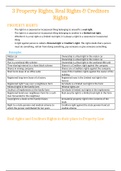
Examples
Motor car Ownership is a Real right in the motor car
House Ownership is a Real right in the motor car
Flat in a sectional title scheme Ownership is a Real right in the sectional title unit
Time-sharing interest in a share block scheme Shares is a Creditors right against the company
Shares in mining company Shares are a Creditors rights against the company
Short term lease of an office suite Lease if the Creditors rights against the owner of the
building
Registered long term lease of a factory Registered ease is the Limited real right in the
factory
Registered right f way over a neighbours farm Servitude is a limited real right in the farm
Mineral rights in the family farm Mineral rights are
Usufruct of implements on the family farm Servitude is limited real rights in the implements
Registered bond over neighbours farm for a cash Real security right is a limited real right in the farm
loan forwarded to the neighbour
Copyright to a book on the family history Immaterial property right in the contents of the
book
Right to a state pension and medical scheme to Creditors right against the state pension fund ad
which the person contributed for ten years medial scheme
Real rights and Creditors Rights in their place in Property Law
, Ownership and Limited Real Rights in corporeal property
Real rights are classified as either ownership or limited real rights.
Ownership is described as the most complete real right, only the real right in ones own property – the real
right ownership means the thig I question belongs to the owner.
Limited real rights are limited to specified uses of property which belongs to someone else.
Similar situation arises when a servitude is established.
If you grant your neighbour the right to use an access road over your arm, the neighbour acquires the right
to certain limited used of your property, while your ownership of the farm remains intact, although its
restricted temporarily y the existence of servitude.
You can still use the road yourself, but your ownership is restricted in the sense that you can no longer
exclude the neighbour from using the rad as determined by the servitude.
Limited real rights are limited to use ad enjoy property belonging to someone else, they conversely imply a
certain restriction of the owner’s entitlements of use and enjoyment/
Most important traditional categories of limited real rights are servitudes and real security rights, each of
which includes a number of well-established subcategories.
All real rights in corporeal property can be classified as either ownership or a limited real right.
The Distinction Between Real Rights and Creditor’s Rights in
Immovable Corporeal Property
The Problem with the Distinction
Both real and creditor’s rights are property rights because they are both;
i) acquired,
ii) exercised
iii) protected
In general it is difficult to decide whether certain rights, with regard to immovable things, are real
rights or creditor’s rights.
The exact nature and scope of the problem posed by this distinction;
A. The problem is largely restricted to corporeal property
B. The problem is restricted to limited real rights
C. The problem is largely restricted to immovable property (registration, may a condition be
registered? – real or creditor?)
D. The problem is limited to rights created in a will or contract (real or creditor? Only with new
rights created)
Rights
PROPERTY RIGHTS
The right in a corporeal or incorporeal thing belonging to oneself is a real right.
The right in a corporeal or incorporeal thing belonging to another is a limited real right.
Whether it is a real right or a limited real right, it is always a right in a corporeal or incorporeal
thing.
A right against person is called a Personal right or Creditor’s right. This right entails that a person
must do something, refrain from doing something, pay someone or give someone something.
Examples
Motor car Ownership is a Real right in the motor car
House Ownership is a Real right in the motor car
Flat in a sectional title scheme Ownership is a Real right in the sectional title unit
Time-sharing interest in a share block scheme Shares is a Creditors right against the company
Shares in mining company Shares are a Creditors rights against the company
Short term lease of an office suite Lease if the Creditors rights against the owner of the
building
Registered long term lease of a factory Registered ease is the Limited real right in the
factory
Registered right f way over a neighbours farm Servitude is a limited real right in the farm
Mineral rights in the family farm Mineral rights are
Usufruct of implements on the family farm Servitude is limited real rights in the implements
Registered bond over neighbours farm for a cash Real security right is a limited real right in the farm
loan forwarded to the neighbour
Copyright to a book on the family history Immaterial property right in the contents of the
book
Right to a state pension and medical scheme to Creditors right against the state pension fund ad
which the person contributed for ten years medial scheme
Real rights and Creditors Rights in their place in Property Law
, Ownership and Limited Real Rights in corporeal property
Real rights are classified as either ownership or limited real rights.
Ownership is described as the most complete real right, only the real right in ones own property – the real
right ownership means the thig I question belongs to the owner.
Limited real rights are limited to specified uses of property which belongs to someone else.
Similar situation arises when a servitude is established.
If you grant your neighbour the right to use an access road over your arm, the neighbour acquires the right
to certain limited used of your property, while your ownership of the farm remains intact, although its
restricted temporarily y the existence of servitude.
You can still use the road yourself, but your ownership is restricted in the sense that you can no longer
exclude the neighbour from using the rad as determined by the servitude.
Limited real rights are limited to use ad enjoy property belonging to someone else, they conversely imply a
certain restriction of the owner’s entitlements of use and enjoyment/
Most important traditional categories of limited real rights are servitudes and real security rights, each of
which includes a number of well-established subcategories.
All real rights in corporeal property can be classified as either ownership or a limited real right.
The Distinction Between Real Rights and Creditor’s Rights in
Immovable Corporeal Property
The Problem with the Distinction
Both real and creditor’s rights are property rights because they are both;
i) acquired,
ii) exercised
iii) protected
In general it is difficult to decide whether certain rights, with regard to immovable things, are real
rights or creditor’s rights.
The exact nature and scope of the problem posed by this distinction;
A. The problem is largely restricted to corporeal property
B. The problem is restricted to limited real rights
C. The problem is largely restricted to immovable property (registration, may a condition be
registered? – real or creditor?)
D. The problem is limited to rights created in a will or contract (real or creditor? Only with new
rights created)