TMS3725 ASSIGNMENT 4 2024
Question 1
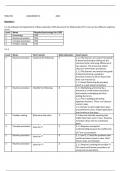
1.1 According to the Department of Basic education CAPS document for Mathematics FET, here are the different cognitive
levels:
Level Name Required percentage for CAPS
1 Knowledge 20%
2 Routine procedure 35%
3 Complex procedure 30%
4 Problem solving 15%
1.2.1
Level Name First 3 words Mark allocation Level reason
2 Routine procedure Factorise the following 7 1.1.1 The learners are aware from grade
9 about factorizing by taking out the
common factor and using difference of
two squares. The previously stated
steps are well-known procedures.
1.1.2 The learners are aware from grade
9 about factorizing a quadratic
trinomial. Factors of 54 are found and
their sum must be 15.
1.1.3 needs factorizing by grouping
which is a well-known procedure.
2 Routine procedure Simplify the following 8 1.2.1 Multiplying a binomial by a
trinomial is a well-known procedure
that involves multiplying out then
adding like terms.
1.2.2 This is adding/subtracting
algebraic fractions. There is an obvious
route to take.
1.2.3 Similar to what might have been
encountered in class. Simple application
that involves a few steps.
4 Problem solving Determine the value 3 1.3 does not look like anything that
might have been seen in class. Requires
to broken down into its constituent
parts
3 Complex procedure Solve for 2 2.1.1 Requires conceptual
understanding because the coefficients
of are not constants.
2 Routine procedure Solve for 6 2.1.2 and 2.1.3 look like problems that
could have been solved in class. Well-
known steps are followed.
2 Routine procedure Solve for 2 2.2.1 Requires isolating the variable .
This needs well-known procedures of
using inverse operations.
, 1 Knowledge Hence, write down 1 2.2.2 Needs recalling the numbers that
are in the set of integers and then
selecting those that lie in the found
inequality
2 Routine procedure Solve simultaneously for 4 2.3 May be solved using the well-known
procedures of substitution or
elimination. Hence, there is an obvious
route to take.
1 Knowledge Write down the 1 3.1 Using the mathematical fact that
the common difference is , the fourth
term may be found by simply
subtracting from the third term.
2 Routine procedure Determine the expression 2 3.2 involves find the general formula for
the th term. This is something that was
covered in class. Has certain routine
steps that are followed.
2 Routine procedure Calculate the number 2 This involves equating the general
formula to the last term and then
solving the linear equation for . Hence
it follows well-known steps. Use of
correct formula.
3 Complex procedure Which term is 3 3.4 does not have an obvious route to
take. Requires conceptual
understanding.
4 Problem solving What is the 2 3.5 This question is non-routine. Higher
order reasoning is required.
1 Knowledge The number of dots 1 4.1.1 uses basic mathematical facts
based on the current term, we find the
next term.
2 Routine procedure The number of dots 1 4.1.2 Simple application that needs a
few steps.
2 Routine procedure A formula for 1 4.1.3 There is an obvious route of
solving this problem.
3 Complex procedure Hence, or otherwise 3 4.2 Non-routine problem. Higher order
reasoning is needed.
1 Knowledge Coordinates of 2 5.1.1 Using the mathematical fact that
the intercept of is
1 Knowledge Range of 1 5.1.2 Using the mathematical fact that
the graph of with
has the range of
.
2 Routine procedure Coordinates of 2 5.2.1 needs the well-known steps of
finding the intercept.
3 Complex procedure Values of 4 5.2.2 Involves making connections
between different representations.
3 Complex procedure Length of 2 5.3.1 Involves making connections
between different representations.
Question 1
1.1 According to the Department of Basic education CAPS document for Mathematics FET, here are the different cognitive
levels:
Level Name Required percentage for CAPS
1 Knowledge 20%
2 Routine procedure 35%
3 Complex procedure 30%
4 Problem solving 15%
1.2.1
Level Name First 3 words Mark allocation Level reason
2 Routine procedure Factorise the following 7 1.1.1 The learners are aware from grade
9 about factorizing by taking out the
common factor and using difference of
two squares. The previously stated
steps are well-known procedures.
1.1.2 The learners are aware from grade
9 about factorizing a quadratic
trinomial. Factors of 54 are found and
their sum must be 15.
1.1.3 needs factorizing by grouping
which is a well-known procedure.
2 Routine procedure Simplify the following 8 1.2.1 Multiplying a binomial by a
trinomial is a well-known procedure
that involves multiplying out then
adding like terms.
1.2.2 This is adding/subtracting
algebraic fractions. There is an obvious
route to take.
1.2.3 Similar to what might have been
encountered in class. Simple application
that involves a few steps.
4 Problem solving Determine the value 3 1.3 does not look like anything that
might have been seen in class. Requires
to broken down into its constituent
parts
3 Complex procedure Solve for 2 2.1.1 Requires conceptual
understanding because the coefficients
of are not constants.
2 Routine procedure Solve for 6 2.1.2 and 2.1.3 look like problems that
could have been solved in class. Well-
known steps are followed.
2 Routine procedure Solve for 2 2.2.1 Requires isolating the variable .
This needs well-known procedures of
using inverse operations.
, 1 Knowledge Hence, write down 1 2.2.2 Needs recalling the numbers that
are in the set of integers and then
selecting those that lie in the found
inequality
2 Routine procedure Solve simultaneously for 4 2.3 May be solved using the well-known
procedures of substitution or
elimination. Hence, there is an obvious
route to take.
1 Knowledge Write down the 1 3.1 Using the mathematical fact that
the common difference is , the fourth
term may be found by simply
subtracting from the third term.
2 Routine procedure Determine the expression 2 3.2 involves find the general formula for
the th term. This is something that was
covered in class. Has certain routine
steps that are followed.
2 Routine procedure Calculate the number 2 This involves equating the general
formula to the last term and then
solving the linear equation for . Hence
it follows well-known steps. Use of
correct formula.
3 Complex procedure Which term is 3 3.4 does not have an obvious route to
take. Requires conceptual
understanding.
4 Problem solving What is the 2 3.5 This question is non-routine. Higher
order reasoning is required.
1 Knowledge The number of dots 1 4.1.1 uses basic mathematical facts
based on the current term, we find the
next term.
2 Routine procedure The number of dots 1 4.1.2 Simple application that needs a
few steps.
2 Routine procedure A formula for 1 4.1.3 There is an obvious route of
solving this problem.
3 Complex procedure Hence, or otherwise 3 4.2 Non-routine problem. Higher order
reasoning is needed.
1 Knowledge Coordinates of 2 5.1.1 Using the mathematical fact that
the intercept of is
1 Knowledge Range of 1 5.1.2 Using the mathematical fact that
the graph of with
has the range of
.
2 Routine procedure Coordinates of 2 5.2.1 needs the well-known steps of
finding the intercept.
3 Complex procedure Values of 4 5.2.2 Involves making connections
between different representations.
3 Complex procedure Length of 2 5.3.1 Involves making connections
between different representations.