

GRADE 12
VISUAL CULTURE
STUDIES
SUMMARIES
1
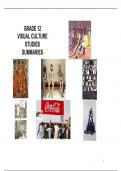
, Artists discussed
QUESTION 1 Emerging artists of South Gerard Sekoto, The song of the Pick
Africa Gerard Sekoto, Prison Yard
George Pemba, Portrait of a young Xhosa woman
George Pemba, Eviction – Woman and Child
QUESTION 2 South African artists Irma Stern, Pondo Woman
influenced by African and/or Irma Stern, The Hunt
indigenous art forms Walter Battiss, Fishermen Drawing Nets
Walter Battiss, Symbols of Life
QUESTION 3 Socio-political – including Jane Alexander, Butcher Boys
Resistance art of the ’70s and Jane Alexander, Bom Boys
’80s Manfred Zylla, Bullets and Sweets
Manfred Zylla, Death Trap
QUESTION 4 Art, craft and spiritual works John Muafangejo. Judas Iscariot betrayed our Lord Jesus for R3.00
mainly from rural South Africa John Muafangejo. New archbishop Desmond Tutu Enthroned
Jackson Hlungwani. Large Crucifix and star
Jackson Hlungwani, Leaping Fish
QUESTION 5 Multimedia and New media – William Kentridge, Johannesburg, 2nd Greatest City after Paris
alternative contemporary and William Kentridge. Shadow Procession
popular art forms in South Van der Merwe, Biegbak/Confessional
Africa Jan van der Merwe, Waiting
QUESTION 6 Post-1994 democratic identity Churchill Madikida, Struggles of the heart
in South Africa Churchill Madikida,Status
Hasan and Husain Essop, Thornton Road
Hasan and Husain Essop, Pit Bull Training
QUESTION 7 Gender issues Penelope Siopis, Patience on a monument
(Choose two artists) Penelope Siopis, Shame
Mary Sibande, ‘They don’t make them like they used to do’
Mary Sibande, Conversation with Madame C.J. Walker
Lisa Brice, Sex Show Works
Lisa Brice, Plastic makes perfect
Jane Alexander, Stripped (“Oh Yes” Girl)
QUESTION 8 Architecture in South Africa Not included in these summaries.
QUESTION 1: Emerging artists of South Africa
2
,GLOSSARY:
Apartheid was the policy of the National Party who came to power in South Africa in 1948. The idea was that different races should be kept separate.
Before 1948 – segregation between the races)
Township art is a term to describe the works of black artists that expressed township life in South Africa. It portrays everyday life such as shebeens, church, etc. It shows how
the black population adapted to urbanisation.
Historical Context:
In 1989 the Johannesburg Art Gallery presented an exhibition of black South African artists to the public called – The Neglected Tradition: towards a new history of South
African art (1930 – 1988). During apartheid there was very little written about the art of black people. This was an important exhibition to change perceptions and to see a more
represented history of South African art.
GERARD SEKOTO (1913 - 1993) GEORGE PEMBA (1912 – 2001)
He stayed in different SA townships such as Pemba was born in 1912 in a small rural village near
Sophiatown, District Six and Eastwood, Pretoria. In Port Elizabeth in the Eastern Cape. He received his
1947, Sekoto moved to Paris, France. He appears to school education in Paterson in the Eastern Cape and
have gone to broaden his artistic experience rather afterwards obtained his teacher’s qualification at the
than as a political exile, although the injustices of the Lovedale Teacher’s College in Alice in the in Eastern
racial situation played a role. He never returned to Cape. Pemba can be seen as a self-trained artist
South Africa, although his stay in Paris was not having only brief contacts with formal art training.
always happy.
INFLUENCES SUBJECT MATTER/THEMES INFLUENCES SUBJECT MATTER/THEMES
His surroundings in South Africa – the Urban scenes of everyday live in the European styles such as Realism – his Portraits and group portraits, social
vibrancy of the townships such as townships, figure compositions and portrayal of the poor in the townships in a documentation , religious works and
Sophiatown and District Six. portraits. A detailed and loving naturalistic way, Impressionism - the protest works. Although Pemba painted
Post-Impressionism. His intuitive sense of documentation of people and places he fleeting moment and Expressionism - some Eastern-Cape landscape, man was
colour links his work with Post- lived in subjective use of colour and distortion in his most important theme. New Brighton
Impressionism. some works. and its people, where he spent most of his
MEDIA: Mainly oil paintings MEDIA: Watercolours, oil paintings life, inspired a large part of his work.
STYLISTIC CHARACTERISTICS ISSUES THAT HIS WORKS STYLISTIC CHARACTERISTICS ISSUES THAT HIS WORKS
RAISES/HIS CONTRIBUTION RAISES/HIS CONTRIBUTION
Figurative; highly subjective colours create His paintings often do not show the harsh A strong feeling for shape in his work - Underlaying themes/issues such as fear,
an emotional impact; His shapes have a reality of life in the townships, but are solid with weight, descriptive and flight, joy, lost, everyday life, cultural
roundness and solidity; Love for patterns; rather involved with exploration of sometimes simplified and with traditions, human right, religion and
for instance the sink roofs portrayed as formal elements. A rather idealized view expressionistic distortion: Early political subjects form his work.His work
parallel lines; Distortion and his often- of these communities. His work is never watercolor works show subtle descriptive gives an interesting view of the changes in
clumsy handling of shapes; Unusual threatening or political, although he shows colors. In later works there are large South Africa – the traditional rural tribal
perspective; His figure compositions often sympathy for his subjects and their color contrasts with sharp contrasts life replaced by urbanisation, as well as
do not depict faces of the people ; circumstances. His work documents areas between light and dark. Primary and political injustices. In his work one gets a
Emotional response/created a strong of South Africa which no longer exist, and secondary colors together with white feeling of togetherness between people –
atmosphere. forms an important historical record of life areas are characteristic of his works. a society that stands together although
in Sophiatown and District Six. One of they are suffering.
pioneers of black art in South Africa and
one of first to make a living from his art.
QUESTION 1: Emerging artists of STYLE OF WORK MEDIUM AND TECHNIQUE
3
, South Africa Figurative Oil painting with strong brushstrokes
TITLE MESSAGE AND MEANING
Gerard Sekoto, The song of the Pick, One of Sekoto’s most political works with
oil painting, 1946 – 47. a contrast between the physical powers of the
workers with the weakness of the white warden.
SUBJECT AND DESCRIPTION The work shows that the black workers, although
subordinated to the white boss, are actually the
Figure composition. The subject is a stronger figures. The title is suitable – the viewer
group of black workers with their can nearly ‘hear’ the song of the pick in this
picks, while a white pipe-smoking visual work.
warden watches them. All the focus is
on the workers with their identical
postures with their picks high above
their heads.
FORMAL ART ELEMENTS
Sekoto simplified shapes
The black figures form a strong diagonal line.
The colour is predominantly in primary colours – red, yellow and blue.
The emotional impact of this works is result of his highly subjective colours.
He created roundness and solidity in his shapes by the strong contrasts between light and dark.
Sekoto cropped the top (not all the picks are visible) which places the viewer in the middle of the action.
The composition is strongly asymmetrical with the large group of workers on the left that are balanced by the small figure of
the warden on the right.
Rhythm is created by the repetition of shapes and colours.
QUESTION 1: Emerging artists of STYLE OF WORK MEDIUM AND TECHNIQUE
South Africa Oil painting with strong brushstrokes
4
VISUAL CULTURE
STUDIES
SUMMARIES
1
, Artists discussed
QUESTION 1 Emerging artists of South Gerard Sekoto, The song of the Pick
Africa Gerard Sekoto, Prison Yard
George Pemba, Portrait of a young Xhosa woman
George Pemba, Eviction – Woman and Child
QUESTION 2 South African artists Irma Stern, Pondo Woman
influenced by African and/or Irma Stern, The Hunt
indigenous art forms Walter Battiss, Fishermen Drawing Nets
Walter Battiss, Symbols of Life
QUESTION 3 Socio-political – including Jane Alexander, Butcher Boys
Resistance art of the ’70s and Jane Alexander, Bom Boys
’80s Manfred Zylla, Bullets and Sweets
Manfred Zylla, Death Trap
QUESTION 4 Art, craft and spiritual works John Muafangejo. Judas Iscariot betrayed our Lord Jesus for R3.00
mainly from rural South Africa John Muafangejo. New archbishop Desmond Tutu Enthroned
Jackson Hlungwani. Large Crucifix and star
Jackson Hlungwani, Leaping Fish
QUESTION 5 Multimedia and New media – William Kentridge, Johannesburg, 2nd Greatest City after Paris
alternative contemporary and William Kentridge. Shadow Procession
popular art forms in South Van der Merwe, Biegbak/Confessional
Africa Jan van der Merwe, Waiting
QUESTION 6 Post-1994 democratic identity Churchill Madikida, Struggles of the heart
in South Africa Churchill Madikida,Status
Hasan and Husain Essop, Thornton Road
Hasan and Husain Essop, Pit Bull Training
QUESTION 7 Gender issues Penelope Siopis, Patience on a monument
(Choose two artists) Penelope Siopis, Shame
Mary Sibande, ‘They don’t make them like they used to do’
Mary Sibande, Conversation with Madame C.J. Walker
Lisa Brice, Sex Show Works
Lisa Brice, Plastic makes perfect
Jane Alexander, Stripped (“Oh Yes” Girl)
QUESTION 8 Architecture in South Africa Not included in these summaries.
QUESTION 1: Emerging artists of South Africa
2
,GLOSSARY:
Apartheid was the policy of the National Party who came to power in South Africa in 1948. The idea was that different races should be kept separate.
Before 1948 – segregation between the races)
Township art is a term to describe the works of black artists that expressed township life in South Africa. It portrays everyday life such as shebeens, church, etc. It shows how
the black population adapted to urbanisation.
Historical Context:
In 1989 the Johannesburg Art Gallery presented an exhibition of black South African artists to the public called – The Neglected Tradition: towards a new history of South
African art (1930 – 1988). During apartheid there was very little written about the art of black people. This was an important exhibition to change perceptions and to see a more
represented history of South African art.
GERARD SEKOTO (1913 - 1993) GEORGE PEMBA (1912 – 2001)
He stayed in different SA townships such as Pemba was born in 1912 in a small rural village near
Sophiatown, District Six and Eastwood, Pretoria. In Port Elizabeth in the Eastern Cape. He received his
1947, Sekoto moved to Paris, France. He appears to school education in Paterson in the Eastern Cape and
have gone to broaden his artistic experience rather afterwards obtained his teacher’s qualification at the
than as a political exile, although the injustices of the Lovedale Teacher’s College in Alice in the in Eastern
racial situation played a role. He never returned to Cape. Pemba can be seen as a self-trained artist
South Africa, although his stay in Paris was not having only brief contacts with formal art training.
always happy.
INFLUENCES SUBJECT MATTER/THEMES INFLUENCES SUBJECT MATTER/THEMES
His surroundings in South Africa – the Urban scenes of everyday live in the European styles such as Realism – his Portraits and group portraits, social
vibrancy of the townships such as townships, figure compositions and portrayal of the poor in the townships in a documentation , religious works and
Sophiatown and District Six. portraits. A detailed and loving naturalistic way, Impressionism - the protest works. Although Pemba painted
Post-Impressionism. His intuitive sense of documentation of people and places he fleeting moment and Expressionism - some Eastern-Cape landscape, man was
colour links his work with Post- lived in subjective use of colour and distortion in his most important theme. New Brighton
Impressionism. some works. and its people, where he spent most of his
MEDIA: Mainly oil paintings MEDIA: Watercolours, oil paintings life, inspired a large part of his work.
STYLISTIC CHARACTERISTICS ISSUES THAT HIS WORKS STYLISTIC CHARACTERISTICS ISSUES THAT HIS WORKS
RAISES/HIS CONTRIBUTION RAISES/HIS CONTRIBUTION
Figurative; highly subjective colours create His paintings often do not show the harsh A strong feeling for shape in his work - Underlaying themes/issues such as fear,
an emotional impact; His shapes have a reality of life in the townships, but are solid with weight, descriptive and flight, joy, lost, everyday life, cultural
roundness and solidity; Love for patterns; rather involved with exploration of sometimes simplified and with traditions, human right, religion and
for instance the sink roofs portrayed as formal elements. A rather idealized view expressionistic distortion: Early political subjects form his work.His work
parallel lines; Distortion and his often- of these communities. His work is never watercolor works show subtle descriptive gives an interesting view of the changes in
clumsy handling of shapes; Unusual threatening or political, although he shows colors. In later works there are large South Africa – the traditional rural tribal
perspective; His figure compositions often sympathy for his subjects and their color contrasts with sharp contrasts life replaced by urbanisation, as well as
do not depict faces of the people ; circumstances. His work documents areas between light and dark. Primary and political injustices. In his work one gets a
Emotional response/created a strong of South Africa which no longer exist, and secondary colors together with white feeling of togetherness between people –
atmosphere. forms an important historical record of life areas are characteristic of his works. a society that stands together although
in Sophiatown and District Six. One of they are suffering.
pioneers of black art in South Africa and
one of first to make a living from his art.
QUESTION 1: Emerging artists of STYLE OF WORK MEDIUM AND TECHNIQUE
3
, South Africa Figurative Oil painting with strong brushstrokes
TITLE MESSAGE AND MEANING
Gerard Sekoto, The song of the Pick, One of Sekoto’s most political works with
oil painting, 1946 – 47. a contrast between the physical powers of the
workers with the weakness of the white warden.
SUBJECT AND DESCRIPTION The work shows that the black workers, although
subordinated to the white boss, are actually the
Figure composition. The subject is a stronger figures. The title is suitable – the viewer
group of black workers with their can nearly ‘hear’ the song of the pick in this
picks, while a white pipe-smoking visual work.
warden watches them. All the focus is
on the workers with their identical
postures with their picks high above
their heads.
FORMAL ART ELEMENTS
Sekoto simplified shapes
The black figures form a strong diagonal line.
The colour is predominantly in primary colours – red, yellow and blue.
The emotional impact of this works is result of his highly subjective colours.
He created roundness and solidity in his shapes by the strong contrasts between light and dark.
Sekoto cropped the top (not all the picks are visible) which places the viewer in the middle of the action.
The composition is strongly asymmetrical with the large group of workers on the left that are balanced by the small figure of
the warden on the right.
Rhythm is created by the repetition of shapes and colours.
QUESTION 1: Emerging artists of STYLE OF WORK MEDIUM AND TECHNIQUE
South Africa Oil painting with strong brushstrokes
4


