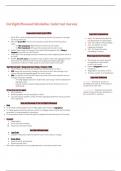
Civil Rights Movement Introduction, Context and Overview
Origins and Context by the 1950s Important Organizations
- By the 1950s, racist attitudes and white supremacy had led to an erosion of. civil rights
• NAACP: The National Association for
for African Americans.
the Advancement of Colored People
• After the US Civil War, new laws were passed to grant African Americans political • CORE: The Congress of Racial Equality
rights:
• SCLC: The Southern Christian
- The 14th Amendment (1868) made African Americans full citizens.
- The 15th Amendment (1870) gave African Americans the right to vote. Leadership Conference
• SNCC: The Student Nonviolent
• Despite these rulings, the Supreme Court upheld racial segregation and in Plessy v.
Ferguson, they ruled it as constitutional. Coordinating Committee
• These rights were gradually removed as conservative whites regained political control in
the South. What Inspired the Movement?
• BY 1900: 'Jim Crow Laws' were passed in most Southern states that segregated African
Americans from white Americans (in schools, housing, jobs & public gatherings) - • The Christian non-violent approach
Continued the treatment of black people as second-class citizens in the South. (civil disobedience and peaceful
protests were used).
'Separate but Equal' - Background Case: Plessy v. Ferguson (1896) • Gandhi's satyagraha ('passive
• Homer Plessy was 1/8 black, but classified by Louisiana state law as black. resistance')
• 1892: Plessy was arrested for refusing to move from the first class carriage to the • Independence movements in Africa.
'colored' carriage and appealed against the court's decision. • Thoreau's concept of civil disobedience.
• 1896: The Supreme Court ruled that: blacks and whites could receive separate services
so long as they were equivalent Important Definitions
- The ruling legally accepted the 'separate but equal' policy in US life and allowed for
segregation laws. Segregation: The policy or practice of
- However, facilities remained largely unequal and African Americans were at a compelling racial, class or ethnic groups to
disadvantage. live apart from each other,
African American Struggles: Civil disobedience: Deliberate and nonviolent
• 10% of population. refusal to obey certain laws, demands as a
• Suffered prejudice in South and ghettos in North. form of protest or resistance.
• Laws not followed: Southern schools remained segregated by 1954 and racists prevents
voter registration.
Aims and Demands of the Civil Rights Movement
• Aims
• To encourage ordinary people to join the fight against discrimination & segregation.
• To change government policies and laws in effort to challenge southern states and the federal
government to provide equality & social justice.
• To use peaceful protests to end social injustice & integrate African Americans into US society.
• Demands:
I. Desegregation
II. End to racist discrimination
III. Equal access and opportunities
Two Main Methods Used
1. Legal Route
• Using the constitution to get the Supreme Court to force sates to comply,\
2. Direct Action
• Aimed at specific discrimination.
• Peaceful protest action
- Both used in conjunction as a two-pronged approach in successful protest action.
, Civil Rights Movement Protests: 1950s
1) Brown v. Topeka Board of Education - 1954
Linda Carol Brown
• Black student living in Topeka, Kansas.
• The all-white primary school refused to enroll her despite her having to walk past it everyday.
The Court Case
• Early 1950s: The NAACP attempted to challenge the doctrine of 'separate but equal' by:
- Arguing that segregation violated the constitution (14th Amendment).
- Showing the psychological damage created by segregation through the 'Doll Test'.
§ The 'Doll Test' showed that prejudice and segregation caused black children to develop a sense of inferiority.
Extent of Success
• .The NAACP took Brown's case to the Supreme Court.
• In 1954, the Supreme Court ruled that segregation in public schools was illegal.
○ HOWEVER: Despite ruling, most Southern schools remained segregated.
• Led to Brown v. Board of Education || (Brown ||)
- The court ordered the still segregated schools to allow black children "with all deliberate speed".
- The court also set out rules on how to desegregate and explained how the US government would ensure that schools did desegregate.
2) Little Rock Nine, Arkansas - 1957
Context
• Despite 1954 ruling, schools remained segregated and blatantly unequal
• Central High School Little Rock: Built in 1927 for $1,5 million and was one of the most expensive, beautiful and largest high schools in the nation.
• Horace Mann High School: Built opened in 1956 for black students and regarded by the superintendent as "the very best this community has to offer".
Summary of events
On 3 September, Judge Davies ordered desegregation to begin after overturning a mother's injunction, and in response to the Arkansas Governor Faubus sending
the National Guard to the school to 'avoid violence'. On the 4 September, 9 African Americans attempted to enter Central High school after being accepted, but were
blocked by the Arkansas National Guard. On 10 September, the federal government compelled Gov. Faubus to obey the desegregation order by filing an injunction and
on the 14th, Pres. Eisenhower met with him to discuss the crisis. On the 20th, the National Guard was removed from Davies' orders and large angry white groups
protested angrily outside the school. Federal troops had to remain at the school to escort the Little Rock nine to class for 6 weeks from the 25th until tensions died
down.
Extent of Successes
• Despite being against the Brown decision, Pres. Eisenhower became the first US president to send federal troops to protect African American rights.
• Ernest Green graduated in 1958 as the first black student to graduate from Central High School.
3) Montgomery Bus Boycott - 1955-56
Context
• The bus boycott was a pivotal example of civil disobedience that shifted the battle for equal rights from court rulings to everyday life.
• The Montgomery community had been organizing for years by the time Rosa Parks protested.
• 1 Dec 1955: Parks was arrested for refusing to give up her seat to a white man (convicted of breaking segregation laws)
Aim
• To end segregation on buses.
Method:
Direct Action Legal Route
• 5 Dec 1955: A 1 day boycott was organized by the Montgomery • The NAACP fought the case Browder v. Gayle
Improvement Association (MIA) and 90% of the black citizens which led to a Supreme Court ruling making
stayed off the buses. local bus segregation illegal.
• The boycott was so widely supported, it turned into a 13- • 20 Dec 1956: Court outlawed segregation of
month mass protest. buses.
• Black citizens either walked or shared lifts.
• The bus company lost 65% of their profits
Extent of Success
• Segregation on public buses ruled unconstitutional by the Supreme Court.
• Martin Luther King, Jr became a prominent civil rights leader as he was the first president of the MIA.
• More international attention focused on Montgomery.
• The boycott displayed the potential for nonviolent mass protests to challenge segregation.
• The boycott inspired following Southern campaigns.
Impact by the End of the 1950s
○ Despite successes achieved in rulings for the desegregation of schools and desegregation of buses, African Americans
continued to be treated as second-class citizens in the South.
○ Legal change was slow to follow.
• Martin Luther King emerged as the leader of the CRM (strongly committed to securing change through non-violent
methods) as a result of the bus boycott.
Origins and Context by the 1950s Important Organizations
- By the 1950s, racist attitudes and white supremacy had led to an erosion of. civil rights
• NAACP: The National Association for
for African Americans.
the Advancement of Colored People
• After the US Civil War, new laws were passed to grant African Americans political • CORE: The Congress of Racial Equality
rights:
• SCLC: The Southern Christian
- The 14th Amendment (1868) made African Americans full citizens.
- The 15th Amendment (1870) gave African Americans the right to vote. Leadership Conference
• SNCC: The Student Nonviolent
• Despite these rulings, the Supreme Court upheld racial segregation and in Plessy v.
Ferguson, they ruled it as constitutional. Coordinating Committee
• These rights were gradually removed as conservative whites regained political control in
the South. What Inspired the Movement?
• BY 1900: 'Jim Crow Laws' were passed in most Southern states that segregated African
Americans from white Americans (in schools, housing, jobs & public gatherings) - • The Christian non-violent approach
Continued the treatment of black people as second-class citizens in the South. (civil disobedience and peaceful
protests were used).
'Separate but Equal' - Background Case: Plessy v. Ferguson (1896) • Gandhi's satyagraha ('passive
• Homer Plessy was 1/8 black, but classified by Louisiana state law as black. resistance')
• 1892: Plessy was arrested for refusing to move from the first class carriage to the • Independence movements in Africa.
'colored' carriage and appealed against the court's decision. • Thoreau's concept of civil disobedience.
• 1896: The Supreme Court ruled that: blacks and whites could receive separate services
so long as they were equivalent Important Definitions
- The ruling legally accepted the 'separate but equal' policy in US life and allowed for
segregation laws. Segregation: The policy or practice of
- However, facilities remained largely unequal and African Americans were at a compelling racial, class or ethnic groups to
disadvantage. live apart from each other,
African American Struggles: Civil disobedience: Deliberate and nonviolent
• 10% of population. refusal to obey certain laws, demands as a
• Suffered prejudice in South and ghettos in North. form of protest or resistance.
• Laws not followed: Southern schools remained segregated by 1954 and racists prevents
voter registration.
Aims and Demands of the Civil Rights Movement
• Aims
• To encourage ordinary people to join the fight against discrimination & segregation.
• To change government policies and laws in effort to challenge southern states and the federal
government to provide equality & social justice.
• To use peaceful protests to end social injustice & integrate African Americans into US society.
• Demands:
I. Desegregation
II. End to racist discrimination
III. Equal access and opportunities
Two Main Methods Used
1. Legal Route
• Using the constitution to get the Supreme Court to force sates to comply,\
2. Direct Action
• Aimed at specific discrimination.
• Peaceful protest action
- Both used in conjunction as a two-pronged approach in successful protest action.
, Civil Rights Movement Protests: 1950s
1) Brown v. Topeka Board of Education - 1954
Linda Carol Brown
• Black student living in Topeka, Kansas.
• The all-white primary school refused to enroll her despite her having to walk past it everyday.
The Court Case
• Early 1950s: The NAACP attempted to challenge the doctrine of 'separate but equal' by:
- Arguing that segregation violated the constitution (14th Amendment).
- Showing the psychological damage created by segregation through the 'Doll Test'.
§ The 'Doll Test' showed that prejudice and segregation caused black children to develop a sense of inferiority.
Extent of Success
• .The NAACP took Brown's case to the Supreme Court.
• In 1954, the Supreme Court ruled that segregation in public schools was illegal.
○ HOWEVER: Despite ruling, most Southern schools remained segregated.
• Led to Brown v. Board of Education || (Brown ||)
- The court ordered the still segregated schools to allow black children "with all deliberate speed".
- The court also set out rules on how to desegregate and explained how the US government would ensure that schools did desegregate.
2) Little Rock Nine, Arkansas - 1957
Context
• Despite 1954 ruling, schools remained segregated and blatantly unequal
• Central High School Little Rock: Built in 1927 for $1,5 million and was one of the most expensive, beautiful and largest high schools in the nation.
• Horace Mann High School: Built opened in 1956 for black students and regarded by the superintendent as "the very best this community has to offer".
Summary of events
On 3 September, Judge Davies ordered desegregation to begin after overturning a mother's injunction, and in response to the Arkansas Governor Faubus sending
the National Guard to the school to 'avoid violence'. On the 4 September, 9 African Americans attempted to enter Central High school after being accepted, but were
blocked by the Arkansas National Guard. On 10 September, the federal government compelled Gov. Faubus to obey the desegregation order by filing an injunction and
on the 14th, Pres. Eisenhower met with him to discuss the crisis. On the 20th, the National Guard was removed from Davies' orders and large angry white groups
protested angrily outside the school. Federal troops had to remain at the school to escort the Little Rock nine to class for 6 weeks from the 25th until tensions died
down.
Extent of Successes
• Despite being against the Brown decision, Pres. Eisenhower became the first US president to send federal troops to protect African American rights.
• Ernest Green graduated in 1958 as the first black student to graduate from Central High School.
3) Montgomery Bus Boycott - 1955-56
Context
• The bus boycott was a pivotal example of civil disobedience that shifted the battle for equal rights from court rulings to everyday life.
• The Montgomery community had been organizing for years by the time Rosa Parks protested.
• 1 Dec 1955: Parks was arrested for refusing to give up her seat to a white man (convicted of breaking segregation laws)
Aim
• To end segregation on buses.
Method:
Direct Action Legal Route
• 5 Dec 1955: A 1 day boycott was organized by the Montgomery • The NAACP fought the case Browder v. Gayle
Improvement Association (MIA) and 90% of the black citizens which led to a Supreme Court ruling making
stayed off the buses. local bus segregation illegal.
• The boycott was so widely supported, it turned into a 13- • 20 Dec 1956: Court outlawed segregation of
month mass protest. buses.
• Black citizens either walked or shared lifts.
• The bus company lost 65% of their profits
Extent of Success
• Segregation on public buses ruled unconstitutional by the Supreme Court.
• Martin Luther King, Jr became a prominent civil rights leader as he was the first president of the MIA.
• More international attention focused on Montgomery.
• The boycott displayed the potential for nonviolent mass protests to challenge segregation.
• The boycott inspired following Southern campaigns.
Impact by the End of the 1950s
○ Despite successes achieved in rulings for the desegregation of schools and desegregation of buses, African Americans
continued to be treated as second-class citizens in the South.
○ Legal change was slow to follow.
• Martin Luther King emerged as the leader of the CRM (strongly committed to securing change through non-violent
methods) as a result of the bus boycott.