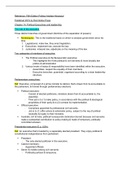
Theme 2 [Types of Psychological Assessment Measures]:
Chapter 10, 12, 13 (Section 13.2) & 15 (Section 15.2 and 15.3)
Chapter 10: Assessment of Cognitive Functioning:
Introduction:
Cognitive ability remained on forefront of psychological assessment – clear & significant
predictor of success in the work & educational contexts. Results from meta analyses – show
stronger evidence of trends in research because they’re based on the collation of large
numbers of similar studies – indicated that cog assessments results are valid predictors of job
performance & training results with predictive validity correlations (indicating
statistical/practical significance)
Theories of intelligence: A Brief History and Overview:
Background
Researchers: Alfred Binet & Theodore Simon used more complex tasks of reasoning/thinking
to measure intelligence – develop techniques for identifying children in need of special
education. Binet wanted test scores to be used practically & not on the basis for a theory of
intellect. Renewed measure of Binet-Simon measure – dynamic assessment
Another modern method that reflects the Binet-Simon approach to assessment –
Computerised Adaptive Testing (CAT)
In adaptive assessment the difficulty level of items is calculated beforehand & items are
interactively selected during assessment to match the estimated ability level of test-taker.
A SA test that utilises this technology: Learning Potential Computerised Adaptive Test (LPCAT).
The modern version of this approach is based on Item Response Theory (IRT) & the use of
interactive computer programmes. However, in principle Binet & Simon applied these same
principles & used the assessment practitioner’s judgement to decide which entry-level item
the child should get first. They made use of: ceiling level by terminating the measure if a
certain number of items at a specific level were answered incorrectly.
New developments in use of computerised adaptive testing include: cognitive diagnostic
assessment (CDA) - educational domain. Where diagnostic assessment linked to remedial
instruction in these areas where lower performance levels are indicated.
Multidimensional computerised adaptive testing (MCAT) shown: offer shorter tests, improve
test precision & increase selection utility compared to traditional testing
Controversy between Spearman’s and Thurstone’s Theories: question of whether intelligence
is influenced by a single general factor or by multiple factors. Both theories actively used
today.
1
, In SA: our country is adapting to the integration of different cultures & guidelines on equity
and affirmative action have been introduced into our legislation
Defining Intelligence:
Psychologists today don’t agree on how to define cognitive functioning/intelligence; how to
explain exactly the way in which it functions; how it should be measured – this complicates
effort in understanding the concept & difficult to build theories/construct procedures &
methods to measure intelligence.
Distinguish between different types of intelligence: biological, psychometric & social
(emotional) intelligence.
- Biological intelligence: focus on physical structure & functioning of brain in ways that
can be measured objectively
- Psychometric Intelligence: we use mainly standardised psychological tests to measure
levels of functioning on psychologically defined constructs. these measures make use
of various types of items & assumption is that ability to display the type of behaviour
needed to correctly answer these items reflects some form on intelligent behaviour
- Social or Contextual (Emotional): defines construct of intelligence in terms of adaptive
behaviour & argues that we must define intelligent behaviour within the particular
context where we find it.
Based on the assumption that the underlying constructs measured by these tests are
universal, test have been adapted and standardised for use in multicultural contexts (an etic
approach)
Greater provision made for: indigenous conceptualisation of the nature & structure of
intelligence (an emic approach)
Cultural environments determine which abilities are preferred & promoted as meaningful
which implies that understanding & respecting the context within which specific abilities are
valued is vital
In addition to intra- and interpersonal domains, cognitive abilities and education were valued
as means to participate in modern economies
Sternberg’s notion of contextual intelligence – environmental demands and priorities
determine which abilities are valued.
Wechsler’s definition of intelligence: as the capacity of the individual to ‘act purposefully, to
think rationally, and to deal effectively with his environment’ retains its relevance also within
different cultural contexts
Theories of Intelligence:
One general factor (g):
Spearman: 1st to suggest that a single general factor (g) – used to explain differences between
individuals.
2
Chapter 10, 12, 13 (Section 13.2) & 15 (Section 15.2 and 15.3)
Chapter 10: Assessment of Cognitive Functioning:
Introduction:
Cognitive ability remained on forefront of psychological assessment – clear & significant
predictor of success in the work & educational contexts. Results from meta analyses – show
stronger evidence of trends in research because they’re based on the collation of large
numbers of similar studies – indicated that cog assessments results are valid predictors of job
performance & training results with predictive validity correlations (indicating
statistical/practical significance)
Theories of intelligence: A Brief History and Overview:
Background
Researchers: Alfred Binet & Theodore Simon used more complex tasks of reasoning/thinking
to measure intelligence – develop techniques for identifying children in need of special
education. Binet wanted test scores to be used practically & not on the basis for a theory of
intellect. Renewed measure of Binet-Simon measure – dynamic assessment
Another modern method that reflects the Binet-Simon approach to assessment –
Computerised Adaptive Testing (CAT)
In adaptive assessment the difficulty level of items is calculated beforehand & items are
interactively selected during assessment to match the estimated ability level of test-taker.
A SA test that utilises this technology: Learning Potential Computerised Adaptive Test (LPCAT).
The modern version of this approach is based on Item Response Theory (IRT) & the use of
interactive computer programmes. However, in principle Binet & Simon applied these same
principles & used the assessment practitioner’s judgement to decide which entry-level item
the child should get first. They made use of: ceiling level by terminating the measure if a
certain number of items at a specific level were answered incorrectly.
New developments in use of computerised adaptive testing include: cognitive diagnostic
assessment (CDA) - educational domain. Where diagnostic assessment linked to remedial
instruction in these areas where lower performance levels are indicated.
Multidimensional computerised adaptive testing (MCAT) shown: offer shorter tests, improve
test precision & increase selection utility compared to traditional testing
Controversy between Spearman’s and Thurstone’s Theories: question of whether intelligence
is influenced by a single general factor or by multiple factors. Both theories actively used
today.
1
, In SA: our country is adapting to the integration of different cultures & guidelines on equity
and affirmative action have been introduced into our legislation
Defining Intelligence:
Psychologists today don’t agree on how to define cognitive functioning/intelligence; how to
explain exactly the way in which it functions; how it should be measured – this complicates
effort in understanding the concept & difficult to build theories/construct procedures &
methods to measure intelligence.
Distinguish between different types of intelligence: biological, psychometric & social
(emotional) intelligence.
- Biological intelligence: focus on physical structure & functioning of brain in ways that
can be measured objectively
- Psychometric Intelligence: we use mainly standardised psychological tests to measure
levels of functioning on psychologically defined constructs. these measures make use
of various types of items & assumption is that ability to display the type of behaviour
needed to correctly answer these items reflects some form on intelligent behaviour
- Social or Contextual (Emotional): defines construct of intelligence in terms of adaptive
behaviour & argues that we must define intelligent behaviour within the particular
context where we find it.
Based on the assumption that the underlying constructs measured by these tests are
universal, test have been adapted and standardised for use in multicultural contexts (an etic
approach)
Greater provision made for: indigenous conceptualisation of the nature & structure of
intelligence (an emic approach)
Cultural environments determine which abilities are preferred & promoted as meaningful
which implies that understanding & respecting the context within which specific abilities are
valued is vital
In addition to intra- and interpersonal domains, cognitive abilities and education were valued
as means to participate in modern economies
Sternberg’s notion of contextual intelligence – environmental demands and priorities
determine which abilities are valued.
Wechsler’s definition of intelligence: as the capacity of the individual to ‘act purposefully, to
think rationally, and to deal effectively with his environment’ retains its relevance also within
different cultural contexts
Theories of Intelligence:
One general factor (g):
Spearman: 1st to suggest that a single general factor (g) – used to explain differences between
individuals.
2