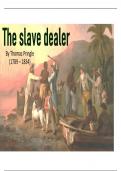
By Thomas Pringle
(1789 – 1834)
,• Thomas Pringle was born in Scotland on 5 January 1789 and emigrated to South Africa
in 1820, along with the English settlers. Even though he spent only six year in South Africa,
Pringle is often been called the ‘Father of South African Poetry in English.”
• He published his work in a newspaper and magazine while living in Cape Town, in everything he
wrote he spoke out against the cruelty of slavery – he wated it abolished.
• Slave trading was a lucrative/profitable business and Pringle’s views were unpopular – his
publications were suppressed in order to silence his objections and calls for reform.
• Unable to make a living from writing, Pringle returned to London in 1826 but continued to speak
out about the horror and injustice of slavery.
• He dedicated the rest of his life to the antislavery movement, and later became the secretary of
the Anti-Slavery Society.
• The work of this society eventually led to the abolition of slavery in the British colonies.
• Pringle did not live to see the passing of the act to abolish slavery in 1838, he died of
Tuberculosis (TB) on 4 December 1834, at the age of 45.
• He was buried in Bunhill Fields, London, but in 1970 his remains were returned to South Africa
and interred at a church near the farm that his family had owned in the Baviaans Valley.
, Slave trade in South
Africa:
• In 1658 the ship Amersfoort delivered 174 Angolian
slaves in the Cape colony.
• The trans-Atlantic slave trade was effectively
practised in the western part of Africa, in countries
such as Ghana, Nigeria and Angola.
• Slave trading was finally abolished in the Cape on
1 January 1834
, • It is a ballad.
• It tells a simple, dramatic, emotionally charged story; that of a son who returns
home to his mother after being away for a long-time, having been involved in slave
trading.
• Each stanza consists of three sets of rhyming couplets and its regular rhythm gives
it a songlike quality.
The poem is divided into 8 stanzas of six (6) lines each - sestets.
Each stanza has three sets of rhyming couplets; a set rhyme scheme is followed
ABABAB /CDCDCD /EFEFEF/etc., right to the end.
It is written in Iambic pentameter.
The poem is written from the third person’s point of view.
(1789 – 1834)
,• Thomas Pringle was born in Scotland on 5 January 1789 and emigrated to South Africa
in 1820, along with the English settlers. Even though he spent only six year in South Africa,
Pringle is often been called the ‘Father of South African Poetry in English.”
• He published his work in a newspaper and magazine while living in Cape Town, in everything he
wrote he spoke out against the cruelty of slavery – he wated it abolished.
• Slave trading was a lucrative/profitable business and Pringle’s views were unpopular – his
publications were suppressed in order to silence his objections and calls for reform.
• Unable to make a living from writing, Pringle returned to London in 1826 but continued to speak
out about the horror and injustice of slavery.
• He dedicated the rest of his life to the antislavery movement, and later became the secretary of
the Anti-Slavery Society.
• The work of this society eventually led to the abolition of slavery in the British colonies.
• Pringle did not live to see the passing of the act to abolish slavery in 1838, he died of
Tuberculosis (TB) on 4 December 1834, at the age of 45.
• He was buried in Bunhill Fields, London, but in 1970 his remains were returned to South Africa
and interred at a church near the farm that his family had owned in the Baviaans Valley.
, Slave trade in South
Africa:
• In 1658 the ship Amersfoort delivered 174 Angolian
slaves in the Cape colony.
• The trans-Atlantic slave trade was effectively
practised in the western part of Africa, in countries
such as Ghana, Nigeria and Angola.
• Slave trading was finally abolished in the Cape on
1 January 1834
, • It is a ballad.
• It tells a simple, dramatic, emotionally charged story; that of a son who returns
home to his mother after being away for a long-time, having been involved in slave
trading.
• Each stanza consists of three sets of rhyming couplets and its regular rhythm gives
it a songlike quality.
The poem is divided into 8 stanzas of six (6) lines each - sestets.
Each stanza has three sets of rhyming couplets; a set rhyme scheme is followed
ABABAB /CDCDCD /EFEFEF/etc., right to the end.
It is written in Iambic pentameter.
The poem is written from the third person’s point of view.