Tutorial 6 on Matrices PREPARATION Memo
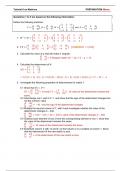
Questions 1 to 5 are based on the following information:
Define the following matrices:
2 5 0
4 15 5 𝑞 2 3 4
𝑇= ,𝐷 = ,𝑊 = 4 1 −3 and 𝑍 =
2 10 2 6 1 −1 0
−1 0 1
2 4 −1 1 0 0 5 4 −1
1. 𝑊 + 3𝐼 = 5 1 0 +3 0 1 0 = 5 4 0
0 −3 1 0 0 1 0 −3 4
4 15 2 3 4 23 −3 16
2. 𝑇𝑍 = = [(2x2)(2x3) = (2x3)]
2 10 1 −1 0 22 −4 8
3. Calculate the value of 𝑞 that will make 𝐷 singular.
5 𝑞
= 0 Singular matrix 30 − 2𝑞 = 0 ∴ 𝑞 = 15
2 6
4. Calculate the determinant of 𝑊.
2 5 0
|𝑊| = 4 1 −3
−1 0 1
= 2(1)(1) + 5(−3)(−1) + 0(4)(0) − [0(1)(−1) + 2(−3)(0) + 5(4)(1)] = 17 − 20 = −3
5. Investigate the following properties of determinants for matrix 𝑇:
5.1 Show that |𝑇| = |𝑇 |
|𝑇| = 4 15
= 10 and |𝑇 | = 4 2 = 10 value of the determinant remains the
2 10 15 10
same.
5.2 Interchange row 1 and 2 of 𝑇, and show that the sign of the determinant changes but
not the numeric value.
2 10
= −10 only the sign of the determinant changes
4 15
5.3 Multiply the second column of 𝑇, with 4 and investigate whether the value of the
determinant changes 4 – fold.
4 60
= 160 − 120 = 40 = 4(10) value of the determinant changes 4 – fold.
2 40
5.4 Subtract each element of row 2 from the corresponding element of row 1, show that
the value of the determinant remains the same.
2 5
= 10 value of the determinant remains the same.
2 10
5.5 Substitute column 2 with 12 and 6, so that column 2 is a multiple of column 1. Show
that the determinant of the new matrix is zero.
4 12 = 0 the determinant of the new matrix is zero.
2 6
Questions 1 to 5 are based on the following information:
Define the following matrices:
2 5 0
4 15 5 𝑞 2 3 4
𝑇= ,𝐷 = ,𝑊 = 4 1 −3 and 𝑍 =
2 10 2 6 1 −1 0
−1 0 1
2 4 −1 1 0 0 5 4 −1
1. 𝑊 + 3𝐼 = 5 1 0 +3 0 1 0 = 5 4 0
0 −3 1 0 0 1 0 −3 4
4 15 2 3 4 23 −3 16
2. 𝑇𝑍 = = [(2x2)(2x3) = (2x3)]
2 10 1 −1 0 22 −4 8
3. Calculate the value of 𝑞 that will make 𝐷 singular.
5 𝑞
= 0 Singular matrix 30 − 2𝑞 = 0 ∴ 𝑞 = 15
2 6
4. Calculate the determinant of 𝑊.
2 5 0
|𝑊| = 4 1 −3
−1 0 1
= 2(1)(1) + 5(−3)(−1) + 0(4)(0) − [0(1)(−1) + 2(−3)(0) + 5(4)(1)] = 17 − 20 = −3
5. Investigate the following properties of determinants for matrix 𝑇:
5.1 Show that |𝑇| = |𝑇 |
|𝑇| = 4 15
= 10 and |𝑇 | = 4 2 = 10 value of the determinant remains the
2 10 15 10
same.
5.2 Interchange row 1 and 2 of 𝑇, and show that the sign of the determinant changes but
not the numeric value.
2 10
= −10 only the sign of the determinant changes
4 15
5.3 Multiply the second column of 𝑇, with 4 and investigate whether the value of the
determinant changes 4 – fold.
4 60
= 160 − 120 = 40 = 4(10) value of the determinant changes 4 – fold.
2 40
5.4 Subtract each element of row 2 from the corresponding element of row 1, show that
the value of the determinant remains the same.
2 5
= 10 value of the determinant remains the same.
2 10
5.5 Substitute column 2 with 12 and 6, so that column 2 is a multiple of column 1. Show
that the determinant of the new matrix is zero.
4 12 = 0 the determinant of the new matrix is zero.
2 6