
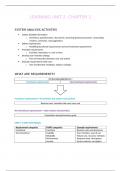
LEARNING UNIT 2: CHAPTER 2
SYSTEM ANALYSIS ACTIVITIES
Gather detailed information
o Interviews, questionnaires, documents, observing business processes, researching
vendors, comments, and suggestions
Define requirements
o Modelling functional requirements and non-functional requirements
Prioritize requirements
o Essential, important, vs. nice to have
Develop user-interface dialogs
o Flow of interaction between user and system
Evaluate requirements with users
o User involvement, feedback, adapt to changes
WHAT ARE REQUIREMENTS?
SYSTEM REQUIREMENTS =
Functional requirements Non-functional requirements
Functional requirements = the activities the system must perform
Business uses, functions the users carry out
Non-functional requirements = other system characteristics
Constraints and performance goals
URPS + is NON-FUNCTIONAL
Requirement categories FURPS categories Example requirements
Functional Functions Business rules and processes
Non-functional Usability User interface, ease of use
Reliability Failure rate, recovery methods
Performance Response time, throughout
security Access controls, encryption
, FURPS +Requirements Acronym
F Functional requirements Usability requirements
Reliability requirements Performance requirements
Security requirements + even more categories …
Additional Requirements Categories
Design constraints –
o Specific restrictions for hardware and software
Implementation requirements –
o Specific languages, tools, protocols, etc.
Interface requirements –
o Interface links to other systems
Physical requirements –
o Physical facilities and equipment constraints
Supportability requirements –
o Automatic updates and enhancement methods
STAKEHOLDERS
Who do you involve and talk to?
Stakeholders- persons who have an interest in the successful implementation of the system
Internal Stakeholders- persons within the organization
External Stakeholders- persons outside the organization
Operational stakeholders- persons who regularly interact with the system
Executive stakeholders- persons who don’t directly interact, but use the information or have
financial interest
SYSTEM ANALYSIS ACTIVITIES
Gather detailed information
o Interviews, questionnaires, documents, observing business processes, researching
vendors, comments, and suggestions
Define requirements
o Modelling functional requirements and non-functional requirements
Prioritize requirements
o Essential, important, vs. nice to have
Develop user-interface dialogs
o Flow of interaction between user and system
Evaluate requirements with users
o User involvement, feedback, adapt to changes
WHAT ARE REQUIREMENTS?
SYSTEM REQUIREMENTS =
Functional requirements Non-functional requirements
Functional requirements = the activities the system must perform
Business uses, functions the users carry out
Non-functional requirements = other system characteristics
Constraints and performance goals
URPS + is NON-FUNCTIONAL
Requirement categories FURPS categories Example requirements
Functional Functions Business rules and processes
Non-functional Usability User interface, ease of use
Reliability Failure rate, recovery methods
Performance Response time, throughout
security Access controls, encryption
, FURPS +Requirements Acronym
F Functional requirements Usability requirements
Reliability requirements Performance requirements
Security requirements + even more categories …
Additional Requirements Categories
Design constraints –
o Specific restrictions for hardware and software
Implementation requirements –
o Specific languages, tools, protocols, etc.
Interface requirements –
o Interface links to other systems
Physical requirements –
o Physical facilities and equipment constraints
Supportability requirements –
o Automatic updates and enhancement methods
STAKEHOLDERS
Who do you involve and talk to?
Stakeholders- persons who have an interest in the successful implementation of the system
Internal Stakeholders- persons within the organization
External Stakeholders- persons outside the organization
Operational stakeholders- persons who regularly interact with the system
Executive stakeholders- persons who don’t directly interact, but use the information or have
financial interest


