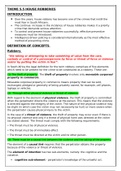
THEME 5.5 HOUSE ROBBERIES
INTRODUCTION
Over the years, house robbery has become one of the crimes that instill the
most fear in South Africans.
The continue increase in the incidence of house robberies makes it a priority
crime that demands serious attention.
To control and prevent house robberies successfully, effective preventive
measures must be introduced.
Intelligence-driven policing is considered internationally as the most effective
method of preventing crime.
DEFINITION OF CONCEPTS
Robbery
“the taking or attempting to take something of value from the care,
custody or control of a person/persons by force or threat of force or violence
and/or by putting the victim in fear”.
In South Africa the legal definition for the term robbery comprises of five elements
which need to be present for the crime to be constituted as a robbery. These are:
(1) The theft of property. The theft of property involves only moveable corporeal
property in commercio.
Moveable corporeal property in commercio means property that can be sold,
exchanged, pledged or generally of being privately owned, for example, cell phones,
laptops or vehicles.
(2) Through either physical violence or threat of violence.
With regard to the element of physical violence, the theft of property is committed
when the perpetrator directs the violence at the person. This means that the violence
is directed against the integrity of the victim. The nature of the physical violence may
be slight (in which case the victim may not necessarily be hurt) or more severe when
the perpetrator causes physical injury to the victim.
In the case of a threat of violence, the theft of property may occur even if there is
no physical violence and only if a threat of physical harm was directed at the victim
(as stated above). The threat must comply with the following requirements.
• The threat must be of physical violence.
• The threat must be of immediate effect.
• The threat must be directed at the victim and no other person.
(3) There must be a causal link between the violence and the taking of the property.
The element of a causal link requires that the perpetrator obtains the property
because of the violence or threat of violence.
The element of intention has two sub-elements, namely: the cognitive and the
conative.
cognitive sub-element - perpetrator’s knowledge of the unlawful act.
, conative sub-element consists of directing his or her will towards an unlawful
act or result
(4) The taking of the property must be unlawful.
The element of unlawfulness means that the act is unjustified or that there are no
grounds or justification to support the perpetrator’s act.
(5) The perpetrator must take the property from the residential premises or house
with the intention to permanently deprive the owner of his/her property.
House robbery
Can be defined as the unlawful taking or attempting to take something of value from
a house belonging to an occupant of the house (i.e. the owner, caretaker or visitor) by
means of physical violence or threat of violence (overpowering and detaining the
victim) while the occupants (s) are present within or on the premises of the residence.
MODUS OPERANDI OF THE HOUSE ROBBER:
Planning stage
Most house robbers plan the house robbery meticulously and in considerable
detail.
The reason for the meticulous planning is that house robbery involves high risk
circumstances for the robbers and therefore requires thorough planning.
In the extreme cases, advance planning took up to 4 months.
(a) Reasons for choosing a specific house
1. The respondents who targeted and attacked houses because of the luxurious
lifestyle of the occupants, describe the concept of wealth as follows:
expensive houses
luxury motor cars belonging to the owner
double-storey houses
houses with expensive fittings, including electronic gates and garden lights
architect-designed houses (houses with a unique architectural style)
valuables, specifically money, kept in the house
2. The most important deciding factor in choosing a specific house and victim is
information received from an informant that a large sum of money is kept in the
house.
Informants supplied information on money kept in the house, the places where
valuables are kept, security measures, the number of vehicles owned, the number
of members of the household, their routine, and how to gain access to the house.
(b) Collusion with security guards
In some of the house robberies, there was collusion between the house robbers
and the security guards.
This collusion took a variety of forms, with the understanding that the proceeds
would be shared if the security guards gave the robbers undisturbed access.
(c) Number of robbers involved in a house robbery
INTRODUCTION
Over the years, house robbery has become one of the crimes that instill the
most fear in South Africans.
The continue increase in the incidence of house robberies makes it a priority
crime that demands serious attention.
To control and prevent house robberies successfully, effective preventive
measures must be introduced.
Intelligence-driven policing is considered internationally as the most effective
method of preventing crime.
DEFINITION OF CONCEPTS
Robbery
“the taking or attempting to take something of value from the care,
custody or control of a person/persons by force or threat of force or violence
and/or by putting the victim in fear”.
In South Africa the legal definition for the term robbery comprises of five elements
which need to be present for the crime to be constituted as a robbery. These are:
(1) The theft of property. The theft of property involves only moveable corporeal
property in commercio.
Moveable corporeal property in commercio means property that can be sold,
exchanged, pledged or generally of being privately owned, for example, cell phones,
laptops or vehicles.
(2) Through either physical violence or threat of violence.
With regard to the element of physical violence, the theft of property is committed
when the perpetrator directs the violence at the person. This means that the violence
is directed against the integrity of the victim. The nature of the physical violence may
be slight (in which case the victim may not necessarily be hurt) or more severe when
the perpetrator causes physical injury to the victim.
In the case of a threat of violence, the theft of property may occur even if there is
no physical violence and only if a threat of physical harm was directed at the victim
(as stated above). The threat must comply with the following requirements.
• The threat must be of physical violence.
• The threat must be of immediate effect.
• The threat must be directed at the victim and no other person.
(3) There must be a causal link between the violence and the taking of the property.
The element of a causal link requires that the perpetrator obtains the property
because of the violence or threat of violence.
The element of intention has two sub-elements, namely: the cognitive and the
conative.
cognitive sub-element - perpetrator’s knowledge of the unlawful act.
, conative sub-element consists of directing his or her will towards an unlawful
act or result
(4) The taking of the property must be unlawful.
The element of unlawfulness means that the act is unjustified or that there are no
grounds or justification to support the perpetrator’s act.
(5) The perpetrator must take the property from the residential premises or house
with the intention to permanently deprive the owner of his/her property.
House robbery
Can be defined as the unlawful taking or attempting to take something of value from
a house belonging to an occupant of the house (i.e. the owner, caretaker or visitor) by
means of physical violence or threat of violence (overpowering and detaining the
victim) while the occupants (s) are present within or on the premises of the residence.
MODUS OPERANDI OF THE HOUSE ROBBER:
Planning stage
Most house robbers plan the house robbery meticulously and in considerable
detail.
The reason for the meticulous planning is that house robbery involves high risk
circumstances for the robbers and therefore requires thorough planning.
In the extreme cases, advance planning took up to 4 months.
(a) Reasons for choosing a specific house
1. The respondents who targeted and attacked houses because of the luxurious
lifestyle of the occupants, describe the concept of wealth as follows:
expensive houses
luxury motor cars belonging to the owner
double-storey houses
houses with expensive fittings, including electronic gates and garden lights
architect-designed houses (houses with a unique architectural style)
valuables, specifically money, kept in the house
2. The most important deciding factor in choosing a specific house and victim is
information received from an informant that a large sum of money is kept in the
house.
Informants supplied information on money kept in the house, the places where
valuables are kept, security measures, the number of vehicles owned, the number
of members of the household, their routine, and how to gain access to the house.
(b) Collusion with security guards
In some of the house robberies, there was collusion between the house robbers
and the security guards.
This collusion took a variety of forms, with the understanding that the proceeds
would be shared if the security guards gave the robbers undisturbed access.
(c) Number of robbers involved in a house robbery