

Written by students who passed Immediately available after payment Read online or as PDF Wrong document? Swap it for free 4,6 TrustPilot
logo-home
Document preview thumbnail
Preview 4 out of 630 pages
Exam (elaborations)

2024 CUS3701 ASSIGNMENT 2

Document preview thumbnail
Preview 4 out of 630 pages

QUESTION 1 ⦁ Insert a table and place the following curriculum implications (numbered 1 – 10 below) for teachers and learners under the correct approach, namely behavioural, experiential, technological, naturalistic, humanistic and OBE: For example: APPROACH CURRICULUM IMPLICATION Academic Curriculum development is a systematic process directed by academic rationality and theoretical logic. PREVIEW APPROACH CURRICULUM IMPLICATION Behavioural ⦁ Teachers become reflective practitioners with seven roles to fulfil. ⦁ Teachers must perceive learners as cognitively functioning individuals within a social context. Experiential ⦁ Assessment is continuous, based on a variety of techniques. ⦁ Informal and hidden curriculum is also important, not only the formal and planned curriculum. Technological ⦁ The same curriculum elements of the academic, experience-based, and technological approaches can be used. Naturalistic ⦁ Self-directed, unstructured, and personalised instruction programmes that are ⦁ “self-paced”. Humanistic ⦁ There is ongoing give and take within specific interest groups and viewpoints, negotiation, and curriculum consensus. ⦁ Teachers must perceive learners as cognitively functioning individuals within asocial context. OBE ⦁ Stress on teachers and their cooperative curriculum decisionsPermission for more teacher input in curriculum decisions. ⦁ In a short essay, using your OWN words, choose a curriculum approach that YOU think has similarities to the ⦁ CAPS⦁ ⦁ that teachers use in most South African classrooms, and write your essay according to the following assessment criteria: Assessment criteria: ⦁ Identify which approach is in line with the CAPS (motivate). ⦁ What are the assumptions of this approach? ⦁ Discuss the curriculum implications for teachers and learners using this approach. ⦁ Justify how you will implement this approach in your own subject. ⦁ In many South African classrooms, the Traditional or Content-Centered Curriculum Approach is used, which is quite similar to the Curriculum and Assessment Policy Statement (CAPS). This approach focuses a lot on learning specific things, like facts and skills, just like CAPS does. ⦁ The idea behind this approach is that there are certain things students should know and be able to do to be considered educated. It's like saying there's a basic set of knowledge and skills everyone should have. In this approach, teachers play a big role in passing this knowledge on to students. They mostly teach by explaining things, and students are expected to remember what they're taught and repeat it back. It's like a step-by-step process, where students learn new things based on what they already know. ⦁ For teachers, this means they have to plan their lessons very carefully to make sure they cover all the required content. They usually teach through lectures and readings, using traditional methods. When it comes to checking what students have learned, teachers often use tests and quizzes to see if students remember the facts they've been taught. ⦁ For students, this means they're in a structured learning environment where the teacher guides them through the material. They're expected to memorize a lot of information and don't always get to be creative or think critically. ⦁ If I were to use this approach in my own subject, I would make sure my lessons match up with what CAPS says students should learn. I would make sure to explain things clearly, give students plenty of chances to practice, and check their understanding with tests and quizzes. I would also try to mix things up with hands-on activities and real-life examples to keep students interested and help them understand better. QUESTION 2 Read through the following statements or scenarios and write down which teaching strategy will be the most effective: ⦁ Learners need to develop a strong base of declarative knowledge to synthesise their knowledge into an appropriate model and recognise common solution strategies. Problem solving strategy ⦁ It is two weeks before the election and you want the learners, who are 18 and who will vote for the first time, to understand exactly how a polling station functions. Discussion as a Teaching Strategy ⦁ The teacher states a problem and ALL the learners in the class participate. They have to find a solution. Problem solving as teaching strategy ⦁ As a teacher, you guide learners to construct new meaning and knowledge based on existing knowledge. Scaffolding strategy ⦁ The teacher and learners took turns leading small-group discussions based on a reading. Cooperative learning through mediation ⦁ The class is divided into small groups that must prepare and present a topic that is unfamiliar to them. The teacher will provide support. Discussion as a Teaching Strategy ⦁ As a Mathematics teacher, your main focus is to listen to the learners' mathematical thinking and use it as a basis for instruction. Cognitively guided instruction ⦁ You want to encourage your learners to be open-minded and allow them to develop self-confidence when reasoning. Teaching critical thinking strategy ⦁ Many aspects can facilitate the learning process, including books, media or objects. But, most importantly, technology enables communication among learners, between learner and teacher, or through automatic feedback. M-Learning strategy ⦁ Asking the learners randomly questions keep everyone on their toes because no one knows who is going to be asked next. Discussion strategy QUESTION 3 Describe the features of effective questioning and feedback by substantiating it with examples from your own experiences. DON’T COPY THE TEXTBOOK! YOU NEED TO MAKE USE OF YOUR OWN EXAMPLES. Suggested length: two to three pages Effective questioning and feedback are essential components of the teaching and learning process, fostering meaningful dialogue between teachers and learners. As an aspirant teacher, I have found that incorporating various features into my questioning and feedback strategies enhances student engagement, promotes deeper understanding, and facilitates continuous improvement. Clarity and Precision: When asking questions or providing feedback, it's crucial to be clear and precise to ensure students understand what is expected of them. For instance, instead of asking a vague question like "What do you think about this story?", I might ask, "What do you think the main character's motivations were for their actions in the story?" Relevance to Learning Objectives: Questions and feedback should align closely with the learning objectives and desired outcomes of the lesson. For example, if the objective is for students to analyze the theme of a novel, I would ask questions like, "How does the author use symbolism to convey the theme?" Feedback would then focus on students' ability to identify and analyze symbolism in the text. Promotion of Critical Thinking: Effective questioning and feedback should encourage students to think critically, analyze information, and draw connections. For instance, I might ask students to explain their reasoning behind a solution to a math problem, and then provide feedback on the validity of their reasoning, prompting them to reconsider their approach if necessary. Encouragement of Participation: Questions should be posed in a way that encourages all students to participate and contribute to the discussion. Feedback should acknowledge and value students' contributions, creating a supportive learning environment. For example, I might say, "I appreciate your perspective on this issue. Can anyone else add to what was said?" Timeliness and Specificity: Feedback should be provided in a timely manner, allowing students to reflect on their performance and make improvements. It should also be specific, highlighting strengths and areas for growth. For instance, instead of simply saying, "Good job," I might provide specific feedback like, "You did a great job explaining your reasoning in your written response, but try to provide more evidence from the text to support your arguments next time." Variety and Differentiation: Instilling a variety of questioning techniques and feedback methods caters to the diverse needs and learning styles of students. For example, I might use a mix of open-ended questions, probing questions, and multiple-choice questions to assess understanding. Similarly, feedback could be delivered orally, written, or through peer review, depending on the needs of the students. Encouragement of Metacognition: Effective questioning and feedback should encourage students to reflect on their own thinking processes and learning strategies. For instance, after completing a challenging task, I might ask students questions like, "What strategies did you use to solve this problem?" or "How did your approach change as you worked through the task?" This type of questioning prompts students to become more aware of their cognitive processes and helps them develop metacognitive skills, which are essential for independent learning and problem-solving. Opportunities for Self-Assessment and Peer Feedback: In addition to teacher- led questioning and feedback, providing opportunities for self-assessment and peer feedback empowers students to take an active role in evaluating their own learning and that of their peers. For example, I might ask students to assess their own understanding of a concept by completing a self-assessment checklist or reflecting on their strengths and areas for improvement in a learning journal. Similarly, I might incorporate peer feedback activities where students provide constructive feedback to their classmates on presentations, projects, or written assignments. This not only enhances students' ability to critically evaluate their own work but also fosters a sense of responsibility and accountability for their learning within the classroom community. QUESTION 4 ⦁ Discuss what influences their views had on curriculum planning and development by using the following four sub-questions as guidelines for the discussion. Which principles for selecting contents and making decisions about Sequencing the contents are important? How should the teacher be guided in their teaching of the curriculum? What should be the focal point of assessment? What is the most valuable aspect of the approach? Principles for Selecting Contents and Sequencing: Ralph Tyler (Product-Oriented): Tyler emphasized a systematic design process where educational objectives serve as reference points for the curriculum. The selection of contents was based on the needs of the subject, society, and learners. Sequencing involved organizing educational experiences to build on one another, creating a cumulative effect. The focus was on clear objectives and a logical progression of learning. Stenhouse (Process-Oriented): Stenhouse advocated for a broader definition of curriculum, focusing on the process of curriculum development. He believed in a "design down, deliver up" approach, emphasizing ongoing research, adaptability, and teacher involvement in the teaching-learning process. Contents were not predetermined but evolved through continuous reflection and adjustment. Freire (Pragmatic): Freire valued the identification of specific knowledge that could be applied in real life. His approach focused on experiential learning, where learners reflect on the value of learning. Contents were linked to learners' daily struggles, and the emphasis was on liberating learners intellectually, socially, and politically. Guidance for Teachers: Ralph Tyler (Product-Oriented): Tyler's approach guided teachers to specify educational purposes by listing behavioral objectives, select content and teaching activities aligned with objectives, implement the prescribed plan, and assess whether learners met the objectives. The teacher played a central role in delivering predetermined content and evaluating learner achievement. Stenhouse (Process-Oriented): Stenhouse's approach guided teachers to engage in ongoing research while teaching, allowing for flexibility and adaptation in response to learners' needs and contextual factors. Teachers were encouraged to actively participate in the design and modification of the curriculum, promoting a reflective and evolving teaching approach. Freire (Pragmatic): Freire's approach guided teachers to ensure that educational experiences could be applied in real life. He emphasized a learner-centered approach, where the teaching-learning process was dynamic and political. Teachers were facilitators in the process of learners reflecting on their experiences and connecting knowledge to practical applications. Focal Point of Assessment: Ralph Tyler (Product-Oriented): Tyler's assessment focused on determining whether the predetermined educational objectives were attained. Evaluation served as the primary justification for the objectives and the starting point in planning. Behavioral evidence, such as tests and questionnaires, was used to assess learner achievement. Stenhouse (Process-Oriented): Stenhouse's approach to assessment was continuous and embedded in the teaching-learning process. Assessment aimed to understand learners' experiences and adapt the curriculum accordingly. It involved observations, interviews, and feedback to inform ongoing adjustments and improvements. Freire (Pragmatic): Freire's assessment focused on the practical application of knowledge in real-life situations. Evaluation aimed to liberate learners intellectually and politically, assessing their ability to critically reflect on and apply their learning in their daily struggles. Most Valuable Aspect of the Approach: Ralph Tyler (Product-Oriented): The strength of Tyler's approach lies in its simplicity and systematic, goal-directed planning. It provides a clear and logical framework for curriculum development, ensuring internal consistency and validity. Stenhouse (Process-Oriented): The most valuable aspect of Stenhouse's approach is its emphasis on adaptability and teacher involvement. It recognizes the dynamic nature of education, allowing for ongoing research, reflection, and modification based on the evolving needs of learners and the context. Freire (Pragmatic): Freire's approach's most valuable aspect is its focus on liberating learners and connecting education to real-life experiences. It emphasizes the practical application of knowledge, critical reflection, and the socio-political dimensions of education. ⦁ Identify and discuss which of the three curriculum approaches (product/process/pragmatic) you would regard as the most appropriate for South African schools within a diverse context (a variety of languages, beliefs, and values) and as a developing country. Substantiate your discussion and support your argument by demonstrating the weaknesses of the approaches that you did not choose. In the context of South African schools with their diversity in languages, beliefs, and values, as well as being a developing country, the most appropriate curriculum approach would be the pragmatic approach advocated by Paulo Freire. Relevance to Real-Life Contexts: Freire's pragmatic approach emphasizes connecting education to learners' daily struggles and real-life experiences. In South Africa, where learners come from diverse socio-economic backgrounds and face various challenges, it's crucial for education to be relevant and applicable to their lives. This approach allows for the exploration of issues such as social justice, poverty, and inequality, which are prevalent in the country. Liberation and Empowerment: Freire's approach focuses on intellectual, social, and political liberation. In a country with a history of apartheid and ongoing socio-economic disparities, empowering learners to critically analyze their realities and advocate for change is essential. By encouraging learners to reflect on their experiences and challenge oppressive structures, the pragmatic approach fosters active citizenship and social transformation. Respect for Diversity: South Africa is characterized by its diversity in languages, cultures, and beliefs. Freire's approach respects learners' diverse backgrounds and acknowledges the importance of incorporating multiple perspectives into education. It allows for the inclusion of indigenous knowledge systems, local languages, and cultural practices, promoting a more inclusive and culturally relevant curriculum. Development of Critical Thinking Skills: The pragmatic approach emphasizes critical reflection and dialogue, encouraging learners to question, analyze, and critique information. In a rapidly changing and complex world, the ability to think critically and solve problems is crucial for personal and societal development. By engaging learners in meaningful discussions and collaborative inquiry, this approach cultivates essential skills for lifelong learning and active citizenship. While the pragmatic approach has strengths that align well with the context of South African schools, the other two approaches (product-oriented and process- oriented) also have their limitations in this context: Product-Oriented Approach (Ralph Tyler): Weakness: This approach tends to prioritize predetermined objectives and standardized outcomes, which may not adequately address the diverse needs and experiences of learners in South Africa. It may overlook the socio-cultural context and perpetuate inequalities by imposing uniform expectations on diverse learners. Process-Oriented Approach (Stenhouse): Weakness: While the process-oriented approach emphasizes teacher involvement, adaptability, and ongoing reflection, it may lack clear guidance and structure, leading to inconsistency and fragmentation in curriculum implementation. In a country with resource constraints and varying levels of teacher expertise, a more structured approach may be necessary to ensure coherence and effectiveness in curriculum delivery. References: Celia. Booyse Elize du Plessis Paperback (2017) Curriculum studies: Development, interpretation, plan and practice CUS3701 Study guide by Unisa E

Content preview

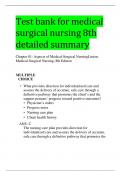
Test bank for medical
surgical nursing 8th
detailed summary
Chapter 01: Aspects of Medical-Surgical NursingLinton:
Medical-Surgical Nursing, 8th Edition


MULTIPLE
CHOICE
• What provides direction for individualized care and
assures the delivery of accurate, safe care through a
definitive pathway that promotes the client’s and the
support persons’ progress toward positive outcomes?
• Physician’s orders
• Progress notes
• Nursing care plan
• Client health history
ANS: C
The nursing care plan provides direction for
individualized care and assures the delivery of accurate,
safe care through a definitive pathway that promotes the

, client’s and the support persons’ progress toward positive
outcomes.
DIF: Cognitive Level:
Comprehension REF: p. 2 OBJ: 1
TOP: Nursing Care Plan KEY: Nursing
Process Step: Planning MSC: NCLEX:
Physiological Integrity: Reduction of Risk

• The nurse is performing behaviors and actions that
assist clients and significant others in meeting their
needs and the identified outcomes of the plan of care.
What is the correct term for these nursing behaviors?
• Assessments
• Interventions
• Planning
• Evaluation
ANS: B
Caring interventions are those nursing behaviors and
actions that assist clients and significant others in meeting
their needs and the identified outcomes of the plan of care.
DIF: Cognitive Level:
Comprehension REF: p. 3 OBJ: 1
TOP: Interventions KEY: Nursing
Process Step: Planning MSC: NCLEX:
Physiological Integrity: Reduction of Risk

• The nurse understands the importance of being
answerable for all actions and the possibility of being

, called on to explain or justify them. What term best
describes this concept?
• Reliability
• Maturity
• Accountability
• Liability

ANS: C
Accountability means that a person is answerable for his
or her actions and may be called on to explain or justify
them.
DIF: Cognitive Level:
Comprehension REF: pp. 6-7 OBJ: 3 | 5 | 7

TOP: Accountability KEY: Nursing
Process Step: N/A MSC: NCLEX:
Physiological Integrity: Reduction of Risk

MULTIPLE
RESPONSE

• The nurse manager is providing an inservice about
conflict resolution. What modes of conflict resolution
should be addressed? (Select all that apply.)
• Suppression
• Accommodation
• Compromise
• Avoidance

, • Collaboration
• Competition
ANS: B, C, D,
E, F
The modes of conflict resolution include accommodation,
collaboration, compromise, avoidance, and competition.
DIF: Cognitive Level: Knowledge
REF: p. 7|p. 8|Table 1.1
OBJ: 7 TOP: Conflict Resolution KEY:
Nursing Process Step: N/A
MSC: NCLEX: N/A
• What are the characteristics of an effective leader? (Select
all that apply.)
• Effective communication
• Rigid rules and regulations
• Delegates appropriately
• Acts as a role model
• Consistently handles conflict
• Focuses on individual development
ANS: A, C, D, E
Characteristics of an effective leader include effective
communication, consistency in managing conflict,
knowledge and competency in all aspects of delivery of
care, effective role model for staff, uses participatory
approach in decision making, shows appreciation for a
job well done, delegates work appropriately, sets
objectives and guides staff, displays caring,


Document information

Uploaded on
June 17, 2024
Number of pages
630
Written in
2023/2024
Type
Exam (elaborations)
Contains
Questions & answers
R125,46

Wrong document? Swap it for free Within 14 days of purchase and before downloading, you can choose a different document. You can simply spend the amount again.
Written by students who passed
Immediately available after payment
Read online or as PDF

Sold
0
Followers
0
Items
15
Last sold
-


Why students choose Stuvia

Created by fellow students, verified by reviews

Quality you can trust: written by students who passed their exams and reviewed by others who've used these notes.

Didn't get what you expected? Choose another document

No worries! You can immediately select a different document that better matches what you need.

Pay how you prefer, start learning right away

No subscription, no commitments. Pay the way you're used to via credit card or EFT and download your PDF document instantly.

Student with book image

“Bought, downloaded, and aced it. It really can be that simple.”

Alisha Student

Working on your references?

Create accurate citations in APA, MLA and Harvard with our free citation generator.

Working on your references?

Frequently asked questions
