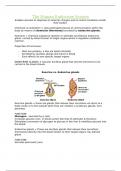
The Human Endocrine System
Enables animals to response to external changes and to control conditions inside
their bodies.
Chemical co-ordination = slow prolonged process of communication within the
body by means of chemicals (Hormones) secreted by endocrine glands.
Hormone = chemical substance (protein or steroids) secreted by endocrine
gland, carried by blood stream to target organs where it regulates metabolic
reaction.
Properties of hormones:
- Most are proteins, a few are lipids (steroids)
- Secreted by ductless glands and travel in blood
- Each affects its own specific target organs
ENDOCRINE GLANDS: a vascular ductless gland that secrets hormones to be
carried in the blood stream.
Exocrine vs. Endocrine glands
Exocrine glands = these are glands that release their secretions via ducts to a
body cavity or to the outside when they are needed, e.g Salivary glands, liver,
pancreas.
FUNCTION:
Glucagon - secreted by α cells
Increases glucose conc. in blood (action like that of adrenalin & thyroxin).
Stimulates conversion of glycogen to glucose in the liver & mobilises glucose into
the blood.
Endocrine glands = These are ductless glands that release their secretions
(hormones) directly into the blood stream to their target organs. Eg, adrenal
gland
FUNCTION:
Secretes pancreatic juice
, 1. Hypothalamus
The hypothalamus is part of the brain, situated above the pituitary gland. It
secrets, amongst others, the hormone ADH (anti-diuretic hormone).
ADHs role:
Promotes re-absorption of water the renal tubule, conserve water. It is stored in
the posterior lobe of pituitary. Osmoreceptors in the blood vessels of
hypothalamus detect an increase in the osmolarity (low water levels) of the
blood. The hypothalamus responds and releases ADH.
2. Pituitary gland
Hypersecretion: over secretion of a hormone
Hyposecretion: under secretion of a hormone
Pituitary - Anterior lobe
GH - (growth hormone)
Promotes skeletal growth (bone & muscle).
Underproduction in infants = dwarfism
Overproduction in infants = gigantism
in adults = acromegaly
Growth hormone disorders:
ACROMEGALY DWARFISM GIGANTISM
Over secretion of GH in Hyposecretion of GH in Hypersecretion of GH in
adults, which leads to hand, prepubertal children prepubertal children
face, and feet enlargement.
TSH – (thyroid stimulating hormone)
Stimulates thyroid gland to produce thyroxin (negative feedback)
FSH – (follicle stimulating hormone)
Females – stimulates oogenisis
Males – stimulates spermatogenesis
LH – (Lutenizing hormone)
Enables animals to response to external changes and to control conditions inside
their bodies.
Chemical co-ordination = slow prolonged process of communication within the
body by means of chemicals (Hormones) secreted by endocrine glands.
Hormone = chemical substance (protein or steroids) secreted by endocrine
gland, carried by blood stream to target organs where it regulates metabolic
reaction.
Properties of hormones:
- Most are proteins, a few are lipids (steroids)
- Secreted by ductless glands and travel in blood
- Each affects its own specific target organs
ENDOCRINE GLANDS: a vascular ductless gland that secrets hormones to be
carried in the blood stream.
Exocrine vs. Endocrine glands
Exocrine glands = these are glands that release their secretions via ducts to a
body cavity or to the outside when they are needed, e.g Salivary glands, liver,
pancreas.
FUNCTION:
Glucagon - secreted by α cells
Increases glucose conc. in blood (action like that of adrenalin & thyroxin).
Stimulates conversion of glycogen to glucose in the liver & mobilises glucose into
the blood.
Endocrine glands = These are ductless glands that release their secretions
(hormones) directly into the blood stream to their target organs. Eg, adrenal
gland
FUNCTION:
Secretes pancreatic juice
, 1. Hypothalamus
The hypothalamus is part of the brain, situated above the pituitary gland. It
secrets, amongst others, the hormone ADH (anti-diuretic hormone).
ADHs role:
Promotes re-absorption of water the renal tubule, conserve water. It is stored in
the posterior lobe of pituitary. Osmoreceptors in the blood vessels of
hypothalamus detect an increase in the osmolarity (low water levels) of the
blood. The hypothalamus responds and releases ADH.
2. Pituitary gland
Hypersecretion: over secretion of a hormone
Hyposecretion: under secretion of a hormone
Pituitary - Anterior lobe
GH - (growth hormone)
Promotes skeletal growth (bone & muscle).
Underproduction in infants = dwarfism
Overproduction in infants = gigantism
in adults = acromegaly
Growth hormone disorders:
ACROMEGALY DWARFISM GIGANTISM
Over secretion of GH in Hyposecretion of GH in Hypersecretion of GH in
adults, which leads to hand, prepubertal children prepubertal children
face, and feet enlargement.
TSH – (thyroid stimulating hormone)
Stimulates thyroid gland to produce thyroxin (negative feedback)
FSH – (follicle stimulating hormone)
Females – stimulates oogenisis
Males – stimulates spermatogenesis
LH – (Lutenizing hormone)