13. Touch
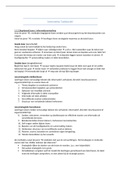
As usual, parts which are about anatomy are mostly composed of definitions, just like it
is the case in the book.
envt = environment; mvt = movement; = = is/are; w/ = with; t = touch; s = skin; ° =
tion; cc = cognitive/cognition; dvpt = development; RF = receptive field; sc = spinal
cord; o = object(s); OR = object recognition, xpce = experience
Kinaesthesia = perception of the position and mvt of our limbs in space.
Proprioception = perception mediated by kinaesthetic and internal receptors.
Somatosensation = collectively, sensory signals from the skin, muscles, tendons, joints and internal
receptors.
Touch physiology
Touch receptors in the skin
Skin = largest and heaviest of the sense organs. Tactile receptors are embedded in the epidermis and
dermis.
Epidermis = the outer of the two major layers of skin.
Dermis = inner of the two major layers of the skin, consisting of nutritive and connective tissues, within
which lie the mechanoreceptors.
Each type of receptor can be characterized by three attributes.
(1) Type of stimulation to which the receptor responds. Pressure, vibration, temperature changes.
(2) Size of the receptive field. Activated when stimulation is applied to a particular area of the body =
the receptor’s RF. Size of RF = extent of the body area that elicits a receptor response.
, (3) Rate of adaptation (fast versus slow). Fast-adapting = FA. Responds with bursts of action
potentials, first when preferred stim is applied and then again when removed. Does not respond
during the steady state btwn stim onset and offset. Slowly adapting = SA receptor. Remains
active throughout the period during which the stim is in contact w/ its RF.
Tactile receptors
Mechanoreceptor = sensory receptor that responds to mechanical stimulation (pressure, vibration or
mvt).
A-beta fibre = wide-diameter, myelinated sensory nerve fibre that transmits signals from mechanical
stimulation.
Glabrous = lacking hair.
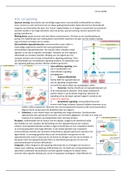
Meissner corpuscle = specialized nerve ending associated with fast-adapting (FA I) fibres that have small
receptive fields.
Merkel cell neurite complex = specialized nerve ending associated with slowly adapting fibres (SA I) that
have small receptive fields.
Pacinian corpuscle = fast-adapting (FA II), large RF.
Ruffini ending = slowly adapting (SA II), large RF.
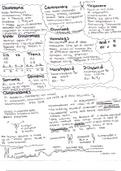
SA I steady downward pressure, fine spatial details & very low-frequency vibrations. Texture
& pattern perception.
SA II sustained downward pressure, lateral skin stretch (grab an object: help determine when
your fingers are shaped properly to pick up the cup).
FA I low-frequency vibra°s (cup = heavier than expected & starts falling down from your
hand).
FA II High-frequency vibra°s (object 1st makes a contact w/ skin, ex: mosquito lands on arm +
an object you’re holding contacts another object: how hard you’re tapping the pencil on your
desk).
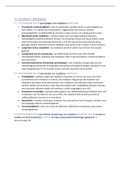
Thermoreceptors
Thermoreceptor = sensory receptor that signals information about changes in skin temperature.
Warmth fibre = sensory nerve fibre that fires when skin temperature increases.
Cold fibre = sensory nerve fibre that fires when skin temperature decreases.
C fibre = narrow-diameter, unmyelinated sensory nerve fibre that transmits pain and temperature
signals.
A-delta fibre = an intermediate-sized, myelinated sensory nerve fibre that transmits pain and
temperature signals.
Bodies = constantly working to regulate internal temperature. Normally, skin: 30-36°, no cold nor
warmth fibres respond much while skin temperature remains in this range.
Start firing if skin gets too warm or too cold + when we make contact w/ an object that is warmer or
colder than our skin.
As usual, parts which are about anatomy are mostly composed of definitions, just like it
is the case in the book.
envt = environment; mvt = movement; = = is/are; w/ = with; t = touch; s = skin; ° =
tion; cc = cognitive/cognition; dvpt = development; RF = receptive field; sc = spinal
cord; o = object(s); OR = object recognition, xpce = experience
Kinaesthesia = perception of the position and mvt of our limbs in space.
Proprioception = perception mediated by kinaesthetic and internal receptors.
Somatosensation = collectively, sensory signals from the skin, muscles, tendons, joints and internal
receptors.
Touch physiology
Touch receptors in the skin
Skin = largest and heaviest of the sense organs. Tactile receptors are embedded in the epidermis and
dermis.
Epidermis = the outer of the two major layers of skin.
Dermis = inner of the two major layers of the skin, consisting of nutritive and connective tissues, within
which lie the mechanoreceptors.
Each type of receptor can be characterized by three attributes.
(1) Type of stimulation to which the receptor responds. Pressure, vibration, temperature changes.
(2) Size of the receptive field. Activated when stimulation is applied to a particular area of the body =
the receptor’s RF. Size of RF = extent of the body area that elicits a receptor response.
, (3) Rate of adaptation (fast versus slow). Fast-adapting = FA. Responds with bursts of action
potentials, first when preferred stim is applied and then again when removed. Does not respond
during the steady state btwn stim onset and offset. Slowly adapting = SA receptor. Remains
active throughout the period during which the stim is in contact w/ its RF.
Tactile receptors
Mechanoreceptor = sensory receptor that responds to mechanical stimulation (pressure, vibration or
mvt).
A-beta fibre = wide-diameter, myelinated sensory nerve fibre that transmits signals from mechanical
stimulation.
Glabrous = lacking hair.
Meissner corpuscle = specialized nerve ending associated with fast-adapting (FA I) fibres that have small
receptive fields.
Merkel cell neurite complex = specialized nerve ending associated with slowly adapting fibres (SA I) that
have small receptive fields.
Pacinian corpuscle = fast-adapting (FA II), large RF.
Ruffini ending = slowly adapting (SA II), large RF.
SA I steady downward pressure, fine spatial details & very low-frequency vibrations. Texture
& pattern perception.
SA II sustained downward pressure, lateral skin stretch (grab an object: help determine when
your fingers are shaped properly to pick up the cup).
FA I low-frequency vibra°s (cup = heavier than expected & starts falling down from your
hand).
FA II High-frequency vibra°s (object 1st makes a contact w/ skin, ex: mosquito lands on arm +
an object you’re holding contacts another object: how hard you’re tapping the pencil on your
desk).
Thermoreceptors
Thermoreceptor = sensory receptor that signals information about changes in skin temperature.
Warmth fibre = sensory nerve fibre that fires when skin temperature increases.
Cold fibre = sensory nerve fibre that fires when skin temperature decreases.
C fibre = narrow-diameter, unmyelinated sensory nerve fibre that transmits pain and temperature
signals.
A-delta fibre = an intermediate-sized, myelinated sensory nerve fibre that transmits pain and
temperature signals.
Bodies = constantly working to regulate internal temperature. Normally, skin: 30-36°, no cold nor
warmth fibres respond much while skin temperature remains in this range.
Start firing if skin gets too warm or too cold + when we make contact w/ an object that is warmer or
colder than our skin.