

Student number: 56180705 Name: Cristalla Soufis
PYC3705
Transformative Counselling Encounters
Assignment 1
Unique number: 662221
Micro-skill Purpose When it’s Examples
used
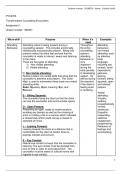
Attending Attending refers to being present during a Throughout Attending
Behaviour counselling session. This includes emotionally, the entire behaviour,
intellectually and physically present. Being fully counselling non-verbal
present makes the client feel and see that the session, attending: such
counsellor is ready to interact, aware and listening attending as attentive
to the client. behaviour is body
There are two types of attending very language,
1) Non-Verbal attending important including eye
2) Verbal attending during the contact, facial
early periods expressions,
1) Non-Verbal attending: of developing gestures,
Refers to basic non-verbal skills that show that the rapport. As leaning
counsellor is attentive and present. The ‘Soler well as during forward, sitting
Map’ is used to summarise these basic non-verbal the sessions squarely, open
attending skills. if the client is and relaxed
Soler: Squarely, Open, Leaning, Eye, and feeling stuck posture.
Relaxed. or rambling.
Verbal
S – Sitting Squarely: attending:
The counsellor faces the client so that the client Visually,
can see the counsellor and communicate openly. auditory,
kinaesthetically
O – Open Posture: formed
Presenting an open, ready to receive posture, sentences.
avoiding any barriers as well as the crossing of Empathic
arms or holding a file in a manner which indicates responding,
a closed body which could convey a closed or selective
switched off mind. restatement,
paraphrasing,
L – Leaning Forward: Reflection of
Leaning towards the client at a distance that is feelings and
comfortable for the client at certain times to summarising.
express interest and concern.
E – Eye Contact:
Natural eye contact conveys that the counsellor is
listening. The eye contact must be diverted from
time to time in order to avoid discomfort. The
counsellor must be aware of cultural norms with
regards to eye contact.
1
, Student number: 56180705 Name: Cristalla Soufis
R – Relaxed Posture:
The counsellor should convey a relaxed yet
professional posture and be aware of any
excessive movements of gestures.
MAP: Refers to Minimal Encouragers, Attentive
and Presentation.
Minimum Encouragers: are used to keep the
client talking. These include nodding the head, or
saying “I’m listening”, “I see”, “go on”.
Attentive: attentiveness showing the counsellor is
listening through non-verbal gestures.
Presentation: refers to the way both the
counsellors and clients present themselves.
TC: Refers to Touch and Cultural differences
Touch - one needs to consider cultural differences
with regards to touch.
Cultural differences – vary with regards to
appropriate expression and non-verbal interaction.
Non-verbal attending includes tone of voice, facial
expressions, head and body movements.
2) Verbal Attending:
There are three main ways in which people
represent and express themselves during
communication.
Visually – saying things like ‘I see, I’m clear, let’s
see”
Auditory – saying: ‘I hear, that sounds’
Kinaesthetically – saying: ‘I sense, I feel, that feels’
A counsellor should listen to words that clients use
and use similar language.
Verbal attending includes:
Skills include empathic responding, selective
restatement, paraphrasing, reflecting feelings and
summarising.
2
PYC3705
Transformative Counselling Encounters
Assignment 1
Unique number: 662221
Micro-skill Purpose When it’s Examples
used
Attending Attending refers to being present during a Throughout Attending
Behaviour counselling session. This includes emotionally, the entire behaviour,
intellectually and physically present. Being fully counselling non-verbal
present makes the client feel and see that the session, attending: such
counsellor is ready to interact, aware and listening attending as attentive
to the client. behaviour is body
There are two types of attending very language,
1) Non-Verbal attending important including eye
2) Verbal attending during the contact, facial
early periods expressions,
1) Non-Verbal attending: of developing gestures,
Refers to basic non-verbal skills that show that the rapport. As leaning
counsellor is attentive and present. The ‘Soler well as during forward, sitting
Map’ is used to summarise these basic non-verbal the sessions squarely, open
attending skills. if the client is and relaxed
Soler: Squarely, Open, Leaning, Eye, and feeling stuck posture.
Relaxed. or rambling.
Verbal
S – Sitting Squarely: attending:
The counsellor faces the client so that the client Visually,
can see the counsellor and communicate openly. auditory,
kinaesthetically
O – Open Posture: formed
Presenting an open, ready to receive posture, sentences.
avoiding any barriers as well as the crossing of Empathic
arms or holding a file in a manner which indicates responding,
a closed body which could convey a closed or selective
switched off mind. restatement,
paraphrasing,
L – Leaning Forward: Reflection of
Leaning towards the client at a distance that is feelings and
comfortable for the client at certain times to summarising.
express interest and concern.
E – Eye Contact:
Natural eye contact conveys that the counsellor is
listening. The eye contact must be diverted from
time to time in order to avoid discomfort. The
counsellor must be aware of cultural norms with
regards to eye contact.
1
, Student number: 56180705 Name: Cristalla Soufis
R – Relaxed Posture:
The counsellor should convey a relaxed yet
professional posture and be aware of any
excessive movements of gestures.
MAP: Refers to Minimal Encouragers, Attentive
and Presentation.
Minimum Encouragers: are used to keep the
client talking. These include nodding the head, or
saying “I’m listening”, “I see”, “go on”.
Attentive: attentiveness showing the counsellor is
listening through non-verbal gestures.
Presentation: refers to the way both the
counsellors and clients present themselves.
TC: Refers to Touch and Cultural differences
Touch - one needs to consider cultural differences
with regards to touch.
Cultural differences – vary with regards to
appropriate expression and non-verbal interaction.
Non-verbal attending includes tone of voice, facial
expressions, head and body movements.
2) Verbal Attending:
There are three main ways in which people
represent and express themselves during
communication.
Visually – saying things like ‘I see, I’m clear, let’s
see”
Auditory – saying: ‘I hear, that sounds’
Kinaesthetically – saying: ‘I sense, I feel, that feels’
A counsellor should listen to words that clients use
and use similar language.
Verbal attending includes:
Skills include empathic responding, selective
restatement, paraphrasing, reflecting feelings and
summarising.
2


